
Universal Consciousness Field, Part Two
The Amputation Is a Method, Not an Accident
When a term set to zero was sixty eight per cent of the universe
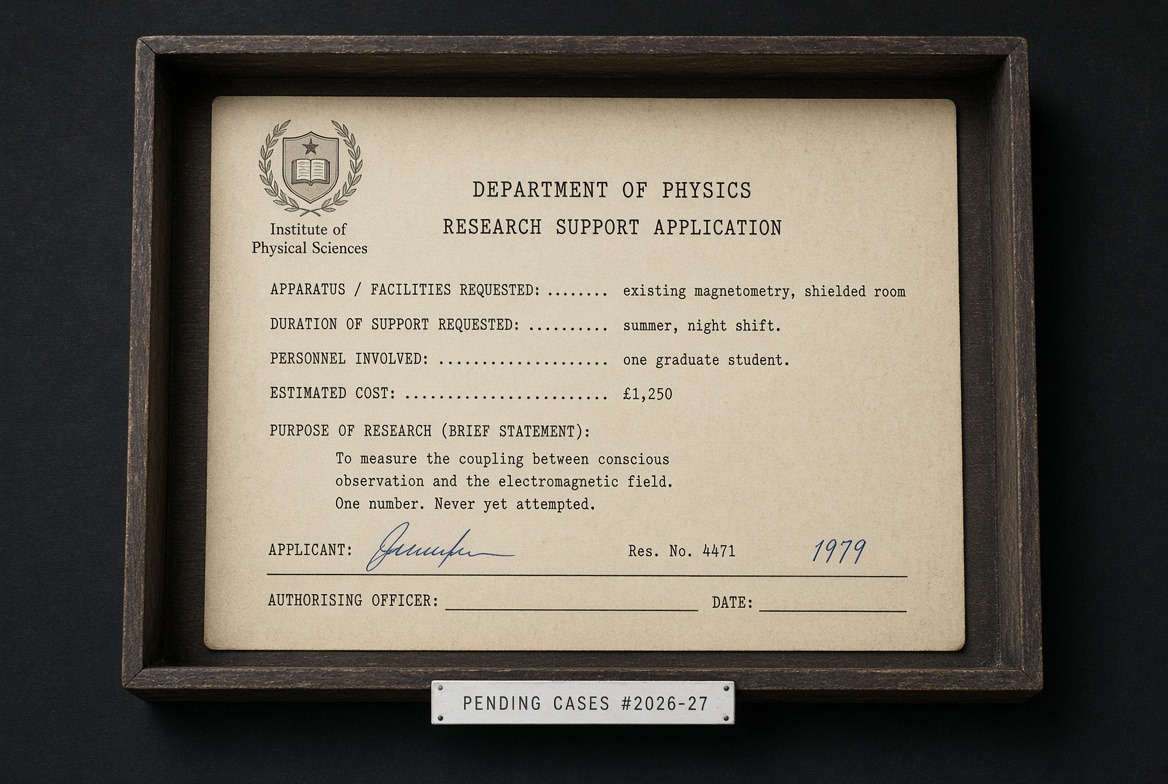
Part One closed on a number nobody has measured. This is the brief to go and measure it. Part Three visually explains the quest in infographics.
The Pattern Recurs
Part One dated an amputation to 1884 and made the case for it. What that case did not yet show is that 1884 was not the only time it happened.
It happens repeatedly, and establishing that changes what kind of claim this is. A single historical grievance can be conceded and set aside. A recurring operation cannot, because it stops being about Maxwell and becomes about how the profession handles anything that would cost it a foundation.
The 1884 case in one paragraph, since Part One has it in full. Maxwell wrote his field theory in 1865 as twenty equations in twenty variables and recast much of it in the 1873 Treatise on Electricity and Magnetism in quaternion notation. Heaviside, working in parallel with Gibbs, cut it to four vector equations. The reduction was good engineering and the modern world runs on it. It also discarded the scalar component and the treatment of the potentials as physically real, and it closed a room Maxwell had left open. Within a generation the compact form was not a simplification of the theory. It was the theory.
Two more cases follow. One in physical chemistry, inside living memory, with a Nobel Prize attached. One in biology, where the consequences reached the statute book.
Prigogine, 1977 onward
The same operation happened inside living memory, to a man with a Nobel Prize, with the participants on record.
Ilya Prigogine took the 1977 Nobel Prize in Chemistry for non equilibrium thermodynamics. His central result is now textbook. Drive an open system far enough from equilibrium with a steady flow of energy or matter and it can organise itself into coherent patterns, sustained only by continuing to dissipate. Near equilibrium, irreversible processes destroy order. Far from it, they create it. Convection cells, chemical oscillators, biological rhythms.
A living organism is the paradigm case. It holds high internal order by continuously dissipating free energy into its surroundings. Read that plainly and it says something nobody flinches at because it arrives in the vocabulary of accounting: there is no object there. Order is not held, it is remade, and it is paid for. Stop the flow and the structure does not decay slowly. It ceases, because there was never anything there but the flow taking a shape.
That half was absorbed entirely. It underwrites complexity science and origin of life research, it is taught everywhere, and it took the highest prize in the field. It is also the respectable floor beneath everything Part One said about living systems: order arising in open systems, no new physics required, nothing violated.
His other claim went nowhere. Prigogine argued that irreversibility is fundamental rather than emergent. The arrow of time is built into the dynamics, he said, not a consequence of reversible microscopic laws plus a special low entropy beginning. He built the formal machinery for it. He wrote three books arguing it, From Being to Becoming, Order Out of Chaos and The End of Certainty, framing the whole thing as a shift from a physics of being to a physics of becoming, in which time and novelty are real rather than illusory.
It was never refuted. No decisive experiment, no crushing paper, no moment at which the community examined the claim and found it wanting. Mainstream statistical mechanics and quantum foundations simply continue to treat the arrow of time as emergent, and Prigogine's foundational position remains a minority view held by a handful of specialists. The usable half was taken and rewarded. The half that would have required rebuilding the foundations was left on the shelf.
Kropotkin, 1890s onward
Outside physics the same cut, and this one happened in the open. Peter Kropotkin published the essays that became Mutual Aid in the 1890s, arguing from field observation that cooperation is as fundamental a factor in evolution as competition. He was not arguing against natural selection. He was arguing about which of its mechanisms had been emphasised, and why.
The competitive reading was amplified, moralised and institutionalised with extraordinary speed, as social Darwinism and then as eugenics. It was useful. It naturalised existing hierarchies. It justified laissez faire economics and colonial expansion. It licensed state programmes of human improvement by selective breeding. Struggle between individuals, classes, races and nations was presented as natural law and as moral duty in the same breath.
None of that was forced by the data. Cooperation was never absent from nature and it was never absent from Darwin's own writing.
Kropotkin was not disproved. He was sidelined, because a competitive narrative suited industrial and imperial projects and a cooperative one did not. Then, across the second half of the twentieth century, the substance of his argument returned under other names and with no acknowledgement: kin selection, reciprocal altruism, symbiosis, endosymbiotic theory, multilevel selection. All now standard. All arrived roughly a century late.
And that century was not a matter of citation etiquette. The eugenic programmes the competitive reading licensed were not a thought experiment. They were legislation, and they were surgery, performed on real people in a dozen countries by men holding scientific credentials and public money. The selective amplification of half a theory is not an academic vice with academic consequences.
Not a Conspiracy. A Ratchet.
ratchet /ˈratʃɪt/ n. (pl. ratchets) 1. A toothed wheel or bar engaged by a pawl that permits motion in one direction only and prevents it in the other; found in socket wrenches, hand winches and cable ties. The direction is fixed by the geometry of the teeth, not by the intention of the operator. 2. fig. A process that advances in a single direction and cannot be reversed, each increment becoming the new baseline from which the next proceeds.
Three cases, three fields, one shape. The usable half is adopted. The half that would require rebuilding the foundations is left unadopted, and never refuted.
It is tempting to call this suppression, and the temptation should be resisted, not out of politeness but because suppression is the weaker claim and the easier one to knock down. Suppression requires an agent, a decision, and somebody who knew. None of the three is present in any of these cases, and demanding them trades the whole argument for a villain.
What is present is a ratchet. Funding bodies allocate to work that fits the accepted framework, because that is what peer review is competent to assess. Careers are built inside frameworks and broken outside them, so the capable and the ambitious route around foundational questions without ever deciding to. Mathematical economy acts as a selection pressure of its own: the compact form of a theory displaces the general form because it is teachable, examinable, and fits on a blackboard.
Textbooks then record the compact form as the theory. Within a generation the discarded material is not merely unfashionable but unknown, because nobody alive was taught it.
Each pressure is individually reasonable. Together they turn one way. That is what a ratchet is: no operator, no intent, motion permitted in a single direction. Its distinctive product is precisely what all three cases show, a question that was never answered and never asked again, which the profession then remembers as a question that was settled.
The institutional character of that barrier matters for one practical reason. If the obstacle were a physical result the question would be closed and no amount of argument would open it. Because the obstacle is institutional, the question is open, and a bench, an instrument and a year of somebody's time is enough to reopen it. A ratchet can be disengaged. A measurement cannot be argued with.
The Precedent That Cuts the Other Way
The obvious objection is that a term discarded from a fundamental equation stays discarded for good reason, and that Part One's whole premise, an amputated formalism with a missing piece, is special pleading dressed as history. The objection has an answer and the answer is not obscure. It is the largest single component of the universe.
In 1917 Einstein added a term to the field equations of general relativity, a constant now written as lambda, for one purpose: to hold still a universe his own equations would not otherwise permit to stand still. By 1930 Eddington had shown that the static solution was unstable in any case, so the term did not even do the job it was inserted to do. Einstein dropped it in 1931. The profession then set lambda to zero and taught it as zero for close to seventy years.
It was never measured to be zero. It was assumed to be zero, and the author's own stated objections to it were matters of taste. In 1919 he wrote that its introduction was gravely detrimental to the formal beauty of the theory. In September 1947 he told Lemaitre that he found it very ugly that the field law of gravitation should be composed of two logically independent terms joined by addition, and that he could not bring himself to believe nature would realise such a thing. Formal beauty and ugliness are aesthetic criteria. On those criteria the largest component of the universe was removed from the equations, and generations were then trained to regard it as an embarrassment the discipline had outgrown.
In 1998 two independent supernova survey teams found the expansion of the universe to be accelerating. The term came back, and it came back for the same class of reason it left: not because anyone had understood it, but because it was the nearest entry already standing in the equations that could absorb the result. It is now standard cosmology and accounts for roughly sixty eight per cent of the total mass energy content of the universe, the single largest item in the budget, and it remains unexplained. The one theory that can calculate a value for it misses the observed figure by many orders of magnitude. The Nobel Prize in Physics in 2011 was awarded for the discovery of the accelerating expansion, not for the constant.
The same year produced a second instance in a second framework. The Standard Model of particle physics was built with massless neutrinos, and the massless assumption was structural rather than empirical. Oscillation results from 1998 onward forced mass terms in. The framework was extended to take them, and that observation took the Nobel Prize in 2015.
Two terms. Two fundamental theories. Both declared absent by consensus, both restored by measurement, both recognised with the highest honour the profession awards. Both inside twelve months.
Anyone wishing to argue that a discarded term cannot return is therefore obliged to explain lambda, and to explain neutrino mass. The anecdote usually reached for at this point will not carry the weight. Einstein's greatest blunder has one source, Gamow, in a Scientific American article of 1956 and in a memoir published after his death. Stachel stated in 1999 that the remark does not appear in Einstein's writings. Livio went through the papers and the Jerusalem archive and found nothing, and concluded the words were probably never said. The counter-case, argued more recently, rests on Wheeler's recollection and on the phrase being consistent with what Einstein wrote elsewhere, which is an argument from plausibility and not a document. So the profession's most quoted admission of error has no primary source, was repeated for sixty years until it became load bearing, and acquired defenders once somebody checked. That is the same ratchet running on the historical record instead of the equations. The word itself is honest about the mechanism: blunder descends from a Norse root for shutting the eyes.
What the precedent establishes should be stated precisely, because overreaching here would forfeit it. It does not establish that the coupling proposed in Part One is real. Lambda returned because the expansion history demanded it and neutrino masses returned because oscillation experiments demanded them, and each produced a sharp, reproducible discrepancy with existing data that no adjustment of other parameters could absorb. No such discrepancy exists here. What the precedent destroys is the procedural objection, the inference from a term being absent in the accepted formalism to its being absent in nature. Twice in one year, in the two most successful theories ever written, that inference was shown to be worthless.
The Debt
Which brings us to what this essay owes rather than what it is owed, and the debt is real. The reason no experimentalist has run the search is not only institutional. It is that nobody has told them what to look for.
An instrument does not detect an effect. It integrates a signal against an expected shape. Give a detector a frequency band, a duration, a geometry and a condition under which the signal should switch on and off, and it will pull that signal out from under noise a thousand times larger by averaging. Give it none of those and it returns exactly what it returns now: a noise floor, with anything unlabelled buried inside. Sensitivity is not the bottleneck. Specification is.
Part One wrote a coupling term with one unknown in it and no accompanying prediction of magnitude, frequency dependence or geometry. That is a hypothesis, not a protocol, and pretending otherwise would be the same manoeuvre this essay has spent two parts objecting to. So: their failure to look is theirs. The absence of anything specific to look for is ours.
There is a second and larger admission owed, and it revises Part One rather than defending it. The term written there produces a classical field, and a classical field is measured by reading an amplitude. But the argument of Part One was that the coupling lives in phase, and phase is not an amplitude. Phase is not directly observable at all. Only phase differences are, and only through interference.
So looking for a phase coupling by reading field strength is looking for the shadow rather than the thing. Worse, it is looking in the one place a century of ordinary electrical work has already ruled out.
Which means the search has two stages rather than one, and they are not alternatives. What follows is written in the order an experimentalist would have to run them, cheapest first.
Step Zero: The Analysis Nobody Has Run
Before any new apparatus is built there is a study available for the cost of a graduate student and a summer, using data that already exists on somebody's server.
Every superconducting qubit laboratory on Earth logs coherence times continuously. Relaxation and dephasing, T1 and T2, are recalibrated many times a day as routine housekeeping, and the logs run back years. Each laboratory also maintains a detailed decoherence budget itemising where the coherence goes: thermal photons, residual electromagnetic fields, vibration, quasiparticles, cosmic rays. Residuals that cannot be assigned are recorded and set aside.
Those logs are timestamped. Which means they also encode, without anybody intending it, when human beings were in the building. Nights and days, weekdays and weekends, holidays, shift patterns, the pandemic shutdowns.
The cross reference has never been performed. Not attempted and abandoned. Not run and published as null. Never performed, because nobody had a reason to.
Three things make this more than a whim. First, the method is already proven for a different variable. A group at Lawrence Livermore sandwiched a transmon qubit between two radiation detector arrays and synchronised event detection against T1 and T2 measurements. After events attributed to penetrating muons they found significant reductions in both, up to around thirty per cent. That is this analysis with a different column in the spreadsheet, and it was publishable.
Second, the motivation is already in print from a serious quarter. Adrian Kent, of Cambridge and the Perimeter Institute, has argued that conscious observers may deviate, perhaps only very subtly and slightly, from quantum dynamics, and that this is reason enough for a stronger and more comprehensive programme of quantum experiments involving quantum observers. That is a foundations physicist at a serious institution calling for this class of work, in the literature, years ago.
Third, the budget itself is not settled, which the field says openly. A Physical Review X paper from February this year reports two level system defects switching at rates up to ten hertz, four orders of magnitude faster than earlier reports, and states plainly that this redefines the timescales relevant to calibration of superconducting processors. The accounting of where coherence goes is being rewritten by the people who own it. This is not a stable ledger with one unexplained line.
The confounds are obvious and must be conceded rather than finessed. Building services, mains noise, foot traffic and vibration all track human occupancy too, and any correlation found would first have to survive them. That is not a weakness of the proposal. Those confounds are precisely what a decoherence budget already itemises, which is why this analysis is possible at all and why these laboratories are the right place to do it.
Heat, vibration and radio noise are the subtraction, not the finding. Every one of them behaves identically whether the person in the room is awake, asleep or under anaesthetic, which is exactly what makes consciousness the one variable you can switch off while leaving all the others running.
Where To Point It: Your Own Connective Tissue
A commissioning brief is a cold document, so it is worth saying where in the human body a search of this kind would actually be aimed. The answer has been in the literature since 1957 and almost nobody outside orthopaedics knows it.
In that year Fukada and Yasuda established that bone is piezoelectric. They cut specimens from human and ox femur and confirmed the effect by three independent methods, static direct, dynamic direct and dynamic converse. The source is not the mineral but the collagen, the main organic constituent, and five decades of subsequent work has settled on that. They found the same effect in the Achilles tendon of a horse and a cow. Collagen is not a local material. Fascia is collagenous and continuous, sheathing every muscle, every organ and every bone in the body. The human tibia generates roughly three hundred microvolts during ordinary walking.
Two details in that 1957 paper matter more than the headline. The effect appears only under shear, when collagen fibres are made to slip past each other. And its magnitude depends on the angle between the applied force and the fibre axis.
Angle dependent and shear driven. Which is a description of a helix. The fibre orientation of the heart wall rotates through its thickness precisely so that contraction produces twist rather than simple squeeze, and that twist, cardiac torsion, is a routinely measured clinical parameter rather than a fringe claim. So the human heart is a large, angle optimised shear generator wrapped in piezoelectric tissue, cycling around eighty times a minute for eighty years. If a preparation exists in which to look for this, it is not exotic. It is beating in the reader's chest.
There is an honest complication and it is the interesting part. Whether collagen piezoelectricity survives in living wet tissue is unresolved. Macroscale measurements find the effect in hydrated tendon insignificant compared with dry, falling towards zero at around forty five per cent moisture content by dry weight, and streaming potentials and flexoelectricity have been offered as alternative mechanisms. But nanoscale piezoresponse force microscopy finds the effect present in both dry and wet bone, across the humidity range including the physiological one.
Read those two results together. The interface sees it. The bulk does not.
Water bound to collagen is not free water. The triple helix is stabilised by an ordered network of water bridges, and that hydration shell has measurably different dielectric behaviour and mobility from the water around it. Ordinary structural biology, not speculation.
Which raises a possibility sixty years of macroscale measurement could not have detected. Suppose the coupling lives in the structured hydration layer rather than in the average of the specimen. Then soaking a tendon and measuring the whole of it is measuring the wrong volume, and reporting an absence.
That is a testable claim, it is derivable from published results, and it needs no new physics. It is also the ratchet again, in miniature. The dry specimen result was clean, measurable and adopted. The physiological question was messy and left open. Sixty years later it is not a live controversy. It is a footnote.
The Classical Null, and Its Price
The second stage is the amplitude search that Part One's term literally describes. It should be run, it will almost certainly return zero, and it is worth running anyway. Here is the invoice.
The instruments exist and are not exotic. Superconducting quantum interference devices have been in clinical service since the 1970s, reading the magnetic fields of the human brain in hospitals across Europe. Their sensor noise floor in a shielded room runs at roughly two to five femtotesla per root hertz, and the practical limit is often not the sensor but thermal fluctuation in the cryostat holding it. Specialised units have been built down to three tenths of a femtotesla. Optically pumped magnetometers need no liquid helium, sit millimetres from the skin, are commercially available at around ten femtotesla and cost a fraction of a SQUID array. Nitrogen vacancy centres in diamond bring the same business down to tens of microns of spatial resolution.
Put that sensitivity in proportion. One femtotesla is a quadrillionth of a tesla. The Earth's field, the one that moves a compass needle, is about fifty microtesla, which is fifty billion femtotesla. These instruments read signals fifty billion times smaller than the field you are standing in, and they do it daily, on schedule, for money. Better than that: in ultra low field work the limiting noise is no longer the instrument but the body being measured, with one group putting the human head's own thermal contribution at around fifty five attotesla per root hertz. An attotesla is a thousandth of a femtotesla. We have reached the point where the patient is noisier than the machine.
A dedicated run needs better shielding, lower temperature operation or improved laser stabilisation, and longer integration times. Tens of thousands to a few hundred thousand for a bench top rig. Not a facility, not a collaboration, not a decade. One postdoctoral salary, a shielded room that already exists in a hundred universities, and a year.
And this stage carries the one hard falsifier the framework possesses. The divergence of a curl is zero, which forces the phase field to satisfy Laplace's equation. No free parameter can soften what follows: no isolated maxima anywhere inside the measurement volume, and interior structure fixed entirely by values on the boundary, the way a soap film is fixed by the wire it is stretched across.
That is testable with an array rather than a single sensor, and testable without knowing how large the effect is. Enclose the preparation, measure the field on a closed surface, and check whether the interior is predicted by the boundary. Any interior concentration the boundary does not account for kills the coupling as written. Which is what a falsifiable claim looks like: an outcome the author is obliged to accept.
What this stage will most likely produce is a bound. It should be published as one, and it is worth having, because it is the credential that buys the third stage and because nobody has ever published one.
The Coherence Search, Where the Claim Actually Lives
The third stage relocates the search to where Part One's argument always pointed, and it needs one distinction made carefully.
A magnetometer reads amplitude. A century of ordinary electrical engineering conducted by conscious human beings standing next to their apparatus bounds any classical amplitude coupling tightly, and this essay accepts that bound without reservation. Had there been a robust coupling of laboratory scale it would have produced unaccountable drift in a million experiments and wrecked the consistency of Maxwell's equations long ago. It did not. Anybody selling a device that responds visibly to intention is selling a fraud, and that arithmetic is the reason.
But that bound does not reach a coupling that manifests as coherence loss, because coherence loss does not appear in a classical measurement at all. A galvanometer cannot register it. Neither can an ammeter, an oscilloscope or a magnetometer. Nobody was measuring coherence in any systematic way until roughly thirty years ago. The century of instruments not twitching bounds an amplitude effect and says nothing whatever about a phase effect, and conflating the two is the mistake that has kept this search in the wrong room.
So the observable changes. Not field strength but decoherence rate. Not whether a needle moves but whether coherence survives longer or shorter than the budget predicts. That budget is calculated to extraordinary precision in every quantum computing laboratory in the world, because accounting for where coherence goes is their entire business. Any residual they cannot assign is exactly the gap where a phase coupling would sit, undisturbed and undetected, having never had any occasion to show up in a classical instrument.
The gating problem inverts usefully here as well. Rather than guessing which mental state produces a steep phase gradient, which the theory cannot yet derive, make the quantum system the sensor and the biological system the variable. Two questions, both concrete. Does the coherence budget of a quantum system show any residual correlated with the presence and state of a conscious observer nearby. And, harder but cleaner, does a biological preparation engaged in information processing show a coherence lifetime its own thermal environment cannot account for.
That second question is quantum biology's existing territory and it has one contested case that should be cited with its dispute attached. Room temperature coherence in photosynthetic light harvesting complexes was reported in 2007 and argued over ever since, with much of the original interpretation now disputed. Cite it for what it demonstrates rather than what it claims: that coherence measurements in warm, wet, living preparations are possible, and that the field polices them hard. Both facts are useful.
Two things this stage costs. The instruments are dearer than a shielded room and a magnetometer, so the one salary invoice does not apply.
And the coherence version currently has no hard geometric falsifier. The Laplace constraint was derived for the classical field term. It does not transfer, and nothing has yet been put in its place, which means this stage as it stands can produce a positive result but cannot be killed by one. That is the weakest joint in the whole framework. It is stated here rather than papered over, and closing it is the next piece of theoretical work required, ahead of any funding application.
Two things it gains, worth more than what it costs. It looks for the coupling where the coupling was always claimed to live, in phase rather than amplitude. And it puts the search inside laboratories already running, already logging residuals, already funded for other reasons entirely.
Why the Programme Cannot Fail
Which brings us to the part that should have made all of this fundable at any point in the last forty years, because it dissolves the one barrier both parts of this essay have spent their length describing.
The career risk is the barrier. Not censorship, not a committee, not a decision by anybody. A young researcher considering this work has to weigh the possibility of spending a year and producing nothing citable in a field with a reputation problem. That calculation is what the ratchet is made of, and it is entirely rational at the individual level.
The calculation is also wrong, and specifically wrong. Every stage returns a publishable number whatever the outcome.
Step zero yields either an occupancy correlation nobody has looked for, or the first published account of how occupancy tracks coherence through known channels in existing hardware. The classical stage yields either an anomalous field component with the predicted signature, or the first published upper bound on a coupling that has never been bounded, quoted to a stated sensitivity. The coherence stage yields either an unassigned residual or a tighter budget.
Not one of those outcomes is a wasted year. Several of them are firsts. All of them are the sort of clean, quantitative negative result a serious discipline is supposed to prize, and the absence of which in this territory is the reason the territory is a swamp. Right now every claim about consciousness, from healing crystals to quantum sales patter, floats in the same unbounded water as the coupling term in Part One, because there is no number anywhere to separate them. A published bound is the first instrument for telling a hypothesis apart from the fraud it gets shelved beside.
On which point: this essay makes no prediction about the sign of the result. It would be easy and cheap to forecast a positive one, and the temptation should be refused, because a prophecy has an expiry date and a demand does not. The likely outcome of a first generation search is a bound. That is fine. That is what was asked for.
The protocol conditions follow from the same logic and are not negotiable. Pre registration of the predicted signature, frequency band, integration time and statistical threshold, deposited before data collection. Power calculation stated in advance, so that a null means something. Operators blind to condition. Sham conditions with the apparatus running and no preparation present. Publication of the outcome whatever it is.
These are not concessions to sceptics. They are the difference between this and fifty years of small hopeful studies. PEAR published its own failed replication, and that single act of discipline is why its benchmark is still worth arguing about while a hundred more flattering results are not.
Who Signs the Requisition
So the position at the end of Part Two is narrower than at the end of Part One, and a great deal harder to wave away.
A strong classical coupling is dead, and this essay says so. A weak one is unexamined rather than excluded, and the difference between those two words is a hundred and forty years of nobody looking. A phase coupling has never been searched for at all, because the instruments capable of seeing one are thirty years old and were built for another purpose. The relevant logs already exist and have never been interrogated. The method for interrogating them has been demonstrated and published, for muons. The motivation has been published, by a foundations physicist at Cambridge. The first stage costs a graduate student and a summer, the second one salary and a room that already exists, and every stage returns a number whether the effect is there or not.
The precedent for a term set to zero by consensus and restored by measurement is not obscure or contested. It is sixty eight per cent of the universe, and it has a medal.
Everything required is present except the decision. That was true in 1884 and it is true this morning.
The needle in the picture has not moved in a hundred and forty two years. Not because the answer came back negative. Because the apparatus was never switched on, and the reason it was never switched on has nothing to do with physics and everything to do with who signs the requisition. Anyone still asking why nobody has measured it should stop asking what physics knows and start asking who signs the requisitions.
Glossary
Amputation. Used in this essay for the removal of part of a scientific formalism for reasons of convenience or elegance, where the removed part is never tested and never returns.
Scalar. A quantity with size but no direction, such as temperature or pressure. Contrast with a vector, which has both. Maxwell’s original formulation carried a scalar component that the 1884 reduction discarded.
Potential. A quantity from which a field can be calculated. Maxwell treated potentials as physically real. Later convention treats them as mathematical bookkeeping, which is precisely the disagreement at issue.
Dissipative structure. Prigogine’s term for an ordered pattern that exists only while energy flows through it: a flame, a whirlpool, a living organism. Cut the flow and the structure does not decay. It stops.
Irreversibility. The one way character of time in real processes. Whether this is fundamental to physics or merely an appearance produced by our ignorance of starting conditions is the question Prigogine lost.
Phase. The position of a wave within its own cycle. Two waves in step reinforce each other, out of step they cancel. Phase is not directly observable; only differences between phases are, and only through interference.
Coherence. The condition in which phase relations within a system hold steady rather than scrambling. It is what quantum computers spend their entire engineering effort protecting.
Decoherence. The loss of coherence to the surrounding environment. A decoherence budget is a laboratory’s itemised account of where the coherence went: thermal photons, stray fields, vibration, cosmic rays.
Coupling constant. A number stating how strongly two things affect one another. Zero means no interaction. In this essay the unmeasured constant is written as kappa.
Laplace’s equation. A condition requiring a quantity to have no isolated peaks, with its interior shape fixed entirely by its values at the boundary, as the surface of a soap film is fixed by its wire. It arises here as an unavoidable constraint on the proposed field.
Femtotesla. A quadrillionth of a tesla, the unit of magnetic field strength. The Earth’s field is around fifty microtesla, or fifty billion femtotesla. Clinical instruments routinely read at single femtotesla.
Piezoelectricity. The property of certain materials, including collagen, of generating an electrical charge when mechanically deformed. Established in bone in 1957 and dependent on shear rather than simple compression.
Pre registration. Depositing the prediction, the method and the statistical threshold in public before collecting data, so that a negative result counts as a finding rather than a disappointment.