
Universal Consciousness Field
A Scientific Revolution Hiding in Plain Sight
The Discovery That Changes Everything About Human Potential

Introduction, to Part One, Two & Three
This is an argument about a number, and about what it means that nobody has bothered to measure it. Two questions have been asked for as long as humanity can remember: How the world was created, and Who are we. The first has been pursued with every instrument ever built. The second has been measured only from the outside, never at the one place where our consciousness would have to touch physics, and that is what this essay is all about. Either mind is something matter produces, a by-product of tissue that switches on once an animal gets complex enough, or it is part of the fabric of the Cosmic All, something the universe does rather than something it grudgingly allows. Or it is neither, and both are wrong. Every civilisation before ours chose the second. Ours took the first, and did so in the century when the instruments to settle it were being built, which is either the worst timing in the history of enquiry or not timing at all.
Two words carry the full load of what follows: Unsupported and unexamined. A claim tested and found wanting has been answered, and honest people drop it. A claim never put to an instrument has not been answered at all; it has been left. Which is the position this argument is in, and it is worth being exact about what stands against it.
On the evidence as it stands, one side has the stronger hand. Consciousness and the brain move together: damage a region and a faculty goes with it, administer an anaesthetic and awareness stops on schedule, stimulate a patch of cortex and the patient reports a smell or a sound. None of that is disputed here. But it establishes only that the brain is necessary, not that it is the source. A radio stops when you break the receiver, and nobody concludes the receiver was composing the music. Generator or receiver, the correlation looks identical from outside, and no further correlation will separate them. What would separate them is a measurement in the field, not in the tissue, and that is where this argument goes.
Part One follows how the measurement came to be unthinkable. In 1884 Maxwell's theory of electromagnetism was culled from twenty equations to four. What went out was not disproved, only inconvenient, and among the casualties was the one quantity capable of carrying a coupling between mind and field. Every physicist trained since has learned the shortened version as the theory itself. No conspiracy was required for this. Funding follows the accepted framework, careers break outside it, elegance prefers the compact form, and textbooks record the compact form as the truth. Each pressure is reasonable alone. Together they permit motion in one direction only, which is what a ratchet is.
Part Two is the brief: what the missing term is, what it would cost to measure, and why the measurement cannot fail, since finding nothing still tells you how big the nothing is, and that is a number. Part Three is the visual companion, written for a reader who has no physics and is assumed to need none.
You are not asked to accept a conclusion here. The conclusion is not available, to me or to anyone, which is the point. You are asked to notice that a question of this size has stood open since 1884, that the instruments capable of settling it are running in laboratories tonight, and that not one of them is pointed at it. Nobody forbade it. Nobody had to. A dead universe was declared, the paperwork was filed, and the men who filed it have been dead for a century while the filing does the work. That is the revenge of the dead heads: not a conspiracy, an inheritance, and it will hold for another hundred years unless somebody in a shielded room switches the thing on and reads the number.
Part One : THE QUEST FOR CONSCIOUSNESS
What if consciousness is not something your brain produces, but something it connects to? What if every thought, intention, and moment of awareness taps into an invisible field that fills all space and connects every mind in the universe? What if this field can influence physical reality in measurable ways, not through mystical powers, but through natural phenomena that operate according to discoverable scientific principles?
This is not speculative philosophy or wishful thinking. The Universal Consciousness Field theory represents the systematic integration of discoveries that have been accumulating in scientific laboratories for over 150 years, discoveries that reveal consciousness as a fundamental force in nature, as real and measurable as gravity or electromagnetism.
The reason this scientific revolution has remained largely invisible is not because the evidence is weak. It is because the implications are so profound that recognising them would require rebuilding much of how our civilisation understands reality, technology, medicine, and human potential itself, and beyond that, who holds wealth and power.
We are talking about a paradigm shift as significant as the transition from flat-earth thinking to understanding planetary motion, or from crediting the vaccine to crediting the soap, the clean water, the sewers and the food safety that had delivered the fall in mortality a generation before any vaccine existed.
The Scattered Puzzle Pieces: Why Genius Discoveries Stayed Separated
Here is what actually happened over the past century and a half: brilliant scientists working in different fields kept bumping into the same revolutionary truth about consciousness and reality. But being isolated by academic boundaries, geographic distance, and different technical vocabularies, nobody knew they were all studying facets of the same phenomenon.
Imagine if five teams of archaeologists discovered different sections of an ancient city, but working on different continents and publishing in different languages, nobody realised the ruins were all connected. Each team would think they had found something interesting but limited. Only when someone finally translated all the reports and mapped the discoveries would the outline of a massive, sophisticated civilisation become visible.
That is exactly what happened with consciousness research. Tesla was documenting cosmic energy effects in his electrical laboratories. Max Planck was still refusing the implications of his own quantum, and did not say that consciousness plays a fundamental role in physical reality until 1931, and then to a newspaper rather than a journal. Quantum physicists were measuring how observation changes matter at the atomic level. Neuroscientists were showing how focused attention physically reshapes brain structure. Medical researchers were documenting how intention affects healing outcomes across distances.
Tesla called it cosmic energy, quantum physicists called it observer effects, neuroscientists called it neuroplasticity, and medical researchers called it mind-body interactions. Because they all used different terminology and worked within isolated academic departments, nobody connected the dots to see they were all documenting different aspects of consciousness operating as a field phenomenon.
The Scientific Foundation: Real Discoveries by Recognised Experts
Let us trace the actual scientific lineage, because this theory is not built on speculation, it is built on documented discoveries by scientists whose names appear on equipment in physics laboratories worldwide.
Michael Faraday (1791-1867) conducted thousands of systematic experiments that revealed something extraordinary about the nature of reality itself. Through meticulous investigation, Faraday discovered that what we call empty space is actually filled with invisible field structures capable of storing enormous amounts of energy and transmitting its effects across vast distances.
When Faraday moved a magnet near a wire, electricity flowed through the wire even though nothing visible connected them. He had uncovered evidence that reality operates through invisible field interactions rather than mechanical contact between separate objects. His experiments with iron filings revealed these field patterns as visible manifestations of invisible organising forces that could arrange matter according to specific geometric patterns.
Faraday understood he was discovering something profound about the fundamental architecture of reality. His own account of the lines of force was careful to claim no more than he could show: they conveyed, he wrote, a better and purer idea than talk of currents or fluids, because they avoided assuming what had not been demonstrated. That was the discipline. The temperament that went with it permitted the other half: nothing, he held, is too wonderful to be true, provided it is consistent with the laws of nature. He suspected field effects extended beyond electricity and magnetism into realms science had not yet learned to measure, and he said so without pretending to have measured them.
James Clerk Maxwell (1831-1879) transformed Faraday's experimental insights into mathematical language that revealed their cosmic significance. Maxwell's equations did not just describe how electricity and magnetism work, they demonstrated that electromagnetic fields are fundamental features of reality itself, capable of storing information, processing complex patterns, and exhibiting behaviours that remarkably resemble thought processes.
Maxwell wrote his field theory in a larger and stranger form than the one taught today. The 1865 paper, A Dynamical Theory of the Electromagnetic Field, set out twenty equations in twenty variables.
The 1873 Treatise on Electricity and Magnetism recast much of it in Hamilton's quaternion notation, a four-part algebra: three directional components, and a fourth that carries no direction at all.
In 1884 Heaviside, working in parallel with Gibbs, cut the system down to the four vector equations every physics undergraduate now memorises. That reduction is why the equations are usable, and it was also an amputation. Out with it went the scalar part of the formulation and the potentials Maxwell treated as physically real rather than as bookkeeping.
Nothing in the discarded material mentions consciousness, and this essay does not pretend otherwise. What the reduction did was harden the field into a purely mechanical object and close the room Maxwell himself had left open. Maxwell wrote extensively about what he termed the aethereal medium, a dynamic field system filling all space that exhibited properties of energy storage, information transmission, and pattern organisation. He treated it as physically real. Heaviside's four equations do not require it.
Twentieth century physics obliged by ruling it out of existence, and a substrate that could have carried consciousness phenomena was written out of the mathematics not because it failed a test but because it was surplus to engineering requirements.
Nikola Tesla (1856-1943) transformed Maxwell's theoretical discoveries into practical demonstrations that proved space was filled with accessible energy that could be directed through proper understanding of field resonance principles. Tesla's wireless power transmission experiments at Colorado Springs demonstrated that enormous amounts of energy could flow through empty space without conventional conductors, guided by field interactions operating according to harmonic resonance.
Tesla's own published position, stated repeatedly and without hedging, was that the energy he pursued was not manufactured but tapped. The machinery of nature was already turning; the engineer's task was to couple to it. He put it best as hooking his machinery to the wheel work of nature. He came to regard what he called cosmic energy as a real reservoir accessible through resonance rather than generation, and he did not consider the question of mind closed. He simply did not settle it, and neither has anyone since.
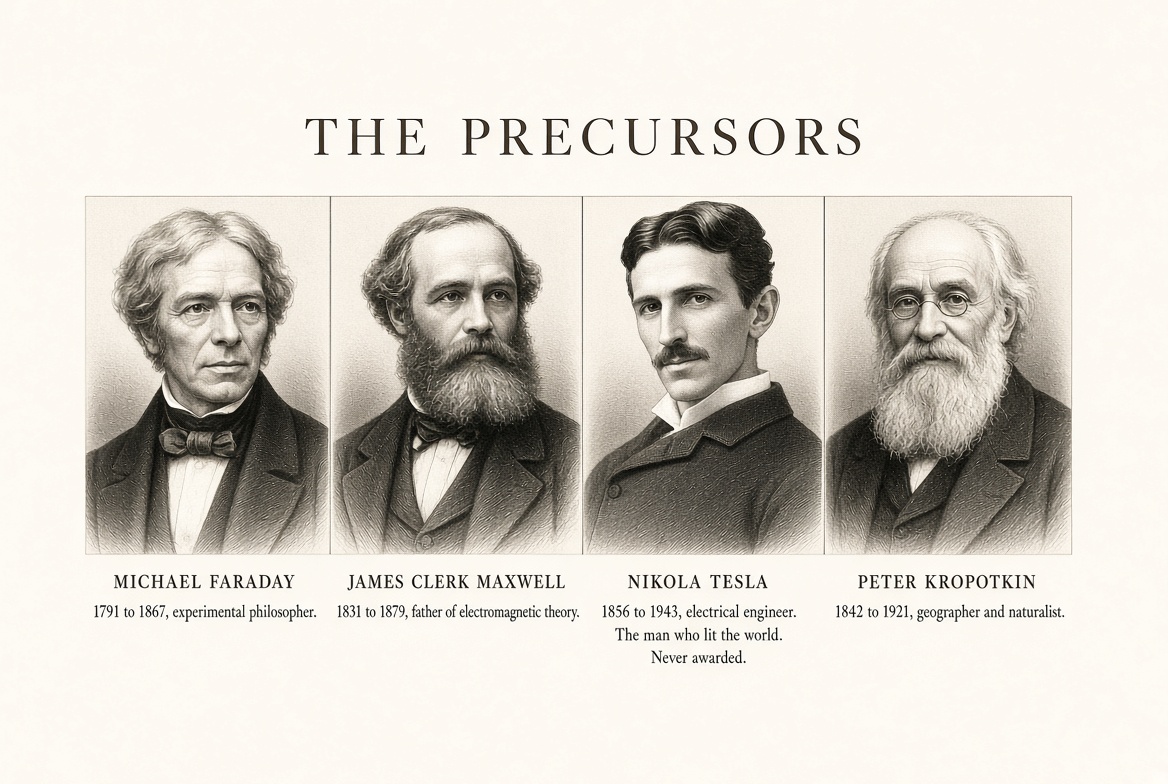
Max Planck (1858-1947) initiated the quantum revolution by discovering that energy exists in discrete packets that respond to observation. Planck spent decades resisting the implications of his own mathematics, fighting to keep the second law of thermodynamics strictly deterministic and the universe strictly mechanical. He called his own energy quantum an act of desperation, produced because an explanation had to be supplied at any price. Then, in an interview with J. W. N. Sullivan published in The Observer on 25 January 1931, he said it outright: he regarded consciousness as fundamental and matter as derivative from consciousness. We cannot get behind consciousness. Everything that we talk about, everything that we regard as existing, postulates consciousness.
It took him thirty years to say it, he did say it, and he said it to a newspaper reporter rather than in a scientific journal, because no journal in his own field would have printed it. That is the founder of quantum theory placing consciousness first in the order of reality, with matter derived from it rather than the other way round. He said it in his seventy-third year, to a newspaper interviewer who asked him directly, and he never once said it in a paper of his own. Planck's quantum mathematics provides the tools for describing how consciousness-field interactions could influence energy and matter at the most fundamental level of physical reality. He had every opportunity. He was publishing on precisely these questions that same year, he directed the Kaiser Wilhelm Society, and nobody on earth could have refused him a page. The position appears in an interview and nowhere in his own physics.
Albert Einstein never even got that far. He fought the randomness his own work had uncovered until the day he died, insisting to the last that God does not play dice. His 1905 paper had made the light itself arrive in lumps, and when Planck and three colleagues put him up for the Prussian Academy in 1913 they asked that the light quantum hypothesis not be held against him. Eight years later the Nobel committee gave him the 1921 prize for the photoelectric law, and explicitly not for relativity. The quantum work was first the embarrassment and then the citation. The relativity was the fame and never got the medal. A discipline that spent sixteen years deciding which half of Einstein to honour was not calmly following evidence. It was managing a problem.
Werner Heisenberg (1901-1976) discovered through his uncertainty principle that conscious observation fundamentally affects quantum systems. His mathematical analysis revealed that measurement does not just reveal what is already there, it actually participates in determining what becomes real. Heisenberg demonstrated that consciousness and matter exist in a dynamic relationship where observation influences reality at the most basic level.
Heisenberg later wrote, in Physics and Philosophy in 1958: what we observe is not nature itself, but nature exposed to our method of questioning. That recognition that consciousness plays an active role in determining physical outcomes provides the scientific foundation for understanding consciousness as a field phenomenon capable of influencing matter through focused attention and intention.
There is a standard answer to all of this and it should be on the table before the argument goes any further. Decoherence says that a quantum system entangled with its surroundings loses its interference properties without anyone observing anything, so the apparent collapse at the screen is the environment doing the work and no consciousness is required. It is a good answer, it is well established, and the case made here does not contradict it. What it does is ask whether the environment has been fully itemised, since a laboratory that budgets for heat, vibration and stray fields has budgeted for everything it thought to include.
Erwin Schrodinger (1887-1961) developed the mathematical framework that describes how quantum systems evolve from multiple simultaneous possibilities into single definite outcomes. His wave equation revealed that quantum systems exist in superposition, multiple states at once, until conscious observation collapses them into specific realities.
Schrodinger's mathematics provides tools for understanding how consciousness could influence which of many possible futures actually manifests in physical reality. The mathematics does not require consciousness. John von Neumann, who wrote the formalism into its rigorous mathematical form in 1932, established something more useful than that: the formalism does not say where the boundary between the quantum system and the classical observer should be drawn, and it gives the same predictions wherever you put it, including at the observer himself. The cut is permitted at consciousness and it is not compelled there, and nothing in this argument needs it to be compelled.
The Part With No Direction
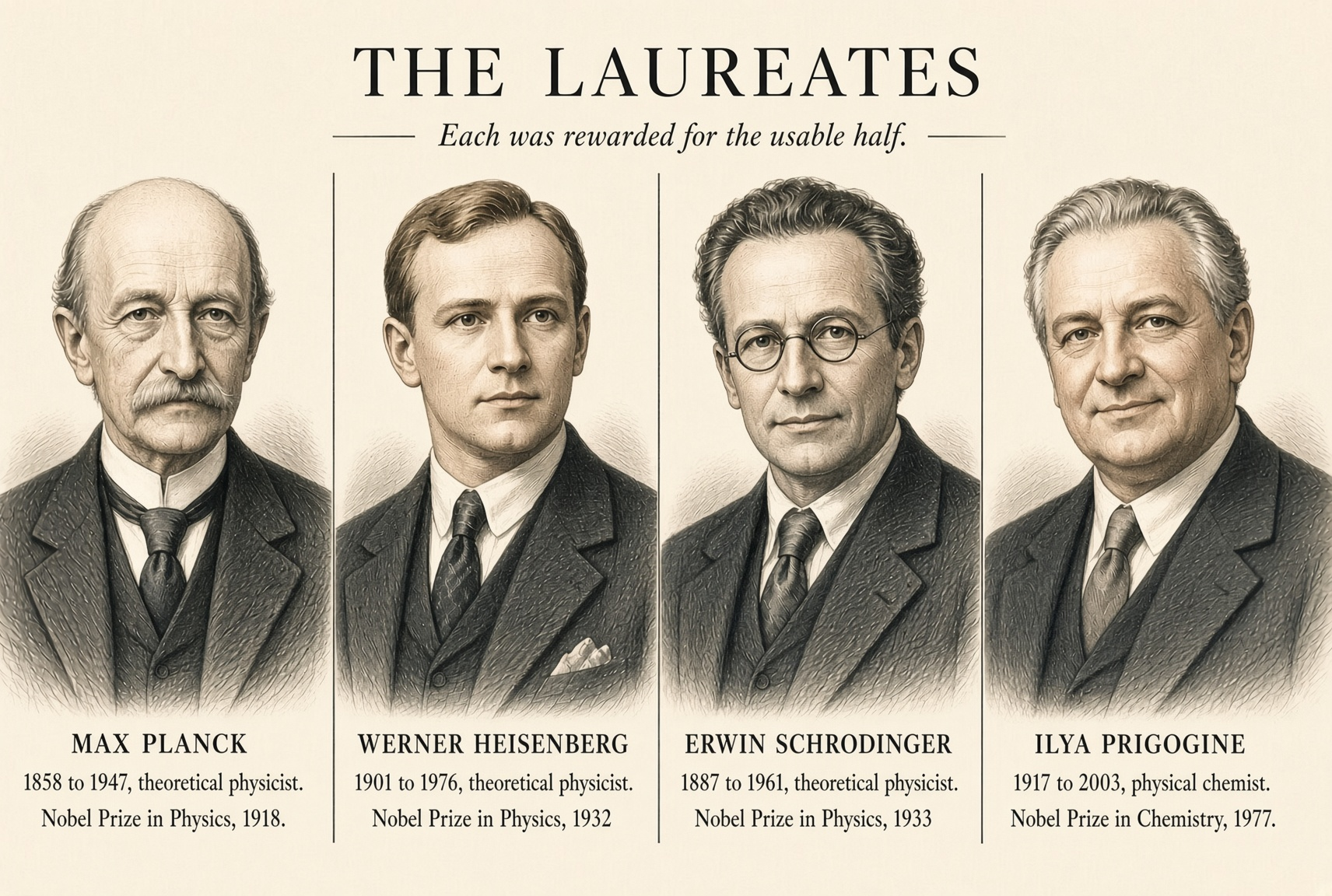
Maxwell's algebra had four parts. Three of them point. They answer two questions at once, how much and which way, in the manner of a wind of forty knots out of the north west. The fourth part answers only the first question. It has size, it has timing, and it has no direction whatsoever. Physics calls that a scalar.
Having no direction is easily mistaken for having no force, so it is worth a moment on that. Swim down three metres and your ears tell you about it. Ask which way that pressure is pointing and the question falls apart, because it is not pushing you north or downwards, it is pressing on every part of you at once. It has a magnitude and no direction, and it is perfectly capable of crushing a hull. Voltage has no direction either, and it kills men. A quantity that points nowhere can do all the work in the room.
Now the second property, which is the one everything else in these three essays depends on. A wave has a size, and it also has a position within its own cycle, how far through the rise and fall it has got at the moment you look at it. That position is called the phase, and anyone who has sat on a harbour arm has watched what it does. A swell running at a vertical wall bounces back with the same height and the same phase, travelling the opposite way, and the two trains lie on top of one another. The result is a pattern that stays put. Certain patches of water heave hard, and other patches a few feet away barely move at all, and they do not swap places. Same water, same swell, same height throughout. The only thing that differs between the patch that heaves and the patch that sits still is where the two waves stand in their cycles at the moment they meet.
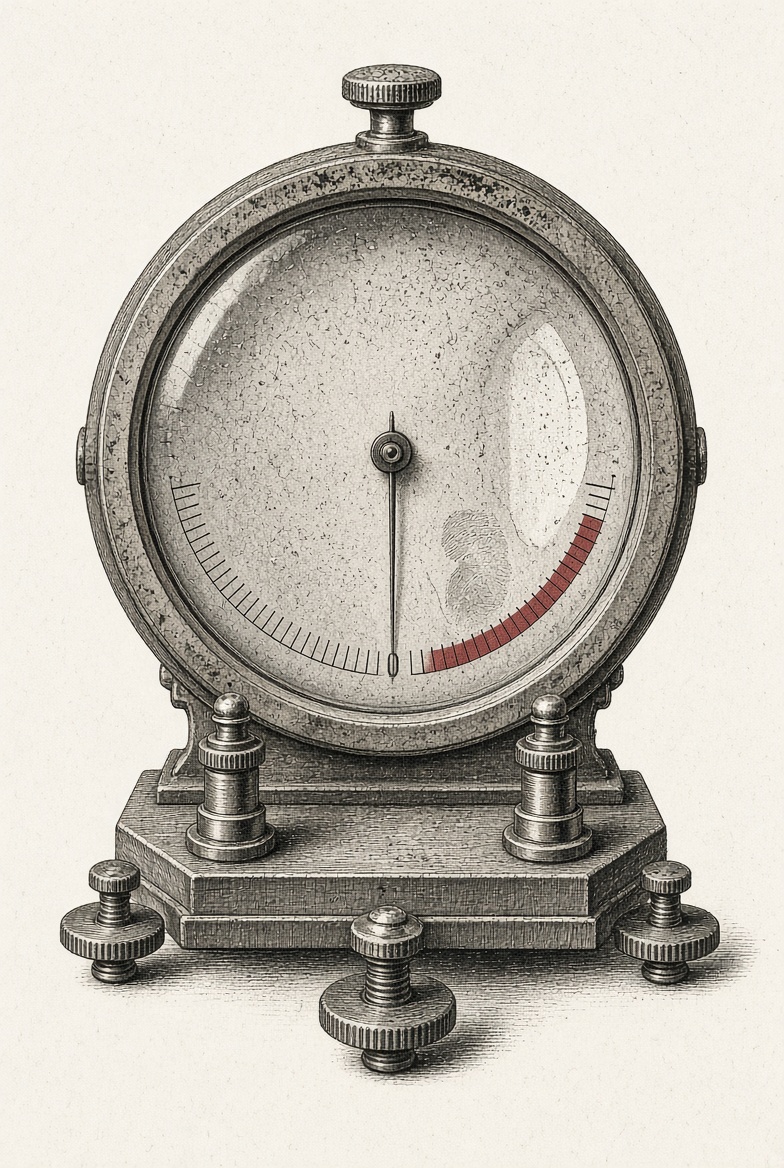
That is the hinge. Every instrument in the standard toolkit answers one question and one only: how much. A needle swings, a coil takes a current, a gauge reads a magnitude. None of them can tell you where a wave stands in its own cycle, and none of them was ever built to, because the quantity was taken out of the fundamental equations in 1884 and instrument makers build to the theory they are given.
Which produces the situation this essay is about. Two waves of the same size, in step, add up to double. The same two waves half a cycle apart add up to nothing. To the needle those two cases are identical readings.
The entire difference between something and nothing lies in a quantity the instruments cannot see, and they cannot see it because a century and a half of instrument design was carried out on the assumption that it was not there.
Nothing was hidden in the sense of being concealed. It was worse than that. The quantity was removed from the textbook, and after two generations nobody remembered there had been anything to look for. You do not build a detector for something you have never been told exists.
And this is where consciousness comes in, because phase is the whole of the question. If mind couples to the field at all, it does not do so by making the field bigger. Nothing about a thought suggests it adds energy to a room, and a century of null results says it does not. It would do so by making something stay in step. That is the only kind of influence a conscious system could exert on a field without lighting up an amplitude meter, and it is precisely the quantity that went out with the sixteen equations in 1884 and never came back.
So the answer to the oldest objection, that if consciousness affected physical reality we would have noticed by now, is that we would not have. We have been holding up a scale and asking what a thing weighs, while the question was always where it stands in the cycle. The instrument was pointed at the wrong property for a hundred and forty years, and every null result it produced was filed as evidence that there was nothing there.
That is the fourth part of Maxwell's algebra. It was cut in 1884, the instruments were built without it, and the question it would have answered has been standing open ever since. The theory that came next put the medium back without noticing what it had recovered.
The Field Comes First
Everything so far has been the particle era: quanta, orbits, wave functions, the observer at the screen. What followed it inverted the picture, and the inversion is not a fringe reading but the standard one. In quantum field theory, the field is the primary object and a particle is a quantised excitation of it, a disturbance in something that fills all space.
The point has been argued in the teaching literature under a title as blunt as the claim, that there are no particles, there are only fields. An electron on this account is not a small object moving through emptiness. It is a state of the electron field, in the way that a note is a state of a stretched string and not a thing sitting on it.
The vacuum of that theory is not empty either. It carries a zero point energy, shifts the energy levels of hydrogen by an amount that Lamb and Retherford measured in 1947, and it exerts a force between two uncharged plates in an evacuated chamber, which has also been measured. A medium filling all space, possessing energy and structure, whose disturbances we call matter. That is the formal position of the most successful theory in the history of the subject.
One distinction has to be made carefully, because it is where the nineteenth century went wrong. The old aether was a substance with a rest frame, something you could in principle be moving with respect to, and that is the thing the interferometers ruled out. The quantum vacuum has no rest frame and no preferred state of motion. What the field era restored was the substance, not the frame.
Anyone who conflates the two invites the answer that was already given in 1887, and there is no need to invite it, because the substance alone is enough for everything that follows.
Dirac Would Not Bend
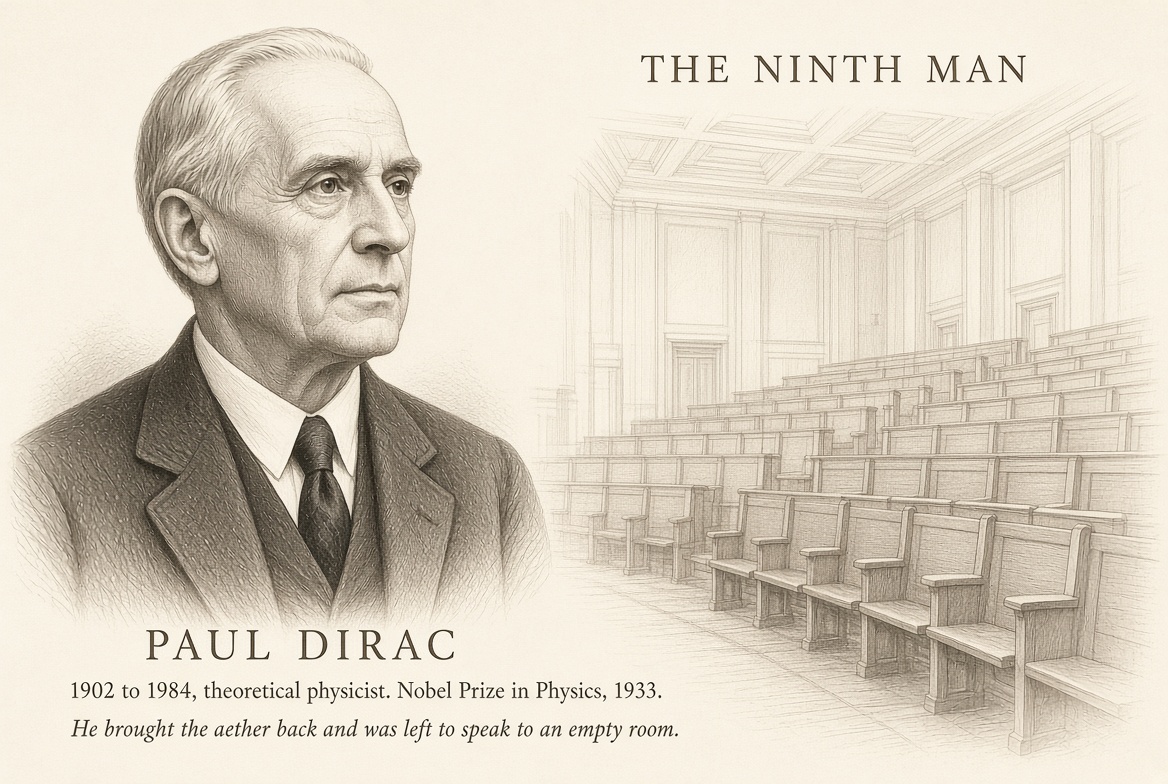
There is a ninth name in this sequence and he is the last man anyone would file under nostalgia for the aether. Paul Dirac wrote the equation that predicted antimatter, founded quantum electrodynamics, and took a share of the 1933 Nobel prize before he was thirty two. He then spent the second half of his life being walked quietly to the edge of the discipline he had built, for the offence of saying that its arithmetic was rigged.
The offence was renormalisation, the procedure by which the infinities appearing in the equations are subtracted away to leave a finite answer. Dirac refused it to the end. Sensible mathematics, he said in 1975, means neglecting a quantity when it turns out to be small, not neglecting it because it is infinitely great and you would rather it were not there. He called the procedure a stop-gap and held that a number coming out infinite where it ought to be finite is a fault in the equations rather than an inconvenience to be doctored. He was not refuted. His work simply moved further and further out of the mainstream, which is the ratchet operating on the man who built the machine.
And in November 1951, in the pages of Nature, he put the medium back. The aether had been abandoned, he wrote, because it could not be reconciled with relativity. Re-examined with what was known by 1951 it was no longer ruled out, and good reasons could now be advanced for postulating one, provided its velocity was subject to the uncertainty relations. With the new electrodynamics, he concluded, we are rather forced to have an aether. Infeld answered the following year that the equations could be written without it. Dirac replied that this was not sufficient for a complete dynamical theory, because the aether velocity is what the Hamiltonian formulation requires, and the Hamiltonian is what you quantise. Not a flourish. A structural requirement, stated by the man who had written the formalism.
Set three of them side by side and the arc is unmistakable. Maxwell treated the medium as physically real and built his theory on it. Tesla worked as though the wheel work of nature were already turning and the engineer's task was to couple to it. Dirac, three generations and two wars later, arrived at the same necessity from the opposite direction, out of pure quantisation rather than off a bench. They did not mean the same object. Maxwell's medium was mechanical, Dirac's was a velocity field under quantum uncertainty. What they share is the structural claim, that the field is not a bookkeeping device laid over empty space but a something with properties of its own. That claim was cut in 1884 for reasons of portability, and every time a first rank physicist has since gone back to first principles it has come back up out of the mathematics uninvited.
Paul Dirac had the equation, the antimatter, the Nobel prize and the chair, and he spent the standing that came with all four rather than accept a subtraction he thought dishonest. Nobody refuted him. They carried on, and the discipline he founded filed his objection as an eccentricity of old age.
Wave First, Particle Second
A choice has to be made here and this essay makes it. The wave is primary. The particle is not a thing but an event, the residue of a wave that has been forced to answer a question.
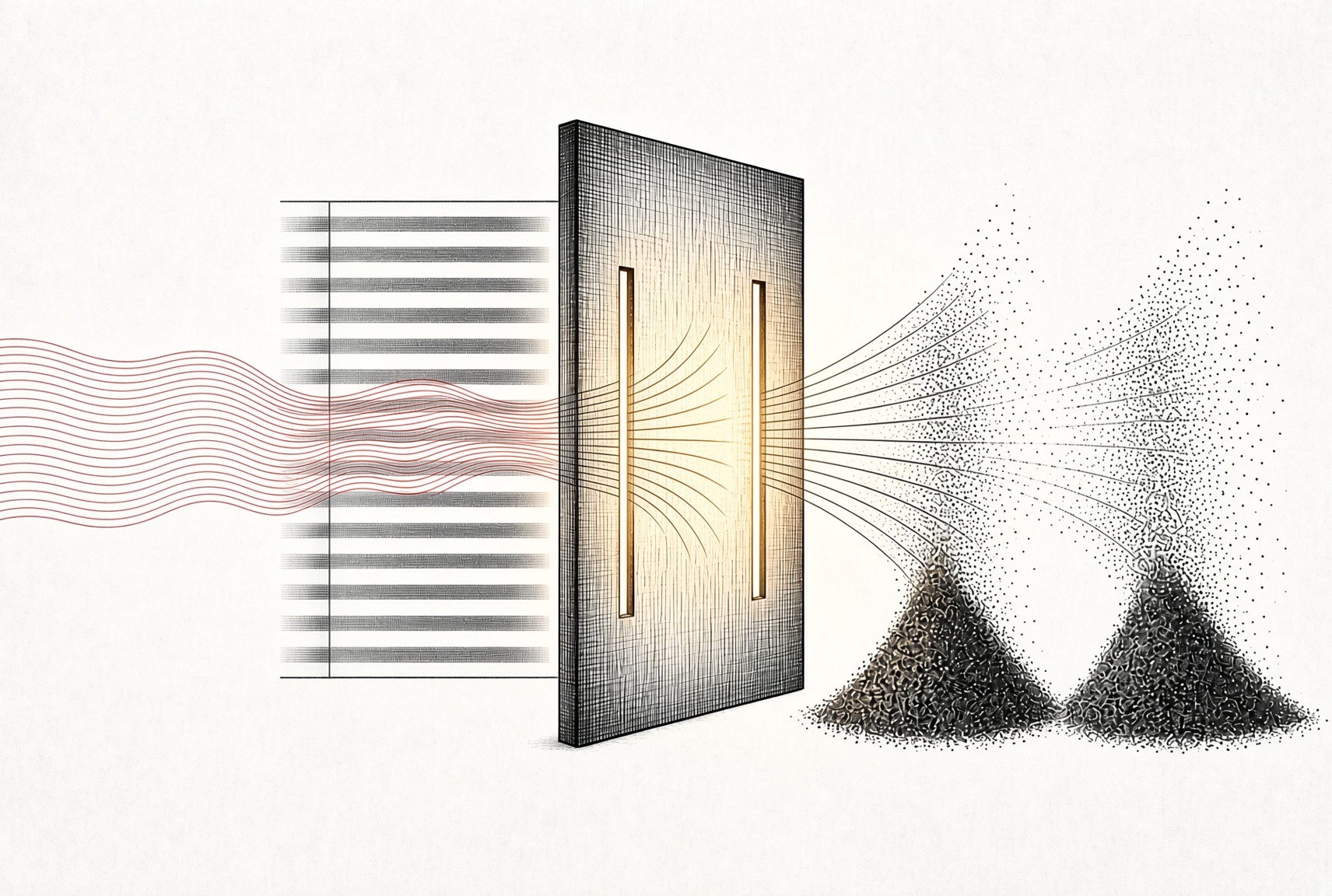
Quantum mechanics hands you two accounts of the same object and no instruction on which to believe. In the wave account the object is extended, continuous, present everywhere its amplitude reaches, carrying phase, capable of interfering with itself. In the particle account it is a point with a position and nothing else. Both predict experimental results. Only one of them describes something that could plausibly be the substrate of mind.
The wave is where the coupling happens, and the reason is phase. Phase is the only quantity in physics that behaves like relation rather than substance. Two waves in step reinforce, two out of step cancel, and neither outcome is a property of either wave taken alone. Coherence is relational by construction. If consciousness participates in the natural order at all it participates there, in the phase relations, not in the debris left over after measurement.
Which makes the particle the derivative term. What we call solid matter is the collapsed matrix, the standing record of wave states already resolved. The double slit shows it without ambiguity: leave the wave unquestioned and the interference pattern builds, ask which slit and the pattern dies and you are left with two heaps of points. A particle is what a wave looks like after interrogation.
Follow that through and the ordinary sense of what is real inverts. The wave order is the natural order. The matricial world we walk around in, made of objects with definite positions, is its collapsed transcript, closer in structure to a dream than to the thing it derives from. Coherent while you are inside it. Definite only where attention has fallen. Assembled continuously out of a substrate that has no definite anything until it is asked. Materialism has the hierarchy upside down. It mistakes the transcript for the source.
Physics has had no settled account of measurement since 1927, which is ninety-nine years of quantum mechanics, the most successful theory ever written, being unable to say what happens when somebody looks at something. That is not a fringe complaint. It is why Copenhagen, many worlds, pilot wave and spontaneous collapse are all still taught as live options, and a discipline does not keep four explanations on the shelf for a problem it has solved. Worth remembering when somebody tells you this territory is closed. Several readings are on offer and every one of them fits the formalism. Wave first is the one taken here. The alternatives are chosen on temperament too. They simply have the manners not to say so.
How Academic Isolation Prevented the Big Picture
Here is where the story becomes both fascinating and frustrating. Each of these discoveries was genuine and significant, but academic compartmentalisation prevented anyone from recognising the pattern that emerges when you put them all together.
José Ortega y Gasset had the measure of it in 1930, in the chapter of La rebelión de las masas he titled the barbarism of specialisation: the specialist, he wrote, is not a wise man but a learned ignoramus, master of his own square metre and confidently ignorant of everything beyond it, and he behaves in the world with all the authority of one who knows.
Maxwell's electromagnetic field theory was studied in physics departments. Planck's quantum mechanics was developed in theoretical physics. Tesla's wireless energy transmission was relegated to engineering applications. Consciousness research was confined to psychology departments. Medical studies of mind-body interactions remained in medical schools.
Nobody had institutional support or academic incentive to synthesise discoveries across these artificial boundaries.
This compartmentalisation was not accidental. Academic institutions developed funding structures, career paths, and peer review processes that rewarded narrow specialisation while discouraging the kind of interdisciplinary thinking needed to recognise consciousness as a unifying field phenomenon. Researchers who tried to connect consciousness studies with physics found their careers stalled and their funding eliminated.
After a generation of that the line no longer needs policing. It polices itself, for free, which is the most efficient censorship ever devised because nobody has to sign anything.
Economic forces reinforced academic isolation. Industries that profited from artificial scarcity in energy, medicine, and technology had strong incentives to prevent the development of consciousness-based alternatives that could make their business models obsolete.
Research funding was systematically directed away from investigations that might unify consciousness and physics, while massive resources supported projects that reinforced the artificial separation between mind and matter. Suppression is the wrong word for it, because suppression implies effort. What actually happens is that the grant is simply not made, the chair is simply not endowed, the journal simply has no section for it, and a generation later there is nothing left to suppress.
The arrangement completes itself when the same institutions that decide what gets funded also supply the public adjudication of what is credible. A discipline that awards its own grants, peer reviews its own output, certifies its own experts, and then presents the result as the settled voice of Science is not describing nature. It is describing its own funding priorities and calling them reality.
Faraday worked in a converted basement with a bench and a coil. He would not recognise the thing wearing his coat.
The Modern Evidence: What Is Being Discovered Right Now
Despite institutional resistance, modern research continues generating evidence for consciousness-matter interactions across multiple scientific fields. What follows is what the primary sources report, at the size they report it, including where they report failure. Stated that way there is nothing in it for a critic's thumb to catch.
Quantum Laboratory Studies
Princeton's Engineering Anomalies Research laboratory, PEAR, ran from 1979 to 2007 under Robert Jahn. Its benchmark experiment on random event generators, reported by Jahn, Dunne, Nelson, Dobyns and Bradish in 1997, drew on 91 operators across 522 experimental series, on the order of 2.5 million trials. The cumulative deviation in the direction of stated intention exceeded chance expectation by 3.8 standard deviations, roughly one in fourteen thousand against chance. The effect per trial is minute, a fraction of a bit, detectable only because the sample is enormous.
PEAR published every result it obtained, positive or null, which removes the file drawer objection at a stroke. Very few of the laboratories that laughed at it can say the same. In 1996 it went further and formed a consortium with the Institut fur Grenzgebiete der Psychologie in Freiburg and the Justus Liebig University group in Giessen to attempt a strict replication of its own benchmark: same protocol, three independent laboratories, 227 participants, around 750,000 trials per condition, power calculated at about 85 per cent. Published in 2000, it failed on the primary measure. All three laboratories showed positive but non-significant trends, and the data instead threw up secondary structural oddities the authors themselves called evidence of inadequate understanding of the phenomenon.
PEAR published that failure itself. Later commentators have argued the benchmark effect rested disproportionately on two exceptional operators, so the replication was powered against an inflated average and never had the sensitivity it thought it had. That argument awaits its own test and will not get one. What stands is a substantial anomaly, published without selection, that did not survive its own strict replication and has been left unexamined ever since. The laboratory closed in 2007 and nobody has been back. A discipline that genuinely wanted the question answered would have sent somebody.
Medical Research Evidence
The MANTRA trials are the honest test case and they cut both ways. The 150 patient pilot reported a signal worth chasing. The multicentre follow-up, 748 cardiac patients across nine US centres, published in the Lancet in July 2005, found no effect on its primary endpoint from either distant intercession or bedside music, imagery and touch. The correspondence that followed described the findings as almost uniformly negative.
Citing the pilot and burying the follow-up is the manoeuvre that has kept this whole field out of serious rooms for fifty years, and it is not made here. The figure circulating in the wellness literature, over 1,400 patients with significantly better outcomes, describes no trial that was ever run. The wider distant healing literature is a mess of small studies, heterogeneous protocols, and reviews that reach opposite conclusions depending on inclusion criteria. The case for consciousness as a field phenomenon does not rest on prayer studies and is not damaged by their failure. Intercession at a distance is a poor test of the hypothesis in any case, because it holds nothing constant and measures an outcome with a hundred inputs.
Neuroscience Discoveries
This is the solid ground and it is solid because it is ordinary. Brain imaging studies show that meditation and focused attention practices physically restructure neural networks within weeks of consistent practice. Cortical thickness and grey matter density change measurably and the finding replicates. Attention training alters the brain that does the attending, and none of it is contested any more.
Magnetoencephalography detects the brain's magnetic fields outside the skull as a matter of clinical routine, at femtotesla scale, and coherence measures shift with meditative state. The field is already measurable from outside the head. The argument is about what it couples to, not whether it leaves the building.
Biological Field Research
Claims that focused intention alters growth rates in bacteria, plants and cell cultures circulate widely and are not relied on here, because the studies are small, the replication record is poor, and the difference between a real effect and an unblinded experimenter is rarely visible from the published paper. That is not a verdict on the phenomenon. It is a verdict on the paperwork. On therapeutic touch specifically the most widely reported controlled test, published in a major medical journal in 1998, found practitioners performed at chance when asked to detect a human energy field. That result is part of the record and it stays in.
The Claim, In One Sentence
If consciousness couples to electromagnetic structure, that coupling has to show up as one extra term in the equations of the field, because adding a term is the only way physics ever registers a new interaction. Nothing mystical about the procedure: it was done for magnetism, for the weak force, for every interaction ever admitted. So this essay writes the term.
Think of the equations of electromagnetism as a ledger that has balanced perfectly for a hundred and sixty years. Every entry is accounted for. What is proposed here is a single new line in that ledger, one quantity, called kappa, that says how strongly consciousness and the electromagnetic field are tied to each other. Kappa is a dial with a reading nobody has taken. Everything else on that line is already measured to absurd precision.
Which is what makes the claim worth making, because it can only go two ways. If kappa reads zero, the new line contributes nothing, the ledger balances exactly as before, and this theory is dead where it stands. If kappa reads anything other than zero, then arranging the right conditions in a laboratory should produce an electrical effect the existing equations do not predict, and the size of that effect is the number to go and find. No interpretation, no argument, no appeal to authority. A reading on a dial.
There is one more thing the term does the moment it is written down, and it works against the theory rather than for it. Adding it forces a restriction on what the consciousness field is allowed to look like: it cannot have isolated peaks or hot spots anywhere, and its shape has to be settled entirely by conditions at its edges, the way the surface of a soap film is settled by the shape of the wire it is stretched across. So any claimed consciousness effect that shows up as an isolated concentration somewhere is inconsistent with this proposal and kills it. A claim that costs its author something is worth more than one that does not.
The arithmetic is at the foot of the essay, in the appendix, for anyone who wants to see the term written out and check it. It is three lines and no specialist knowledge is required to read them. But nothing that follows here depends on it. Everything after this point rests on one sentence: there is a single number that settles the question, and in a hundred and forty years nobody has gone to measure it.
What This Means for Technology and Medicine
If consciousness really does operate through field effects, the practical implications could transform human civilisation as dramatically as electromagnetic technology did over the past two centuries. Everything in this section depends on kappa being other than zero, and nobody has gone to measure it.
Medical Applications. Understanding consciousness as a field phenomenon could revolutionise healing by working with consciousness-field interactions alongside conventional therapies. That attention, expectation and mental state affect immune function, cellular repair and recovery rates is established and unexplained, currently filed under placebo, which is a label for a gap rather than an account of one. A coupling term turns a gap into a quantity.
Communication Technology. If consciousness can influence quantum systems through field interactions, the first place to look is where phase is already engineered to extraordinary precision. Every interferometer, every superconducting circuit, every quantum computer is in the business of building and protecting coherent phase relations against everything in the environment. If phase gradients couple to anything else, those instruments are where the signature would appear, and they are already built, running, and logging the noise.
Energy Systems. Understanding consciousness field interactions could lead to energy technologies that access what Tesla called cosmic energy through resonance with natural field systems rather than mechanical generation. Three separate propositions sit in that sentence and they are worth keeping separate: that energy can be moved by resonance, which is established engineering; that the vacuum has structure and zero-point energy, which is established physics; and that either can be tapped for useful net work, which is not established. Collapsing the three into one is how this subject earned its reputation, and keeping them apart is how it gets out of the hole.
Educational Applications. Recognising consciousness as a field phenomenon could transform learning by working with consciousness-field interactions to enhance information processing and retention. This is the cheapest place to test consequences and the most neglected. If attention training produces measurable structural change in the brain, which it does, then learning environments designed around attention rather than content delivery ought to outperform. That is testable next term, in a classroom, without a single new instrument.
The Alternative Timeline: What Could Have Been
To understand how profoundly consciousness field suppression has affected human development, consider what might have happened if these discoveries had been allowed to develop naturally without institutional interference. What follows is counterfactual and labelled as such. The point of it is not the hardware. It is that the cost of a closed question is invisible by construction: nobody mourns the instrument that was never built, and no committee is ever asked to account for the discipline it declined to fund.
The Field Physics Revolution, 1870 to 1900
Without the artificial separation between consciousness and physics, researchers would have recognised electromagnetic fields, gravitational effects, and quantum phenomena as expressions of a unified consciousness field rather than filing them in three departments. Tesla's Colorado Springs experiments indicated that Earth functions as a resonant system supporting standing wave patterns that could be accessed for both energy and propulsion.
Pursued rather than defunded, resonance-based propulsion was a nineteenth century engineering problem, not a twenty-first century one.
Understanding consciousness as the organising principle behind field effects would have made the modulation of field interactions through focused intention a trained skill rather than an occult one, and precision field manipulation a manufacturing discipline.
The Liberation from Mechanical Thinking, 1900 to 1925
Without the limiting influence of purely mechanistic physics, humanity could have developed intuitive field technologies that any consciousness could understand and operate.
Space and time would not have remained abstract mathematical concepts; field physics would have revealed consciousness itself as the fabric of reality organising into the patterns we call matter, energy, space and time.
Transport, construction and architecture would have developed around resonance rather than combustion. Instead the century spent its genius on the internal combustion engine and its treasure on two wars fought with it.
The Materialisation Revolution, 1925 to 1950
Understanding matter as organised energy patterns leads to reconstructing any element by imposing the correct vibrational pattern on quantum fields, and the endpoint of that line is fabrication from the field rather than extraction from the ground.
What that removes is not an industry but a business model. Scarcity, and the mining, shipping, warehousing, logistics and consumer psychology built on managing it, all become unnecessary at once. Which is a plain statement of who had an interest in the line not being pursued, and it requires nobody to have conspired. It requires only that they held the purse.
Addressing Inevitable Scepticism
If this is real, why is nobody talking about it? The same reason relativity and quantum mechanics were not widely discussed for decades after their discovery. Paradigm shifts take time, especially when they challenge fundamental assumptions about reality, and longer still when the assumptions are load-bearing for somebody's revenue. What is left of the field is being done in small rooms on small money, which is what happens to a question the institutions have decided not to have.
Where are the practical applications? There are none, and anyone offering you one is selling something. Applications follow a measured coupling constant, and there is no measured coupling constant. What is emerging, in isolation because the theoretical framework has not been unified, is the groundwork: bio field medicine, consciousness-based healing, meditation research, brain-computer interfaces, quantum consciousness studies.
How can consciousness affect physical systems? Through the same class of mechanism that allows magnetic fields to affect iron filings or electromagnetic fields to carry radio signals. Not contact, but coupling. That is not an argument that it happens. It is an argument that if it happens, physics already has the vocabulary and would not need rewriting, only extending. The term above is what extending looks like.
Why have scientists not discovered this already? Many did, and published, and were filed under different headings by different departments. Tesla's cosmic energy, the observer effects of quantum mechanics, the mind-body interactions of the medical literature, the psi phenomena of the psychologists: four vocabularies, possibly one phenomenon, and nobody employed to check. The search has been sporadic, underfunded and hazardous to a career, and no null result from a search conducted like that closes anything. A question is not answered by being left alone.
But is the physics not settled? This is the objection that arrives with the most confidence and survives the least contact with the numbers. Ordinary matter, everything on the periodic table, every atom in every instrument ever built, accounts for roughly 5% of the mass-energy content of the universe. Dark matter takes about 27% and is named for the fact that nobody knows what it is. Dark energy takes about 68% and is named for the same reason. That is 95% unaccounted for, on the standard model's own figures. A discipline in that position is entitled to demand evidence. It is not entitled to reject anything on grounds of implausibility. That argument was spent the moment the budget came in.
The Testing Phase: How We Find Out for Sure
Science advances through testing predictions, and one number decides this one. Every experiment worth running is an attempt to bound kappa.
Advanced Quantum Laboratory Studies. Modern quantum measurement technology can test whether different consciousness states systematically affect quantum system behaviour, and whether focused attention influences measurement outcomes according to predictable, replicable patterns. Replication in this field means pre-registration, pre-stated power calculations, published protocols and publication regardless of outcome. PEAR's failed consortium is the model to follow, not the cautionary tale to explain away.
Electromagnetic Field Detection. Sensitive instrumentation can measure whether consciousness states correlate with detectable field changes, and whether different mental states produce measurable electromagnetic signatures correlating with subjective experience and conscious intention. The interferometers and superconducting circuits already in service are the best instruments ever built for the job and none of them is pointed at it.
Biological Response Research. Controlled experiments can test whether conscious intention affects biological systems through field interactions rather than conventional communication channels, with living systems exposed to focused intention under conditions eliminating sensory contact, electromagnetic communication and environmental variables.
Information Transfer Experiments. Tests can determine whether consciousness can transmit information through field effects operating independently of conventional channels, under conditions blocking all known electromagnetic and sensory pathways.
Collective Effect Studies. Large-scale experiments can test whether group consciousness produces measurable effects on physical systems. If consciousness fields interact and amplify, collective intention should produce stronger effects than individual intention in ways that can be measured and analysed statistically.
The Boundary Condition. Laplace's equation for the phase field is a hard prediction with no free parameters and it is unusual in this literature for being falsifiable without measuring kappa at all. That is the cheapest experiment on the list and the one nobody has run.
What This Means for Your Life
If consciousness field theory proves correct, it fundamentally changes what it means to be human. You are not just a biological machine that happens to be aware, you are a conscious being whose awareness connects to a fundamental field that fills all space and links all minds. Your thoughts and intentions are not just private mental events, they are interactions with a field that can influence matter and energy according to discoverable principles. The author stands in awe.
This does not make you omnipotent or grant magical powers. A coupling constant that has evaded detection for a century and a half is, by definition, weak. But it does suggest that consciousness operates according to natural principles that can be understood, developed and applied constructively. Learning to work with consciousness-field interactions could become as important for personal development as understanding nutrition and exercise has been for physical health.
The boundary between mind and matter, between subjective experience and objective reality, may be far more permeable than we have assumed. Instead of being isolated individuals trapped inside our own heads, we might be connected through field interactions we are only beginning to recognise. That is a smaller claim than the ones usually made in this territory and a far more dangerous one, because it can be checked.
Personal Development. Understanding consciousness as a field phenomenon suggests that practices like meditation, focused attention and intention training could have effects extending far beyond personal well-being.
Relationships and Community. If consciousness operates through field effects, emotional states, intentions and mental focus could have measurable effects on people around you.
Health and Healing. Mental and emotional states are not just psychological factors, they are field interactions that can directly influence biological processes.
Creativity and Learning. If consciousness can influence information processing through field effects, then creative inspiration and accelerated learning might be natural consequences of working with consciousness field interactions rather than against them.
Science Forgotten
There is a version of this argument older than any laboratory in it. It is not that religion got there first and science is catching up; the traditions contradict each other on specifics as sharply as they contradict physics. It is prisca sapientia, the proposition that revelation is not pre-scientific guesswork but degraded knowledge, a transmission that has lost most of its content and kept its shape.
This is not a fringe position dressed up. Sir Isaac Newton held it, in writing, at length. In the draft scholia he prepared for a revised Principia between 1693 and 1694 he set out to demonstrate that the ancients had already known four things: that matter is atomic and moves by gravity through void space, that gravity acts universally, that it falls off as the inverse square of distance, and the true system of the world. He credited the inverse square law to Pythagoras and held that the Pythagoreans had concealed the result inside the harmony of the spheres, a metaphor pitched at ordinary understanding. The man who wrote the Principia did not believe he had discovered gravitation. He believed he had recovered it.
Read that way, the convergence is the argument. Traditions with no contact, separated by oceans and millennia, arrive at the same small set of structural claims: that consciousness is prior, that the manifest world is a lesser or derived order, that number and proportion are the joints of creation. Either that is coincidence at improbable scale, or there was something to transmit. Convergence across independent lineages is how phylogeny is reconstructed and how lost languages are recovered. It is a recognised method and it is not disgraced by the company it keeps here.
If religion is science forgotten, then what survives is a corrupted transmission, and a corrupted transmission has signal and noise in it by definition. Admitting the noise is not a concession. It is the only thing that makes the signal worth reporting, and a tradition claiming to have preserved everything is claiming not to have been corrupted, which is the one thing we can be sure is false.
Which returns us to 1884 and gives that date its weight. The Heaviside reduction was not vandalism. It was housekeeping, done well, by a man who wanted equations an engineer could use, and the modern world runs on the result. But it is the same operation described throughout this essay: a simplification, adopted for good reasons, hardening over a generation into a description of what exists.
If that can happen inside a documented century, in print, with the correspondence preserved and the losers still alive to complain, then it can happen across a millennium with no documents at all. That is the whole claim. Not that the ancients knew everything, but that amputation is the normal condition of transmitted knowledge, ours included, and that we are the last people qualified to assume we are the exception.
The Road Ahead: From Theory to Reality
The Universal Consciousness Field theory represents a research programme rather than a finished conclusion.
Independent Research Networks. Developing consciousness field science requires research networks operating independently of institutional structures designed to maintain the separation. Crowdfunding, private facilities and international collaboration provide alternatives to conventional academic research systems.
Open-Source Development. Consciousness field research benefits from open-source methodologies enabling rapid sharing of experimental results, theoretical developments and practical applications. The internet provides unprecedented opportunity for collaborative research that bypasses institutional gatekeeping.
Practical Technology Development. The most compelling evidence will come from working technologies that demonstrate consciousness-field interactions. Devices that consistently respond to conscious intention in measurable ways cannot be dismissed through theoretical argument or institutional resistance.
Educational Applications. Consciousness field principles can be tested through educational programmes that teach consciousness-field interaction techniques alongside conventional subjects. If consciousness really does enhance learning through field effects, those programmes should produce measurably superior outcomes.
Conclusion: The Next Phase of Human Evolution
What is not in doubt is the amputation. That is a matter of record with a date on it, and it cost us the question rather than the answer. Twenty equations became four, the medium became unnecessary, the unnecessary became the non existent, and by the time Planck had something to say about consciousness there was no room in the building to say it in. Ninety-five per cent of the universe is unaccounted for and the instrument we use to look at it was trimmed for portability in 1884 by a telegraph clerk in Devon who thought the EM Treatise was cluttered. He was right about the clutter. Nobody checked what went out with it.
Do not think we are at the beginning of anything. We are a century late, and deliberately late. There was always a committee to decline the grant, a chair left unendowed, a supervisor explaining to a promising student that this was not a career driver. They never lost the argument.
They made sure it was never held. And if an answer ever arrives they will have discovered it themselves, on a Tuesday, with a press release. The tell will be the credential and never the data.
One number decides this. A hundred and forty years, every facility on Earth, and nobody has measured it. Anyone still asking why should ask the people who own the laboratories.
Appendix: The Mathematics
Three lines, set out for anyone who wants to check the claim rather than take it on trust. This is not a reading of Maxwell. It is an addition to him, declared as such so nobody has to guess, and it is kept to the minimum required to make the claim fail if it is wrong.
Electromagnetic Field Extensions
Faraday's law in standard form says a changing magnetic field drives a circulating electric field:
∇ × E = −∂B/∂t
Add one coupling term:
∇ × E = −∂B/∂t + κ∇ψ
Psi is the phase of the quantum wave function, the relational quantity from the section above. Grad psi is how steeply that phase varies from point to point. Kappa is a coupling constant stating how strongly, if at all, the two are tied. That is the entire claim and its virtue is that it is cheap to kill. Everything in it except kappa is already measurable. If kappa is zero the term vanishes and classical electromagnetism stands untouched, which is what every existing measurement says to the precision at which it was taken. If kappa is not zero, then engineering a steep phase gradient should produce a circulating electric field Faraday's law alone does not predict, and the size of that discrepancy is the number to hunt.
One consequence comes free, and it constrains the exercise rather than flattering it. The divergence of any curl is zero, and magnetic field lines have no ends. Take the divergence of both sides and you are forced to:
∇²ψ = 0
The phase field cannot be arbitrary. It has to satisfy Laplace's equation, the same equation governing steady heat flow and the shape of a soap film. Whatever this coupling is, it is not a free parameter with a free field hanging off it. It inherits a constraint the moment it is written down, and that constraint is itself a prediction: no localised maxima, no isolated hot spots, structure determined entirely by conditions at the boundary. Any claimed consciousness field effect showing isolated structure is inconsistent with this formulation, which would kill the coupling as written and leave the question itself standing.
Quantum Mechanical Applications
The same move can be made on Schrodinger's equation, adding a consciousness field operator to the Hamiltonian:
iℏ ∂ψ/∂t = Ĥψ + Ĉψ
This provides the tools for describing how consciousness field interactions could influence quantum wave function evolution, and it is the same exercise as the one above: declared, minimal, and answerable by measurement rather than by argument. One term, one constraint, one number to go and measure is a research programme. A page of speculative equations is a mood.