
Three Amigos at the Sands
Once, at a Las Vegas casino called the Sands, the room belonged to three men who had worked out that power is mostly stagecraft and the rest is who picks up the cheque. Frank Sinatra, the crooner from Hoboken, who could empty a bar with a ballad and fill it again with a phone call. Dean Martin, who sang with whisky where his blood should have been and watched the room over the rim of the glass. And Sammy Davis Jr, who could outdance and outsing both of them, and who, in the late sixties, publicly joined the Church of Satan, medallion and all, before quietly thinking better of it. They called themselves the Rat Pack. The Sands was imploded in 1996 to make room for a fake Venice. The act outlived the building, because the act was never about the building.
Call these three the Rat Pack of world power, and give each man his double. The crooner is the order, five centuries of Jesuit formation. The watcher at the bar is the apparatus, Palantir and the surveillance republic. The small electric one who cannot stop is the permanent revolution, the Jacobin engine that always ends with the blade turned inward. Three turns, one act, and the names are below.
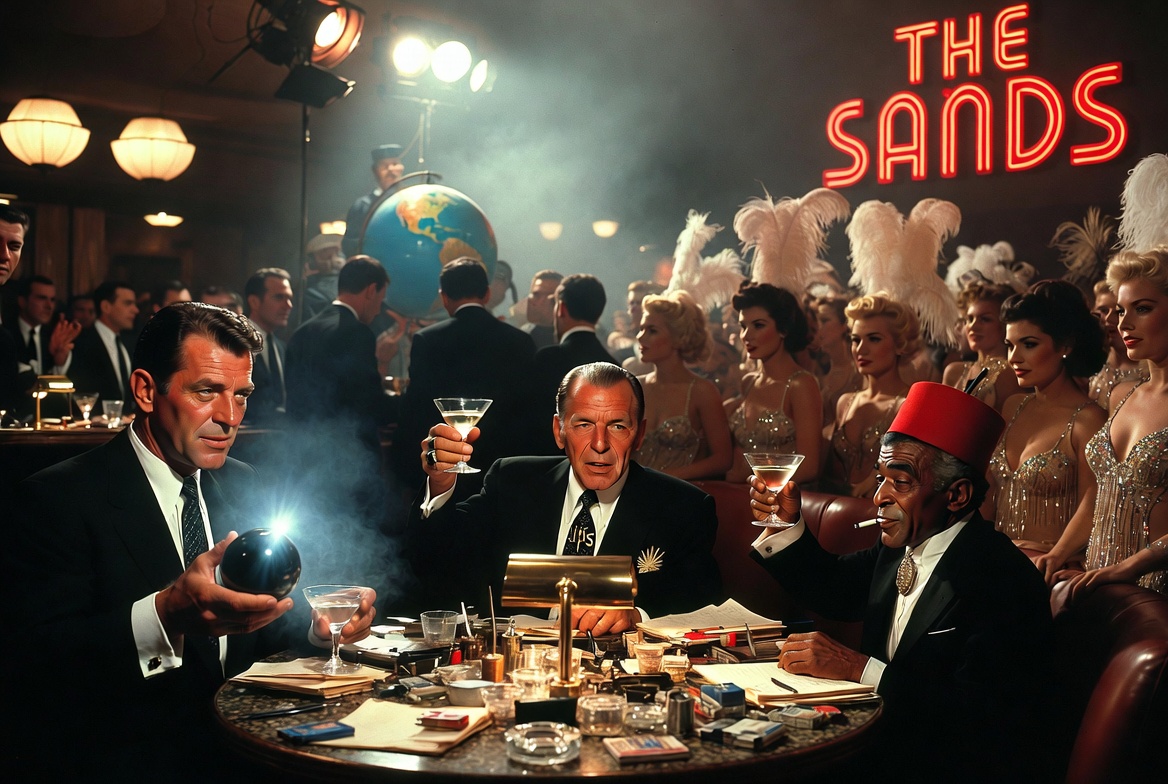
Sinatra is the Jesuits. Five centuries of polish, the headliner who has been confessor to kings and schoolmaster to their sons, the voice everyone knows and almost nobody can place. His instrument is not the blade but the boy: take the sons of the well-heeled young, put them in the right schools, form them before they know they are being formed, place them high and keep them loyal for life. The end justifies the means, and the means were always other people's children. The method does not build one elite, it builds layers of them, seeded through every institution that matters, and four centuries on the World Economic Forum lifted the trick wholesale and called it Young Global Leaders, as if grooming the under forties into the next tier of power were a fresh idea. It was never fresh. The order perfected the oldest version of it, indispensable to power while answering to a different management entirely, financing the whole show, the missions, the colleges, the banks, with money that was always someone else's. God's work, other people's money. He never reaches for the bill. The bill simply arrives, paid.
Martin is Palantir. Charming, unhurried, watchful in a way the laughing crowd never quite registers. He is the one who remembers everything and feels none of it, the confession booth rebuilt as a database, the man at the end of the bar who knows your sins before you have finished committing them and files them without a flicker. The firm took its name from a seeing-stone that showed you everything and drove its watchers mad, and it took that name on purpose. Warm to your face, cold all the way down. You tell him everything because he is such good company. That is the entire point of him.
Davis is the Jacobins. The smallest man on the stage and the most electric, the one who cannot stop moving because the moment the act ends he is out of work. His talent is grievance, freshly manufactured nightly, a fresh outrage for every house, because a revolution that finishes has fired its own revolutionaries. His committees of public safety always reach, in the end, for the same prop: the guillotine, sold to the crowd as clean, rational, humane justice and run as a daily abattoir, until the day it ran out of enemies and took the men who built it, Robespierre's own neck under his own blade. That is the tell of the type. The outrage cannot be switched off, so it turns inward and devours the house. He is the only one of the three who said out loud whose management he had signed with, and then, like all the best performers, swore blind it had never happened.
Grievance, surveillance, absolution. One stage, three turns, a single act.
On the stage behind them the Earth keeps turning on its stand, a prop nobody is watching, swept around by a lone janitor while the act in the corner decides what the show will be.
Here is the part worth keeping after you close the page. You never needed these three in a room together, and the essays do not claim they were. A conspiracy requires a meeting, a plan, a leak waiting to happen. This needs none of that. It needs only a shared incentive, and the incentive they share is permanent crisis, because permanent crisis is the one condition under which the grievance-maker, the watcher and the absolver are all simultaneously indispensable. They do not have to conspire. They harmonise. That is what makes it durable, and it is also what makes it far harder to throw out of the casino than any cabal, because there is no cabal to catch. There is only an act, and an act survives every venue that ever housed it. Only the third man ever brings the blade, and in the end the blade is always pointed inward.
Next, something completely different.