
THE SPIRIT OF EXUMA
Same As It Ever Was
"You may ask yourself: well, how did I get here?"
Talking Heads, Once in a Lifetime, (1980)
Prologue: Dublin, August 2026
The agenda for the 2026 retreat of a private network called Dialog, scheduled for August 12 to 16 at Powerscourt Estate near Dublin, reads as follows. Navigating WWIII. Battlefield Technologies. Bring Back Nuclear. Disinformation and Deepfakes. Contrarian AI Takes. Three Predictions for Iran. Democracy Under Surveillance. Build-a-Cult. And, to unwind after a hard day of civilisational architecture: private tours of a distillery, Saint Patrick's Cathedral, and the Guinness Storehouse.
The network was co-founded in 2006 by Peter Thiel, the billionaire co-founder of Palantir Technologies, whose software forms the analytical backbone of the US military's kill-chain decision infrastructure and whose operational contracts run through USSOCOM, the CIA, the NSA, and the Pentagon. Among the 222 people registered for the Dublin retreat are the US Treasury Secretary, a sitting senator who chairs the US Senate committee with oversight of data privacy regulation, NATO's Supreme Allied Commander Europe (SACEUR,) the US Army Secretary, multiple executives from Google and DeepMind, and the founders of several of the country's largest surveillance and data-broker companies. None used a government email address to register, placing their attendance outside public records laws.
In June 2026, Swiss hacktivist maia arson crimew, following an anonymous tip, found that the Dialog website's code contained an unprotected directory of 113 names and that full registration records for the Dublin retreat were publicly accessible. Internal member dossiers were separately leaked to journalists. The leak revealed that Dialog operates an internal grading system: C for the most famous and powerful, A for established but less prominent members, B for most people.
Members are also scored on the value they add to the network and flagged on whether they can be trusted to moderate discussions. AI tools build dossiers on every member and potential member before admission.
Crimew observed afterwards that it was wild how people who run the world are so confident in their safety that they do not bother with proper operational security. The observation is correct. The question it does not address is whether that confidence is truly earned.
This essay is in response to that question. The answer does not start in Dublin, nor in this century. It begins on a London street in the thirteenth century, with three gold balls hanging over a door, and it ends above the atmosphere, in the only ocean left that has no coastline. It is necessarily a long one.
I. The Unchangeable Names
There are families whose names do not appear in leaked directories. They do not appear because they have not needed to appear for five centuries or more. Power at sufficient depth and duration does not require visibility. It requires continuity, and continuity requires nothing so vulgar as a conference.
Begin with the Lombards. Not a single family but a class: the Italian banking dynasties from Asti, Piacenza, and the towns of the Po valley who operated in London from the thirteenth century, on the street that is still called Lombard Street, within walking distance of the Bank of England that was founded around the corner four centuries later. They introduced the instruments that made the entire subsequent architecture possible: letters of credit, bills of exchange, double-entry bookkeeping, the ability to move value across sovereign boundaries without moving gold. The three golden balls hanging outside every pawnbroker in the English-speaking world are the heraldic symbols of the original Lombard banking houses. The geometry of modern global finance is still the geometry they established.
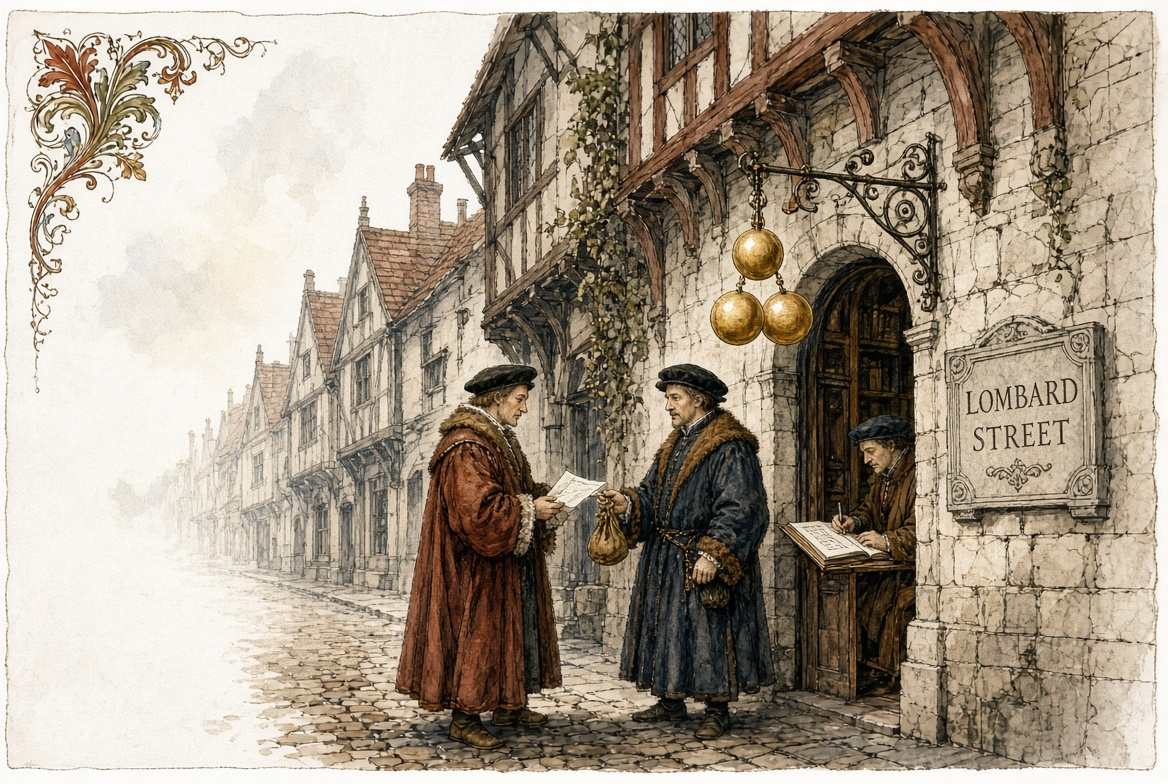
Artist's visualisation, thirteenth century. Three golden balls over a doorway, a letter of credit changing hands, a clerk entering the line. The instruments that made everything after it possible: the bill of exchange, double-entry bookkeeping, value moved across sovereign borders without moving gold. The balls still hang outside every pawnbroker in the English-speaking world.
The Medicis of Florence ran the most sophisticated banking network in fifteenth-century Europe, produced four popes, two queens of France, and financed the Renaissance as a commercial and political project simultaneously. Their banking architecture established templates for the relationship between private financial capital and sovereign power that run, in updated form, through every subsequent iteration of the story this essay is telling. The Medicis did not fund art because they loved beauty. They funded art because beauty was the most durable form of soft power available to a banking family that needed sovereign legitimacy it could not acquire by birth.
The Colonna family and the Orsini have faced each other across a thousand years of Roman political history, which is itself a structural point. The oldest power networks do not consolidate into a single line. They maintain internal competition, because competition makes them resilient in ways that monopoly does not. The Colonnas produced Pope Martin V in 1417, who ended the Great Schism. They are still Roman aristocracy today. The Orsinis produced three popes and more cardinals than any other Roman family, maintained estates and military garrisons across the Papal states for centuries, and absorbed every political transition that destroyed lesser formations around them.
The Chigi are the Sienese bankers who became the Vatican's primary financial house, produced Pope Alexander VII, and whose family palazzo in Rome is today the official seat of the Italian Prime Minister. The building that houses the head of the Italian government belonged for centuries to a banking dynasty that served the Holy See. That sentence is the essay in miniature.
The Pallavicini ran the same trade from Genoa and then from Rome, banking the Holy See across the centuries in which the Genoese houses were the working capital of Habsburg Spain. They are still there. The Torlonia came last and came biggest: papal bankers who financed the Vatican through the Napoleonic wreckage and the Italian unification that followed, and made dukes for services rendered. The last great house of its kind, ennobled on the strength of a ledger, and holding land in the Roman campagna into living memory. Five centuries after the Lombards opened on that London street, the mechanism had not changed. Only the paper had.
The Barberini, whose Pope Urban VIII tried Galileo and whose dismantling of the Pantheon's bronze fittings to melt them for Bernini's baldachin at Saint Peter's produced the Roman saying that what the barbarians did not do, the Barberini did, established the institutional template for elite asset extraction from public patrimony that every subsequent governing class has refined and replicated.
The Doria of Genoa ran the Mediterranean in the sixteenth century through the naval genius of Andrea Doria, operating under Habsburg patronage, establishing the connection between Genoese banking capital, Spanish imperial military reach, and the financing of oceanic expansion. Genoa before Venice. Venice before London. London before New York. The sea-law baton passing forward from one financial centre to the next while the operating logic remained constant.
The Grimaldi took the shorter route. On a January night in 1297, Francesco Grimaldi, known to his contemporaries as Malizia, (the cunning,) presented himself at the gate of the fortress on the rock of Monaco dressed as a Franciscan and asking shelter. The guards admitted the monk. He drew a sword from under the habit, the men behind him rushed the gate, and the rock changed hands. The family coat of arms carries two monks with swords to this day, which is an unusual degree of candour for a heraldic device. Genoese, and Genoese in the full sense: privateering, tolls levied on shipping that had no choice but to pass, and the long patient business of being a sovereign nobody could afford to invade. Seven hundred and thirty years later the rock is a principality, a treaty partner of France, and one of the most effective tax jurisdictions on earth. A man in a false habit at a gate at night is a jurisdiction, if he holds it long enough and nobody finds it worth the cost of taking back.
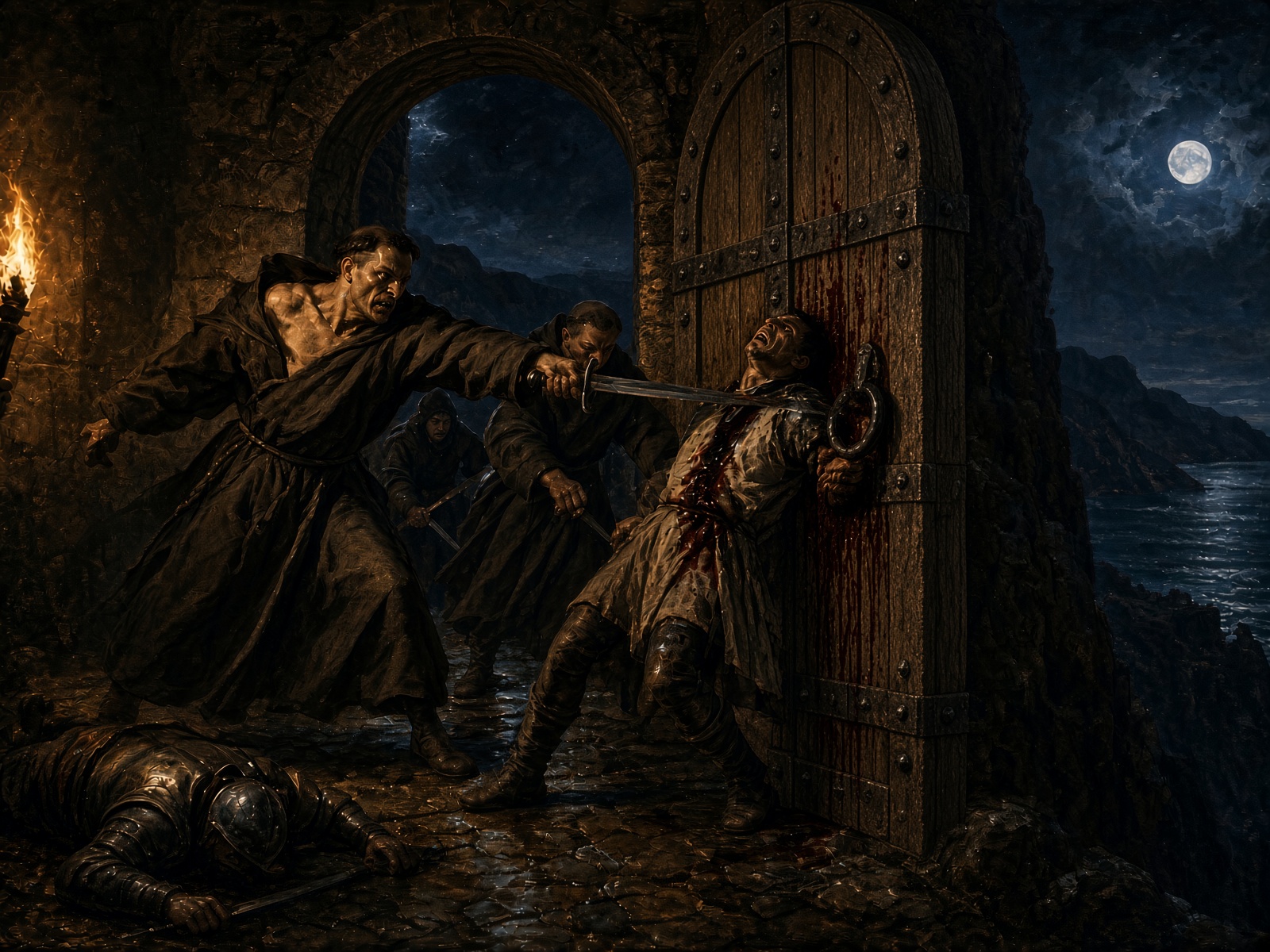
Francesco Grimaldi took the rock, 8 January 1297. The habit got him past the gate. The steel kept him in Monaco four years. Charles of Anjou's men reclaimed it in 1301. The Grimaldis did not keep the rock for good until 1419. The image is the founding myth, not the founding fact. The ledger was written in iron, but rewritten twice. After that, the harbour fees did the rest.
Henry Morgan sacked Panama in 1671, burned it, and took what could be carried. England disowned the raid, recalled him to London to answer for it, and then knighted him and sent him back to Jamaica as Lieutenant Governor, where he sat on the bench and hanged pirates until he died in 1688 as a respectable colonial official. The career is not an anomaly. It is the Grimaldi progression run at speed and in the Atlantic rather than the Mediterranean: take by force, hold long enough that removal costs more than accommodation, then receive the legitimacy that was always available to whoever ended up holding the ground. The privateer and the governor were the same man and the Crown never pretended otherwise. Three centuries later the rock that Malizia took with a sword under a monk's habit is a principality, and its harbour is the parking lot of the obscenely rich: the new money that arrived last week, and the old wealth that has been there so long it no longer needs to be seen arriving. The bankers and the buccaneers were never separate professions.
One of them simply stopped going to sea.
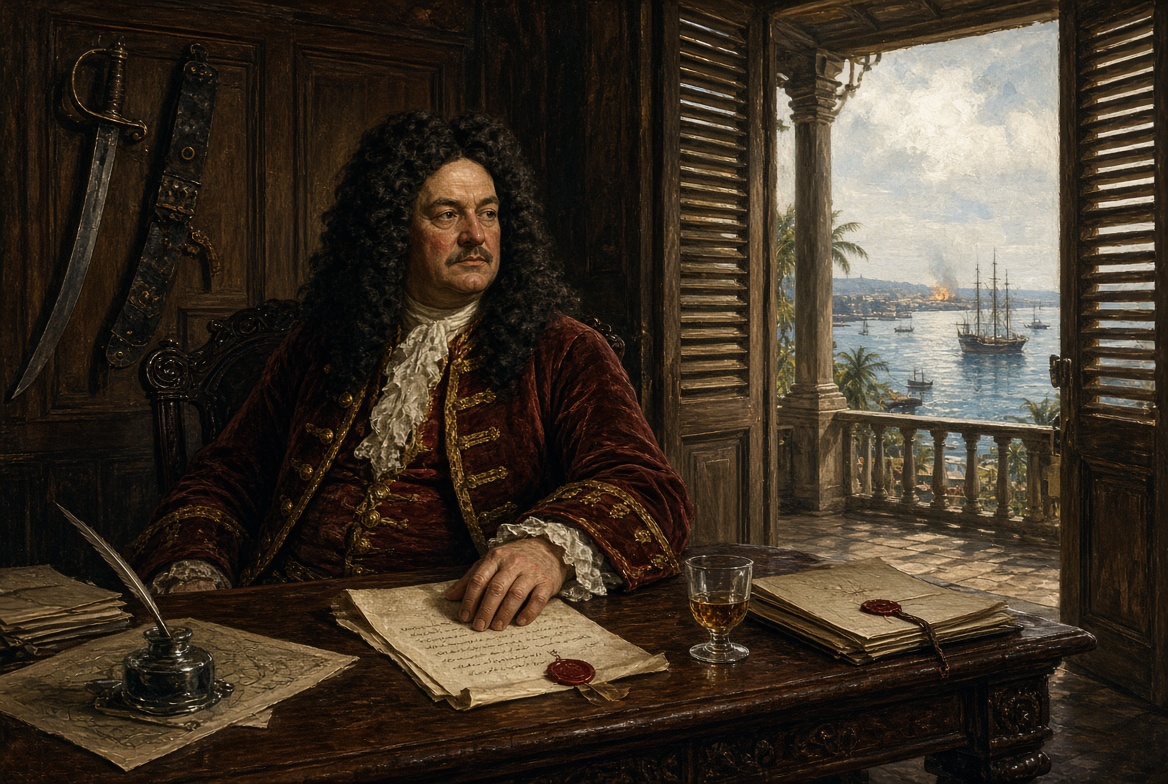
Artist's visualisation. Henry Morgan sacked Panama in 1671 and burned it. England recalled him to London to answer for the raid, then knighted him and sent him back to Jamaica as Lieutenant Governor, where he sat on the bench hanging pirates until he died in 1688, a respectable colonial official. The sword on the wall and the commission in his hand are the same career. The Crown never pretended otherwise.
The Fuggers of Augsburg are where the argument acquires its sharpest single document. Jakob Fugger the Rich, almost certainly the wealthiest private individual in history in relative terms, financed the bribe that made Charles V Holy Roman Emperor in 1519, purchasing the votes of the electoral princes systematically with Fugger capital. When Charles proved slow in acknowledging his obligations, Fugger wrote him a letter that exists in the archives and states plainly that the imperial crown would not have been achieved without Fugger support, that this is commonly known, and that repayment is expected accordingly. This is the earliest explicit documented statement of the relationship between private banking capital and sovereign power that this essay traces across five centuries. The Fuggers also financed the papal indulgence sales whose corruption triggered Martin Luther's 95 Theses, making them the inadvertent co-authors of the Protestant Reformation and the religious wars that killed a third of Central Europe's population. The return on lending money to popes was occasionally catastrophic for everyone except the bankers.
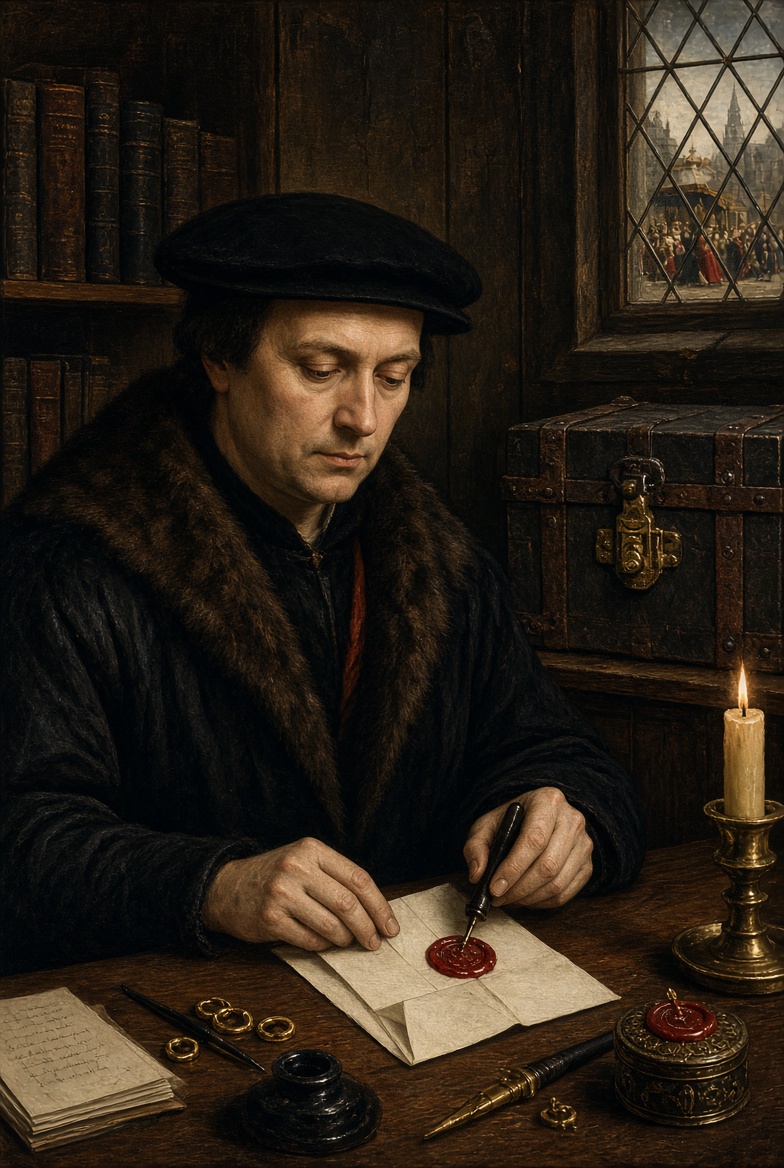
Artist's visualisation. Jakob Fugger seals the letter to Charles V, 1519. It says the crown was bought with Fugger money, that everybody knows it, and that the money is now due. The earliest plain statement in the archives of what private capital expects from a sovereign it has paid for.
The Odescalchi are the structural key to understanding how the medieval Italian banking world produced the Anglo-American financial architecture. Benedetto Odescalchi became Pope Innocent XI in 1676. In 1688 he financed William of Orange's invasion of England, providing the capital that made the Glorious Revolution possible. That revolution produced England’s constitutional settlement of 1689, the Bill of Rights, and six years later the founding of the Bank of England in 1694. The BoE, founded on the template established by the Genoese and Venetian banking houses, became the model for central banking that the City of London then exported to the world. The line from a Lombard banking family producing a pope who bankrolled a Dutch invasion of England to the Bank of England, the East India Company, and the entire subsequent offshore financial architecture is not a loose analogy. It is a documented institutional lineage running in continuous thread across four centuries.
The nineteenth century added new names to the same architecture rather than replacing it. The Rothschild houses spread across five European capitals and made sovereign lending a family business conducted between brothers, which solved the problem of trust across borders that had constrained every banking house before them. The US robber barons, John Pierpont Morgan above all, imported the model wholesale, and when the US decided in 1913 that it required a central bank, the structure was drafted in private at Jekyll Island by a small group of bankers and one senator (Aldrich,) and the institution that emerged was owned by its member banks rather than by the public it served. The Bank for International Settlements followed in 1930, in Basel, Switzerland, chartered to sit above national jurisdiction and answerable to no parliament, which is the Lombard principle in its purest modern form. These names are better known than the ones above, and for that reason less interesting. The point is not that they are new. The point is that they are not.
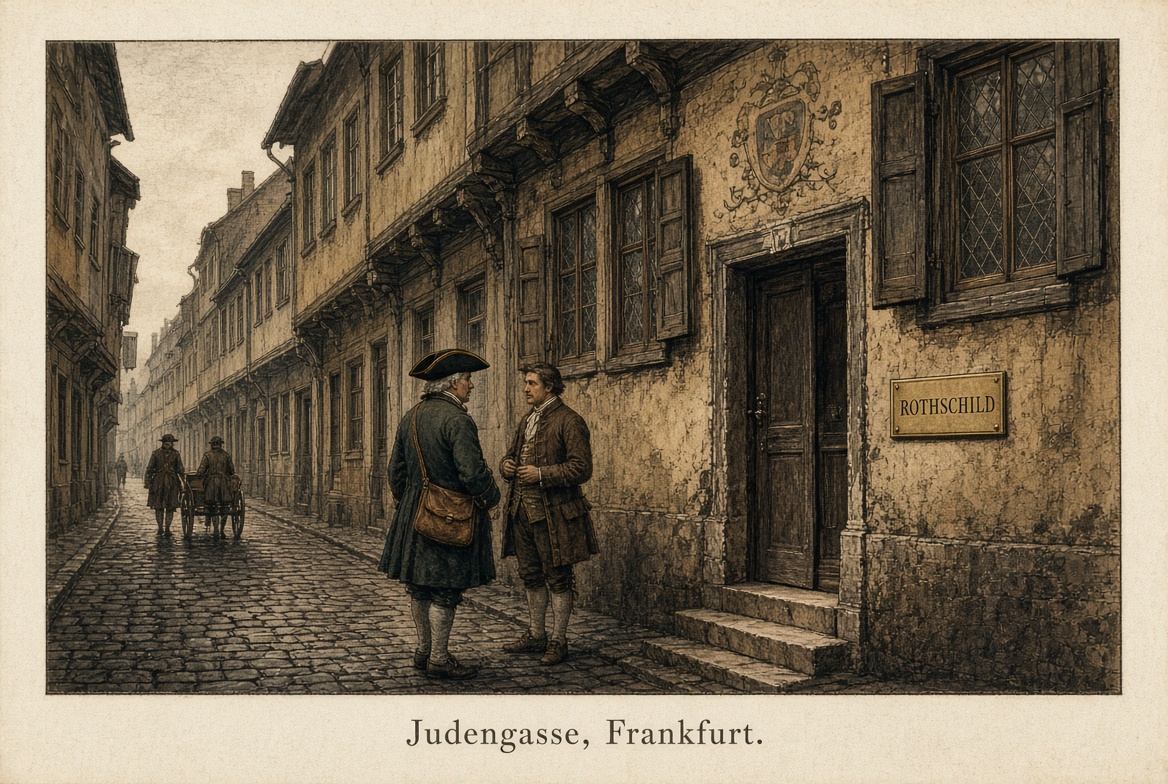
Artist's visualisation, 1784. Credit starts as a sign anyone can read. It ends as a name on a door in a street nobody may leave. When the gate came down, five brothers went to five capitals.
And then the Vatican, which has never been far away from these manifest terrestrial matters of substance.
The Institute for the Works of Religion (IOR), known as the Vatican Bank, operates outside the regulatory framework of every national banking authority on earth. The Vatican is a sovereign state and the bank is its internal financial instrument, answerable to no external audit authority. In June 1982, Roberto Calvi, chairman of Banco Ambrosiano and known in the Italian press as God's Banker, was found hanging under Blackfriars Bridge in London with bricks in his pockets and a false passport. He had been laundering money for the Sicilian Mafia through the Vatican Bank and was a senior member of Propaganda Due, the P2 masonic lodge under Licio Gelli whose 962 documented members included a future Italian president, the heads of all three Italian intelligence services, senior military commanders, judges, and major newspaper editors: a parallel state embedded inside the official one, which is the oldest structure in this essay wearing its most exquisite Italian clothing.
His death was ruled suicide by the first inquest. The second returned an open verdict. Nobody has ever been definitively convicted.
Blackfriars Bridge spans the Thames. Admiralty jurisdiction. The body of God's Banker, found hanging over the river that runs through the heart of the sea-law city, with stones from a jurisdictionless river in his pockets. Some stories write themselves so precisely that the temptation is to suspect they were arranged.
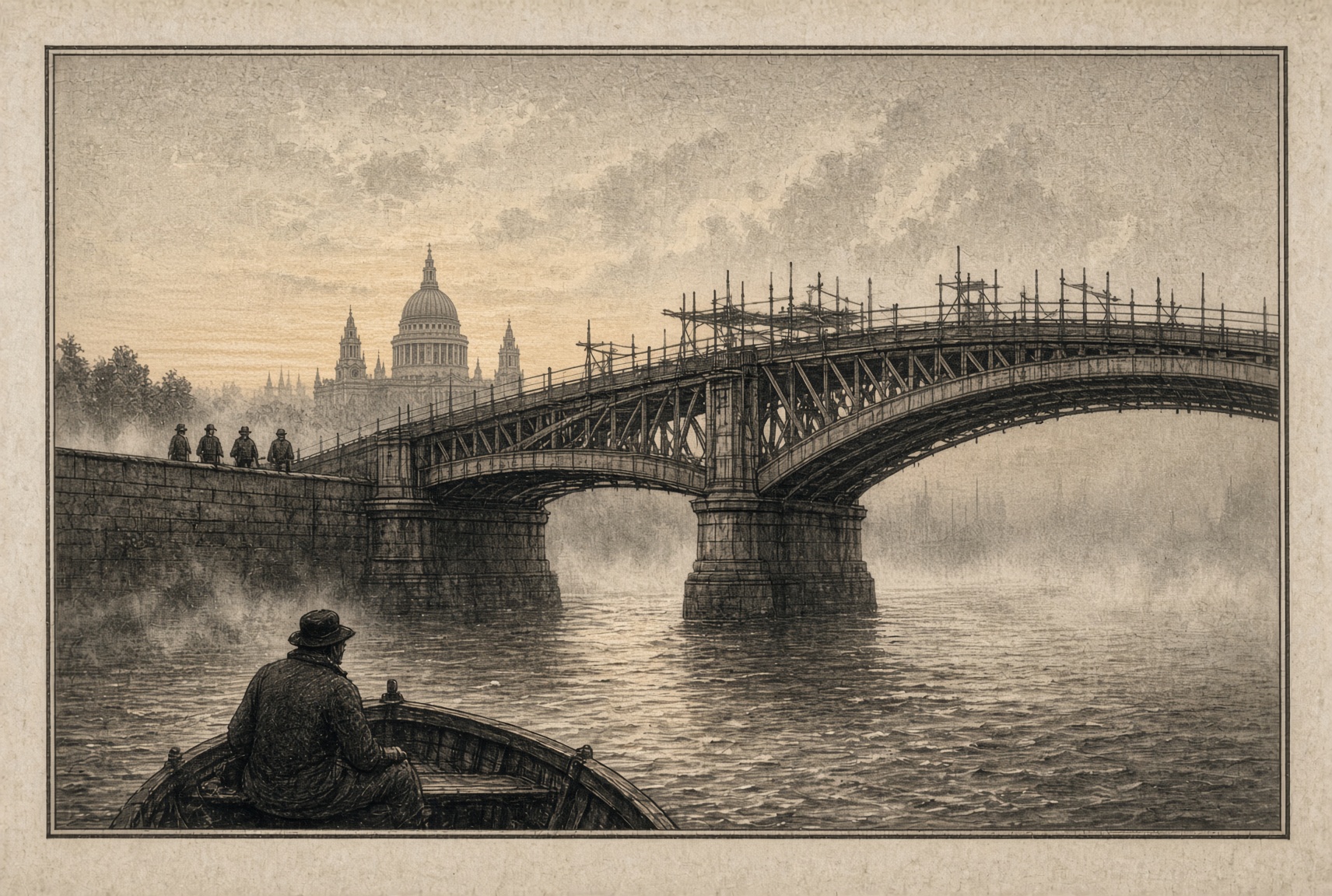
Roberto Calvi, chairman of Banco Ambrosiano, was found hanging under this bridge in June 1982 with bricks in his pockets and a false passport. The first inquest said suicide. The second returned an open verdict. Nobody has been convicted. The bridge spans the Thames: admiralty jurisdiction, the river that runs through the sea-law city.
These are the higher echelons. The Venetian Black Nobility, the families that maintained position through the collapse of the Republic itself and into the modern European order, never needed a conference. Never needed a grading system. Never needed an AI dossier tool. Membership in structures of this depth is inherited or earned across generations or it does not happen. Dialog, for all its operational significance in the present moment, is a recent and visible formation. The families that have held structural power since the medieval period are a different category, and the distinction matters for understanding what the current technocratic convergence actually represents in the longer arc.
At the service layer below those unreachable names, the families that facilitate the movement of power between its permanent holders and its temporary administrators have always paid a heavy price for their proximity. The bin Laden family built Saudi construction infrastructure through closeness to the House of Saud and produced one son who brought the full weight of US military response down on a family name that had nothing to do with his decisions. Power at that level does not protect the families that serve it. It uses them, and when they become inconvenient, it burns them publicly.
The Khashoggis understood this. It did not save them.
II. The Spirit of Exuma
When the thirteen colonies concluded their revolution against the British Crown and the republic began to consolidate, a substantial population faced an impossible choice. The Loyalists, those who had remained faithful to King George III through the war, were not simply on the losing side of a political argument. They were the losing side of a social revolution, and the victors were not forgiving. Estates were confiscated. Prominent Loyalists were tarred and feathered.
Between 1783 and 1785, approximately sixty thousand Loyalists left the former colonies. Many went to Canada. A significant number, perhaps eight to ten thousand, sailed south into the Caribbean and the Atlantic island chains, accepting Crown land grants in the Bahamas, the Turks and Caicos, and the lesser islands of the Lesser Antilles. They brought their slaves, their furniture, their seeds, and their loyalty to a Crown that had already effectively abandoned them, and they settled in places that were, by any practical measure, outside the jurisdiction of the world they had left.
The Exumas are a chain of three hundred and sixty-five cays stretching southward through the Bahamas. The Loyalist settlers who arrived in the 1780s built their plantations, lost them to soil exhaustion and the abolition of slavery, and settled into a different existence: chicken farming, fishing, small-scale agriculture, and the trade that the geography naturally encouraged, which is to say contraband, smuggling, and the thousand varieties of commerce that flourish in the spaces between jurisdictions. They were living, without theorising it, inside the oldest operating principle of Anglo-American commercial expansion: the space between sovereign territories is where the real business happens, and the people who know how to operate in that space hold a structural advantage over those who do not.
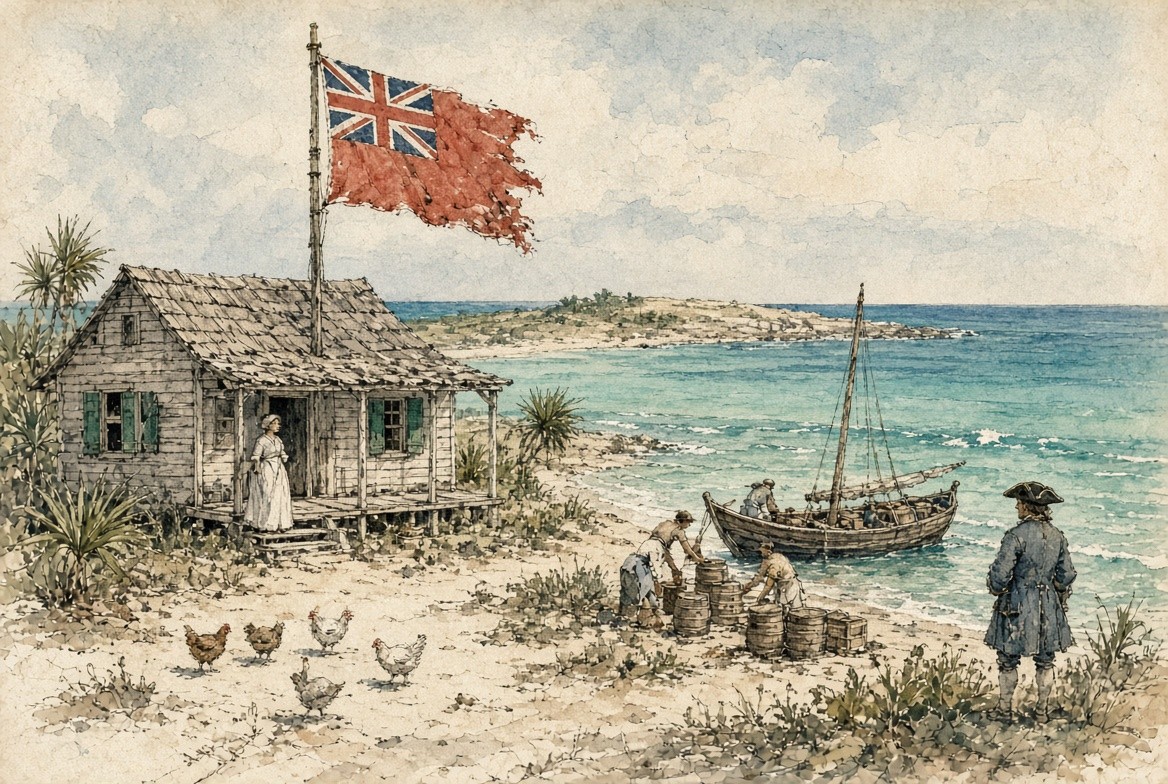
Artist's visualisation, circa 1790. The good subjects of King George III, dumped on a sandbar with a Crown land grant, a dead flag and whatever they could carry out of a country that wanted them tarred. The soil went in twenty years. Abolition finished the rest. What was left was chickens, conch, and three hundred and sixty-five cays that God appears to have designed for the express purpose of losing things in.
So they lost things. They wrecked ships onto the reef and salvaged them before the screaming stopped. They ran cargo ashore at night on beaches no customs man could find with a chart and a week to spare. They got very good at the difference between what a ledger says and what a hull contains. A century later their grandchildren ran rum into Florida for thirteen years of Prohibition and made more money than the plantations ever did.
Then they came home. Quietly, one family at a time, into the country that had run them out, carrying the only inheritance that survives salt: sovereignty is a negotiation, the gap between two flags is where the money lives, and the sole difference between a smuggler and a broker is who files the paperwork. Wall Street did not teach them a thing. They arrived fluent.
They lived there for two centuries. Their descendants slowly merged back into the US system, carrying the habits of mind that two hundred years of jurisdictionless existence produces: a fluency with the gap between law and practice, an understanding that sovereignty is a negotiated rather than an absolute condition, a relationship to official structures that is instrumental rather than reverent. The spirit of Exuma is not a metaphor for offshore finance, though it accommodates it. It is a disposition toward the space between sovereignties that shaped the Anglo-American order before the republic existed and continues to shape it now.
Epstein's island in the Exumas was not located there by accident. The Bahamas is a Crown dependency whose legal structures make it specifically resistant to US regulatory and judicial reach. But the deeper point is not about Epstein. It is about the operating environment's continuity. The Loyalist settlers of the 1780s, the offshore financial architecture of the twentieth century, and the intelligence networks that use Caribbean jurisdictions as operational space are all expressions of the same logic. Power operates in the gaps. The gaps are where sea law runs.
III. The Sea-Law Spine
There is a constitutional secret at the heart of the Anglo-American order hiding, as the best secrets do, in plain sight. The architecture of five centuries of Western commercial and imperial expansion has never operated primarily under the law of the land. It has operated under admiralty and maritime commercial law: the law of the sea, the law of vessels in the High Seas, the law of corporate persons and contract that supersedes the rights of natural persons wherever commerce crosses sovereign boundaries.
The City of London is not subject to the same law as the rest of Britain. It has its own Lord Mayor, its own police force, its own constitutional framework derived from commercial and admiralty precedent, directly descended from the Lombard banking houses that established themselves on that street in the thirteenth century. Parliament can legislate for England. It cannot simply legislate for the Square Mile without the City's consent. This is not historical curiosity. It is the operational heart of the financial architecture that ran the British Empire.
The East India Company did not operate under British common law. It operated under royal charter, the instrument of admiralty jurisdiction. The Company governed territory, raised armies, collected taxes, fought wars, and signed treaties with foreign powers without the constitutional accountability that land law requires. It was, precisely, a vessel: a corporate person operating in jurisdictionless waters between sovereignties, accountable to no court a natural person could access.
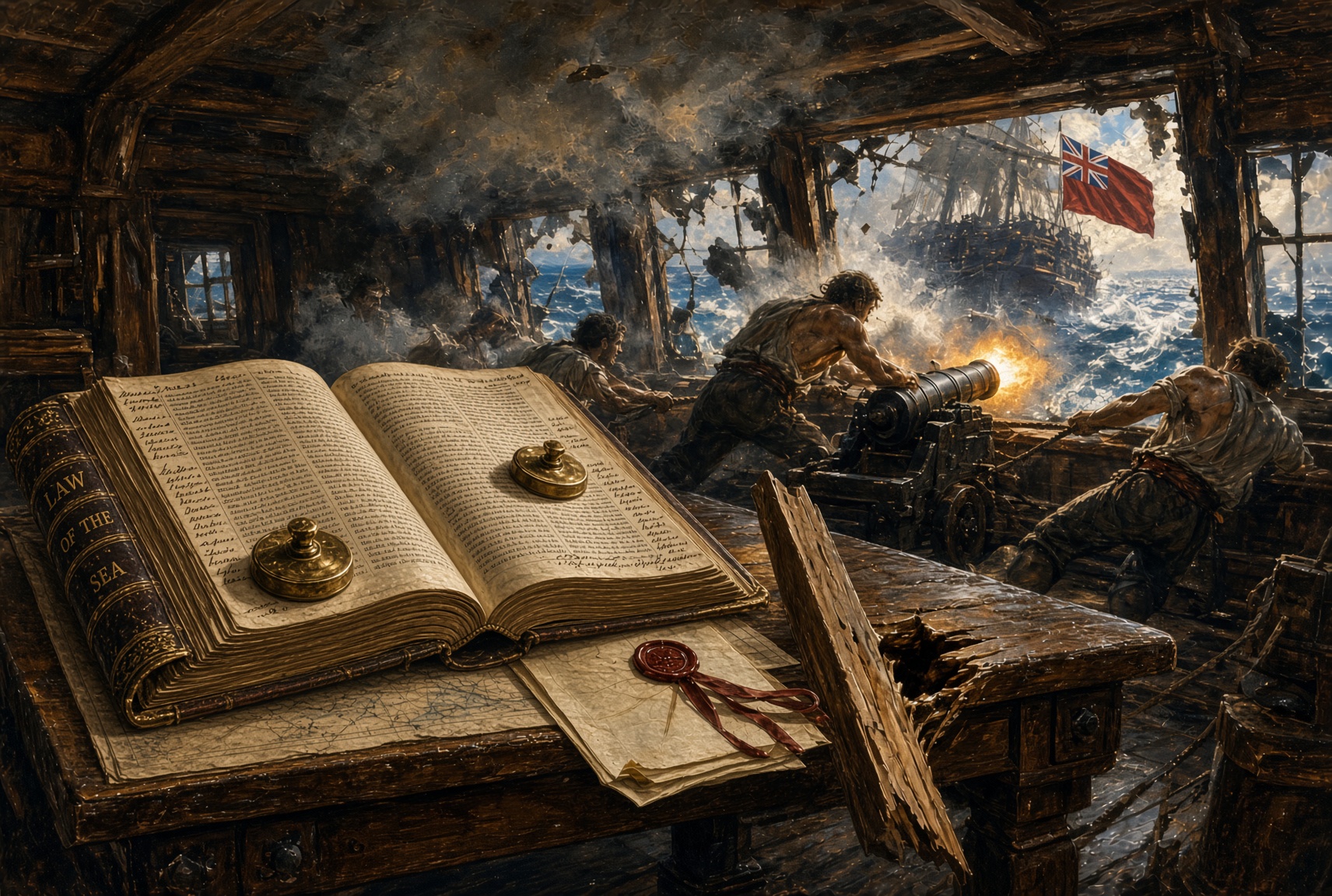
Artist's visualisation. An East India Company ship engages a three-masted opium carrier flying colours she has no right to. Flying false colours was routine and lawful right up to the moment of firing, when custom required the true ensign to go up. That is where the phrase comes from. The men on the gun are settling a question the book on the table has already answered: a vessel carries the law of the flag she flies, not the law of the water beneath her. The charter raises the armies, collects the taxes and signs the treaties. The guns enforce what the charter says. Neither answers to any court a natural person can reach. Three centuries on, the vessel is a holding company, the flag is a jurisdiction chosen for its tax treatment, the cabin is an office nobody is required to visit, and the false colours are hoisted at a company registry office.
The thirteen colonies were a maritime commercial project administered through chartered companies and admiralty courts, financed from the City of London, governed by instruments of corporate rather than parliamentary law. The US Declaration of Independence was a land-law revolt against a sea-law empire. The empire lost the colonies and never conceded the underlying architecture. It relocated it offshore, into treaty structures, financial instruments, and Commonwealth arrangements that preserved the monetary and legal relationships after formal political sovereignty was surrendered. When Barings and Hope & Co of Amsterdam arranged the bond financing that allowed the United States to pay Napoleon for Louisiana in 1803, providing the capital that doubled the republic's territory, they were not acting patriotically or anti-patriotically. Capital has no flag. It has only a rate of return, and the sea-law city provided both sides of the transaction with what they needed. That is the principle in its most naked expression.
Offshore financial centres, free ports, special economic zones, flags of convenience, the Cayman Islands and British Virgin Islands operating outside parliamentary oversight while inside the Crown's financial architecture: these are not anomalies in the system. They are the system, running the same admiralty logic the East India Company ran, with the clothing updated.
The largest offshore jurisdiction on earth is not an island. Delaware has fewer than a million residents and is the legal domicile of more than two thirds of the Fortune 500, with over a million registered entities sharing a single address on North Orange Street in Wilmington. Its Court of Chancery has sat since 1792, without a jury, deciding corporate disputes and nothing else, which is the actual product: not low tax but predictable law, made by judges who have done nothing but this for two hundred years. The Cayman Islands learned it from somebody.
A consulate is not a building on foreign soil that happens to fly a flag. Under the Vienna Convention and the admiralty traditions that precede it, a consulate is extraterritorial sovereign space, a vessel that does not float, governed by the law of the flag rather than the law of the land on which it sits. When Saudi journalist and Washington Post columnist Jamal Khashoggi walked through the doors of the Saudi consulate in Istanbul on October 2, 2018, he crossed a jurisdictional threshold that his Turkish fiancee, waiting outside under Turkish law, could not cross with him. He entered a vessel. He never walked out.
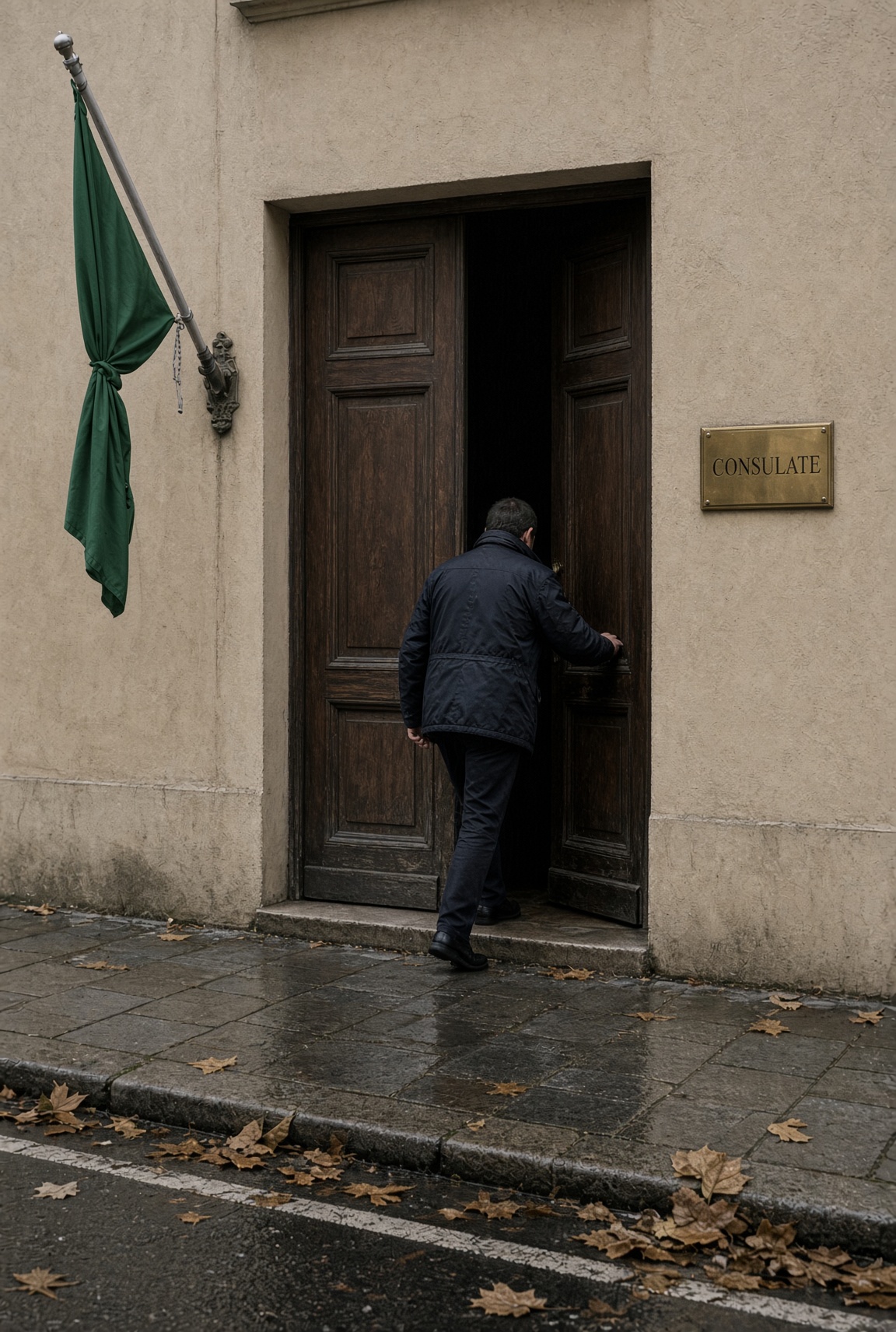
Istanbul, 2 October 2018. A consulate is not a building on foreign soil that happens to fly a flag. It is extraterritorial sovereign space, a vessel that does not float, governed by the law of the flag and not the law of the ground it stands on. The pavement is one jurisdiction. The step is another. He went in to collect a document he needed in order to marry.
IV. The PROMIS Template: Maxwell, Moscow, and the Floating Archive
Robert Maxwell was born Jan Ludvik Hyman Binyamin Hoch in a Carpathian shtetl in 1923. He survived the Second World War through means that remain partially classified, served in British Military Intelligence in occupied Germany in the immediate postwar period, and emerged from that experience with a complete education in the operational uses of information, institutional access, and the moral flexibility that intelligence work requires and produces.
Pergamon Press, which Maxwell built into a major academic and scientific publishing house from the early 1950s, performed multiple functions simultaneously. It was a legitimate and commercially successful publisher at a moment when postwar university expansion created enormous demand for exactly that product. It was also, as subsequent investigation established, one of the primary channels through which the Soviet Union financed the Western European communist parties during the Cold War. The revolving door between Moscow, the Western communist parties, British intelligence, and the international publishing world that Maxwell embodied was the operational environment of the Cold War's cultural front, and Maxwell was its most flamboyant commercial practitioner. Whatever his evolution into a man of baroque personal appetites and spectacular financial criminality, his ideological origins were genuine: he had come from exactly the Central European Jewish poverty that the communist movement had offered the most coherent answer to, and that thread was probably never entirely severed. The profit motive and the idealist reflex ran together in Maxwell throughout his career, which made him simultaneously useful to multiple patrons and ultimately trustworthy to none.
The vessel he operated from in his final years was named the M/Y Lady Ghislaine, after his daughter. It had been built originally for Emad Khashoggi, grandson of Muhammad Khaled Khashoggi, personal physician to King Abdulaziz ibn Saud, founder of modern Saudi Arabia, and nephew of Adnan Khashoggi, the arms dealer whose fortune was built on brokering deals between Riyadh and Washington, and involved in the infamous Iran Contra operation. The vessel that had been built for the Khashoggi family was sold off and became Maxwell's operational base, and from it he conducted the distribution of what became the most consequential surveillance software of the twentieth century.
In 1982 the US Department of Justice stole a database programme called PROMIS from a small Washington company called Inslaw, modified it with a covert surveillance backdoor, and began distributing it internationally through Maxwell. PROMIS was sold as a legitimate case-management tool. Governments and intelligence agencies installed it because it worked. They simultaneously opened their most sensitive databases to whoever controlled the backdoor. The methodology was replicable and has been replicated continuously: develop a product that targets adopt voluntarily because it serves their interests, embed the surveillance function invisibly, distribute through commercial channels. The most effective surveillance infrastructure is the one its targets install themselves.
Maxwell's FBI file has grown progressively more classified over time. More redacted in 2013 than in 1994. More redacted in 2017 than in 2013. Progressive reclassification is the signature of active suppression, not passive archiving. The file is still being worked more than thirty years after Maxwell went over the side of his own yacht.
He went into the Atlantic off Gran Canaria on November 5, 1991, after demanding in the order of four hundred million pounds from Mossad for his continued silence about the full scope of what he had done for them. They declined. The pension fund scandal that dominated subsequent coverage consumed all the available oxygen and the intelligence architecture underneath was never forensically examined. The Israeli government flew his body to Jerusalem. The Prime Minister attended the burial on the Mount of Olives. Multiple serving and former Mossad chiefs were among the pallbearers. You do not get buried on the Mount of Olives with Mossad chiefs carrying your coffin because you ran a newspaper.
The PROMIS template did not end with Maxwell. The Clipper Chip in 1993 attempted to embed the same logic into the encryption standard itself. Public revolt killed the proposal. The intent migrated into Carnivore, the FBI's deep packet inspection system running at the ISP layer in the late 1990s. After 2001, PRISM formalised the harvesting of the social graph through the platform companies, operating under terms of service contracts rather than constitutional law. Sea-law governing land-people because they clicked the form.
Pegasus closed the circle. Developed by the Israeli company NSO Group, sold globally as a counter-terrorism capability, it was used against journalists, opposition politicians, and one Saudi journalist named Jamal Khashoggi, nephew of Adnan Khashoggi, first cousin of Dodi Fayed, grandson of the physician to Ibn Saud. He was tracked to his death inside a consulate in Istanbul by software that was the direct methodological descendant of the programme distributed from the deck of the yacht named after the daughter of the man who sold it. The deck of a vessel originally built for his family. The world is not large.
Same as it ever was.
V. The Darwin Machine
The operation that Jeffrey Epstein ran for the better part of three decades is most commonly framed as predation. The framing is not wrong. It is incomplete.
What Epstein ran was relationship infrastructure: talent spotting, network mapping, and compromising material collection running simultaneously against the same targets, deployed in the service of interests that have never been fully attributed. He was not the architect of that infrastructure. He was a wide boy with extraordinary social gifts and a financial background that does not withstand scrutiny, recruited into an operational role by a network whose principals have remained largely invisible throughout the story's public life.
What made the operation function at the level it did was not primarily coercion. It was the logic of consensual self-blackmail. The entrapment was, to a very large degree, self-administered. The island, the residences, the cameras: these were not a trap sprung on unsuspecting powerful men. They were an initiation. The price of admission to the circle that Epstein mediated was making yourself vulnerable to the circle. You joined by providing the leverage. The membership fee was the compromising material, paid knowingly, because the access was, apparently, worth the price and because remaining outside a network quietly restructuring the world you operated in was the less attractive of alternatives.
Kompromat collected under those conditions does not require deployment to function. The knowledge that it exists, held by an unknown party, is sufficient to produce compliance indefinitely. Once built, a blackmail architecture of that quality is permanent infrastructure. It does not die with its operators.
The disposal of Maxwell and Epstein was not a failure of the system. It was the system functioning as designed. Individual operators are processed when the cost of maintaining them exceeds their operational value. Maxwell's demand for four hundred million pounds shifted that calculation immediately. Epstein's political exposure made continued protection more costly than disposal or even perhaps extraction. What the system required was not their survival but the survival of the archive and the continuity of the method. The archive transferred to new custody before the disposal was complete. It remains there.
Ghislaine Maxwell currently resides in a minimum-security camp in Bryan, Texas, transferred there after a two-day private interview with the Trump administration's Deputy Attorney General. She has filed legal petitions naming twenty-five high-profile men who made secret settlements with victims. She is not a prisoner seeking justice. She is an asset negotiating the terms of her continued silence.
This is the pyramidal Darwinian logic running underneath all of it. The system selects for its own perpetuation, not for the perpetuation of any individual node. The families that serve power at sufficient proximity know this or learn it at personal cost. Power at that level does not protect you. It uses you, and when you are no longer useful, it marks you surplus to requirements and proceeds.
The Dialog network is the current iteration of the same architecture in updated form. The physical infrastructure of islands and cameras has been replaced by data infrastructure that is cheaper, more scalable, and leaves less forensic trace. The AI dossier tools Dialog uses on its members are the Epstein operation running at scale and speed, without the logistical overhead and without the physical vulnerability that exposed the previous generation's method. The Virginia campus near Langley that Dialog has been acquiring land to build is the institutional consolidation phase: the transition from nomadic private retreats to permanent infrastructure in the immediate geography of the US intelligence community. The praetorian guard is building its barracks.
VI. The Agoge and the 700-Year Question
The claim that the technocratic convergence represents a Spartan succession to the failing Athenian democratic model requires that we understand what Sparta actually was, which its contemporary admirers consistently fail to do.
Athens in its decline is easy to diagnose. After Pericles, the demos voted for the Sicilian Expedition over the explicit warnings of Nicias, who they simultaneously elected commander on the theory that appointing a sceptic would moderate the disaster of the policy. They executed Socrates. They handed themselves first to Sparta and then to Macedonia. The institutions survived the defeat but had ceased to function as instruments of governance before the final surrender. The partitocracy that characterises contemporary Western democracy, parties that stopped being vehicles for representation and became self-perpetuating extraction machines, is Athens after Pericles in its essential dynamic: the shell of the institution persisting after the civic substrate that made it function has been consumed.
Sparta's 700 years of constitutional stability were not produced by military organisation. They were produced by the Agoge.
The Agoge was Sparta's system of collective formation, and what made it structurally distinctive was not its harshness alone but its universality and its self-application. Every male Spartan citizen of the warrior class went through the same formation. The sons of kings went through it. There was no exemption for wealth or family connection. Boys were taken from their families at seven and entered a collective formation system that ran until thirty. They slept in the open. They were deliberately underfed and expected to supplement their diet by theft, with punishment not for stealing but for being caught. They underwent ritual flogging competitions to test endurance without visible distress. They were formed not merely in warfare but in music, poetry, and the political and ethical culture the city required of its citizens.
The result was a citizen class that shared a genuinely common formation. Not an ideology imposed from above but a common experience of hardship and mutual dependency that had been lived rather than professed. The trust this produced within the Spartan citizen body was real and durable in a way that no purely ideological formation produces, because it was grounded in the shared fact of what each Spartiates had actually done and survived. This is what produced the 700 years.
And then they could not stop.
There was no second gear. No institutional pathway toward a less demanding mode of existence, because mellowing was coded as the first step toward the weakness the Agoge was designed to eliminate. The system optimised so completely for one condition, the condition of existential military and civic pressure, that it lost the capacity to function in any other. The birthrate among Spartiates collapsed because the formation demands made family life secondary. The helot population, the enslaved Messenians who outnumbered the Spartiates by perhaps seven to one and whose labour was the economic foundation of the entire system, was managed through institutionalised terror but never resolved, because resolution would have required the Spartiates to become something other than what the Agoge had made them. Epaminondas broke the myth at Leuctra in 371 BC with a tactical innovation that Spartan military doctrine had made structurally impossible to adapt to. After Leuctra it was over.
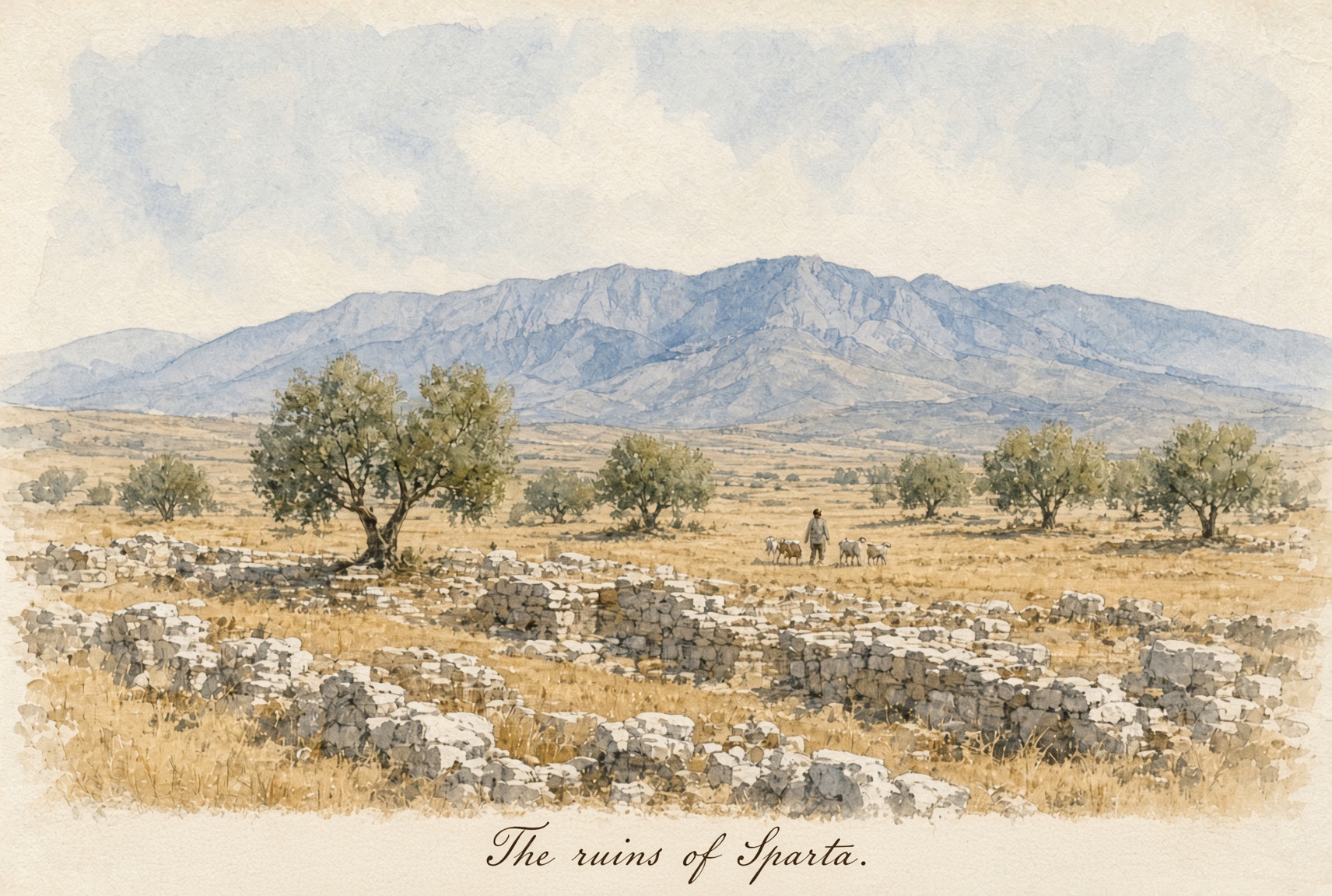
Seven hundred years of constitutional stability, and this is the estate. No columns, no forum, no monuments. The most complete institutional self-application in ancient history left less standing than the cities it defeated. Sparta harshed itself out of existence.
Sparta harshed itself out of existence. That is the precise formulation. Not conquered before it was ready. Not undermined by external subversion. It applied its own formation logic so completely and for so long that it consumed the demographic and adaptive capacity required for survival in a changing world. The most coherent institutional self-application of a single governing principle in ancient history, and it killed itself with it.
Now consider the Dialog membership list.
The people proposing the Spartan model as the honest alternative to Athenian democratic failure have not been to the Agoge. They grade each other for desirability on a database. They score members from one to four on value added to the network. They take tours of the Guinness Storehouse. They run matchmaking services for the single among their number. The session titled Build-a-Cult is moderated by the founder of a Christian networking website. These are not people who have submitted themselves to collective formation through shared hardship. They are people who have insulated themselves, with great thoroughness and at considerable expense, from the application of any principle they propose for others.
Both models ran themselves out of existence, and the thing neither tried is the responsible individual: educated, answerable for his own governance, in a state small enough to be watched, with office by rotation and constant audit. That is the opposite of the Jacobin instinct, which needs the masses moved as one addled beast, steered by fear and doubt and kept ignorant above all.
The one arrangement none of them has ever shown the least interest in is the citizen state: a well educated and responsible individual who knows the law, understands his duties, serves in a rotating office rather than a lifelong career, stays awake, and defends the res publica against all enemies foreign and domestic under a living constitution that is worked rather than worshipped. A civil compact between citizens, not a hierarchy above them.
What they are proposing is not the Agoge. It is the helot economy with a Spartan flag over the barracks. The harshness, to whatever degree it exists in the programme, is for the people outside the directory. The people inside have arranged their comfortable permanent exception.
The genuine Spartan claim would require Peter Thiel and Scott Bessent and the NATO Supreme Commander and the Google executives to submit themselves to the same formation they propose for the civilisation they intend to manage. The Agoge produced civic equality within the formation class through shared experience of hardship. What Dialog produces is a graded hierarchy of access and influence, maintained through relationship infrastructure and compromising material logic updated for the digital environment. Athens at least was honest about what it was.
VII. Baked Alaska and the Coming Consolidation
On March 30, 1867, US Secretary of State William Seward signed the treaty purchasing Alaska from the Russian Empire for 7.2 million dollars, approximately two cents per acre. The American press called it Seward's Folly. Seward's Icebox. A frozen wasteland of no conceivable value. The mockery was sufficient that Charles Ranhofer, the French chef at Delmonico's restaurant in New York, created a dessert in honour of the acquisition: a hot exterior over a frozen centre, sweet on the outside, cold at the core. He called it Baked Alaska. It is still on menus.
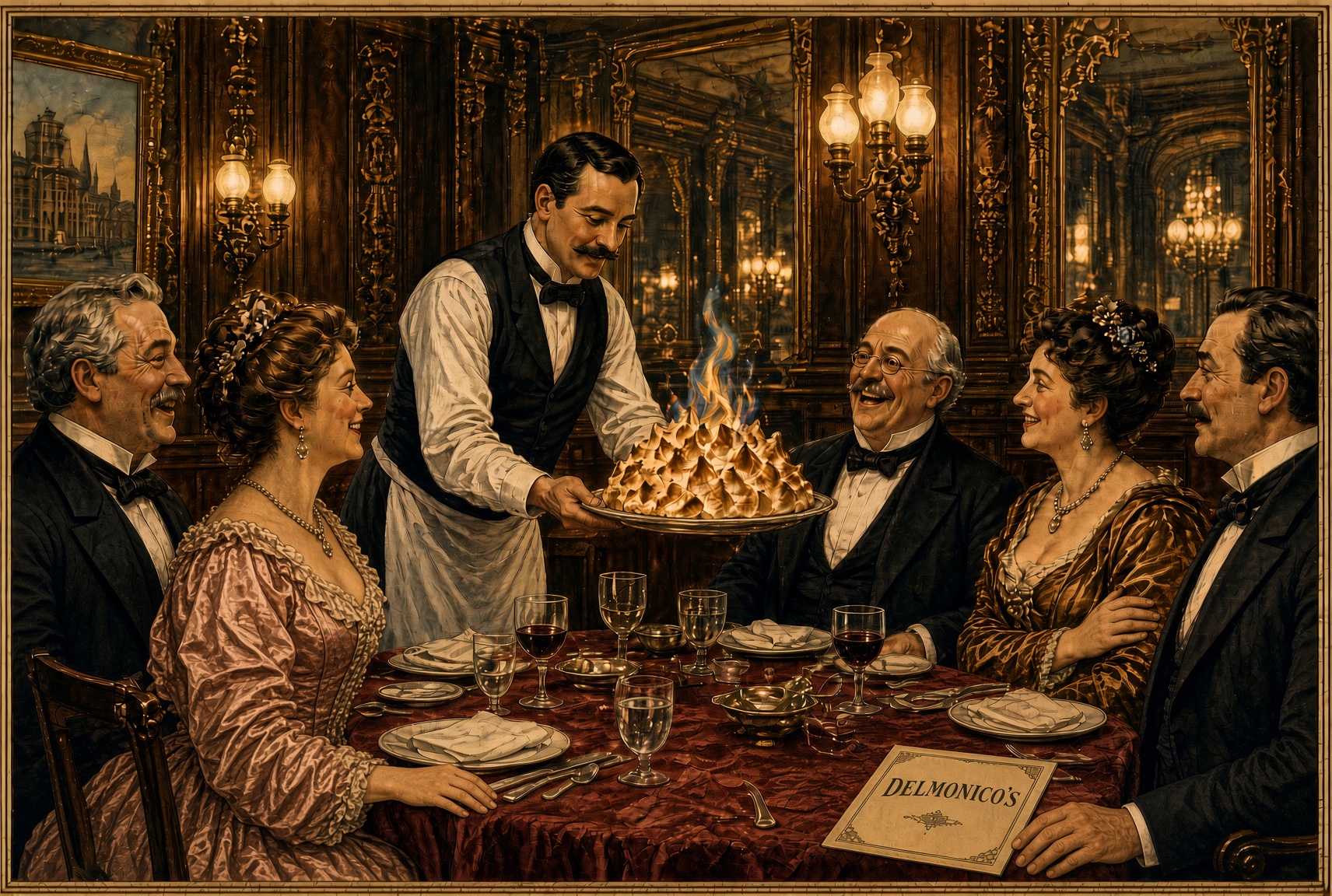
Delmonico's, New York, 1867. Charles Ranhofer created the dessert to mock Seward's purchase of a frozen wasteland at two cents an acre. Hot outside, cold at the core. The joke is still on the menu. The template is still running: acquire non-contiguous territory by transaction rather than conquest, and let the frivolity of the moment cover the strategic seriousness of the move.
The purchase was not folly. It was the template. A continental power acquiring non-contiguous territory by commercial transaction rather than military conquest, extending the sea-law empire's reach without the friction of war, securing strategic geography and resource wealth for a price that seemed absurd to contemporaries and looks like theft in retrospect. The frivolity of the cultural moment, the jokes, the dessert, masking the strategic seriousness of the move. This is how the method works when it is working well.
The template is running again.
Greenland sits at the intersection of the Arctic passage, which is opening as the polar ice retreats, and the strategic approaches between the Atlantic and Pacific. Its mineral wealth, including rare earth deposits that the current industrial transition requires in quantities that no existing supply chain can provide, is extraordinary. Its population is fifty-six thousand people. Its formal sovereignty rests with Denmark, a NATO member whose defence relationship with the United States makes any meaningful resistance to Washington's strategic intentions ceremonial rather than substantive. The public statements about purchasing Greenland or acquiring it as the 51st state are not the policy. They are the negotiating position before the policy, which is effective strategic and economic absorption on terms that make formal Danish sovereignty a flag without a hull.
Alberta is the energy architecture. The Canadian province holds the third-largest proven oil reserves on earth, a Conservative-governed territory with a political culture closer to Texas than to Ottawa, increasingly hostile to a federal government it regards as ideologically captured and economically destructive. A referendum on joining the United States, or on some form of formal economic integration short of that, is no longer an abstract speculation. It is a live political conversation in a province whose energy wealth makes it strategically essential to a US that is resolving the question of hemispheric resource independence as a matter of national security rather than economics.
Alberta folding into the Union by referendum would accomplish three things simultaneously. It would seal the financial and resource foundation of the consolidated Spartan Americas. It would complete the effective liquidation of the pro-Chinese Canadian federal state, whose Confucius Institute network, whose Pacific-facing trade policy, and whose demographic and immigration architecture have made it, from Washington's strategic perspective, a soft-power asset for Beijing operating on the northern border. And it would remove the last significant gap in the territorial and resource consolidation of the Western hemisphere before whatever comes next.
The Spartan US state will not tolerate that network on its doorstep. The domestic Confucius network, embedded in universities and cultural institutions across the country, is the parallel intelligence and influence architecture that any serious Spartan formation addresses before it addresses anything external. Securing the Americas from enemies domestic and foreign is not a slogan in this configuration. It is the operational prerequisite for everything else.
Russia's role in this architecture is widely misread, and the misreading serves no analytical purpose. Russia spent two decades after the Cold War actively and repeatedly requesting Western integration. Gorbachev proposed the common European home. Yeltsin inquired about NATO membership directly. Putin, a graduate of the World Economic Forum's Young Global Leader programme and a figure whose formation was in significant part shaped by the same transnational technocratic infrastructure as the Blair and Merkel generation, asked Clinton directly in his first year in office about the possibility of NATO membership. Russia was admitted to the G8. Putin sat at Davos. Every approach was met with systematic rebuffing and simultaneous eastward expansion of the alliance Russia was asking to join, on terms that made Russian membership structurally impossible while using Russian interest in membership as leverage.
Ukraine forced the resolution. Putin's formation pulled in two directions simultaneously, the WEF-compatible integrationist and the siloviki-answerable Russian security nationalist, and the siloviki (Men of Steel) collectively lost patience. The Ukrainian situation was metastasising into a NATO membership trajectory that the Russian military and intelligence establishment had identified as an existential boundary condition. Putin dragged his feet precisely because his formation made decisive action against the Western project he had been trained to join genuinely difficult. The siloviki read the hesitation as weakness compounding the strategic danger and demanded the termination of the Ukrainian EU Frankenstein before it became a NATO Frankenstein on the Russian border. His cover is not blown, but the trajectory is visible.
Russia's actual strategic interest is not integration into the Western order. It is recognition of a sphere of influence, a buffer, and the right to sell energy to whoever pays. The consolidated Americas framework suits Moscow's interest precisely because it removes NATO expansion pressure, the primary Russian security concern since 1991, while leaving Eurasia to its own devices. Ivan does not want in. Ivan wants to be left alone in his own yard, which is a fundamentally different disposition from the hostile expansionism that Western strategic communication has required it to be.
Spain is the EU carcass in microcosm and the most instructive European case study available. It is not a country in political difficulty. It is a sovereign entity being liquidated simultaneously from multiple directions: Anglo-American financial and intelligence penetration running through the structures established during the transition from Francoism; French and German institutional absorption through EU mechanisms that have progressively transferred economic and regulatory sovereignty to Brussels and Frankfurt; Moroccan demographic and political pressure on the southern frontier that successive Spanish governments have managed as a bilateral issue rather than as the strategic operation it structurally resembles; and an internal political class either captured by or actively serving those external interests, as the Teresa Ribera trajectory, the Zapatero-era infrastructure decisions, and the judicial investigations now surrounding Pedro Sánchez, his family, several of his ministers and his party demonstrate. What those investigations are describing is not a series of scandals. It is a criminal network. Time will tell. Any Ibero-American project originating in Madrid is a pipe dream not because the cultural and linguistic connection is weak but because the entity that would need to lead it no longer controls its own energy policy, its own border, or its own judicial appointments. Spain as a royal project, as a civilisational proposition with hemispheric reach, is over. The liquidation is not coming. It is running.
The EU itself functions in the emerging order as a managed consumer dependency: demographically declining, industrially hollowed by the energy price consequences of its own strategic choices, militarily dependent on US security guarantees it has chronically underpaid for, and politically fragmented to the degree that no coherent strategic response to any of the above is structurally possible. Its function is as a consumer market and a manufacturing sub-contractor for the consolidated Americas on one side and the Chinese industrial complex on the other. The managed dependency is already the reality. The current decade is producing its formal acknowledgement.
China is the pressure that justifies the entire formation. The existential peer competitor whose industrial scale, whose demographic depth, whose Belt and Road infrastructure reach, and whose patient multi-generational strategic culture represents a genuine civilisational challenge to the Anglo-American sea-law order. The Spartan Americas consolidation, the Greenland and Alberta acquisitions, the liquidation of soft-power Chinese assets in the Western hemisphere, the managed containment of Russia: none of this makes strategic sense except in relation to the question of which civilisational model organises the next century. That question is the engine driving everything else.
THE BELL
On 28 April 2026, in white tie, in the East Room, the King of England handed the President of the United States a brass bell.
It came off the conning tower of HMS Trump, a T-class submarine launched in 1944, and it is inscribed with her name and the year. The official description calls it Admiralty-pattern. Nobody had to reach for the word. It was in the press release.
Charles delivered it with a line: should you ever need to get hold of us, just give us a ring. Earlier, answering the President's remark that Europe would be speaking German without the United States, he had offered the other half: dare I say that, if it wasn't for us, you'd be speaking French. Then he went to the Capitol and addressed a joint meeting of Congress, the first British monarch to do it in more than thirty years. In September 2025, at Windsor, the Crown had presented the same President with a hand-bound volume from the Royal Bindery celebrating the 250th anniversary of the Declaration of Independence. The document that severed the connection, tooled in leather, as a memento.
Consider what the object is. A vessel's bell is what a vessel is identified by and mustered to. HMS Trump was the last Royal Navy submarine stationed in Australia and left on 10 January 1969, when the Australians took the station over. She was broken up at Newport, in Wales, beginning 1 August 1971, fifteen days before Nixon closed the gold window and ended the last formal link between the dollar and gold. Two things scrapped in the same fortnight, one of them a hull.
There is a concept in circulation that the current administration is dismantling the postwar arrangement, that admiralty and the City and the whole globalist superstructure are being called out at last. The record does not support it. What is apparent is the end of the multilateral layer: the WHO, the Paris climate accord, the WTO left toothless, tariffs in place of trade rules, Munich Security. That is the trimmings, not the nitty gritty.
The nitty gritty is being taken over, not taken down. Stablecoin legislation builds a dollar rail that avoids correspondent banking, which is the City's actual trade. Delaware and Wyoming do domestically what Cayman was built to do offshore. Palantir is the chartered company with a data centre: a corporate person exercising state functions, contracted to the intelligence apparatus, accountable to no court a natural person can reach. Every element is the East India Company's instrument with its clothing updated, which is the sentence this essay has repeated since the thirteenth century.
The debt is only an arrangement if somebody keeps rolling it. Foreign holders carry roughly a quarter of the marketable Treasury stock, and the two largest are Japan and the United Kingdom, both security dependencies, both holding over a trillion each. The EU holds through Belgium, Luxembourg, Ireland and the Cayman conduits. None of this is charity. A state that cannot defend itself buys the paper of the state that defends it and calls the transaction a reserve policy. That is what tribute looks like when it is booked as an asset.
Energy is the other leg, and the position is stronger than the debt. The US is the largest oil and gas producer on earth and now the largest exporter of liquefied natural gas, and Europe arrived at that dependency by its own hand. Nord Stream lies on the seabed, Russian pipeline gas is gone from the German industrial base, and the replacement arrives by ship at a price set in dollars on terms renegotiated annually. Japan and South Korea sit in the same position by geography. So the consolidated Americas do not merely hold the reserve currency. They sell the commodity that currency is priced in, to the customers who also hold the debt. Handler, broker and creditor in one seat.
Which is why Russia is not the adversary this architecture requires. Russia has energy to sell, no wish to hold Treasuries, and one strategic demand, which is a buffer. Grant the buffer and the only remaining peer competitor is the one with four times the population, the industrial base and the patience. The casino does not need Moscow at the table. It needs Moscow not sitting at Beijing's.
The empire lost the colonies in 1783 and never conceded the underlying scheme. It relocated it. What is happening now is the same manoeuvre running the other way: the registry moves, the flag changes, the law of the flag stays exactly what it was.
Nobody is kicking the City out of anything. The King came to dinner, made a joke about the French, and left a bell.
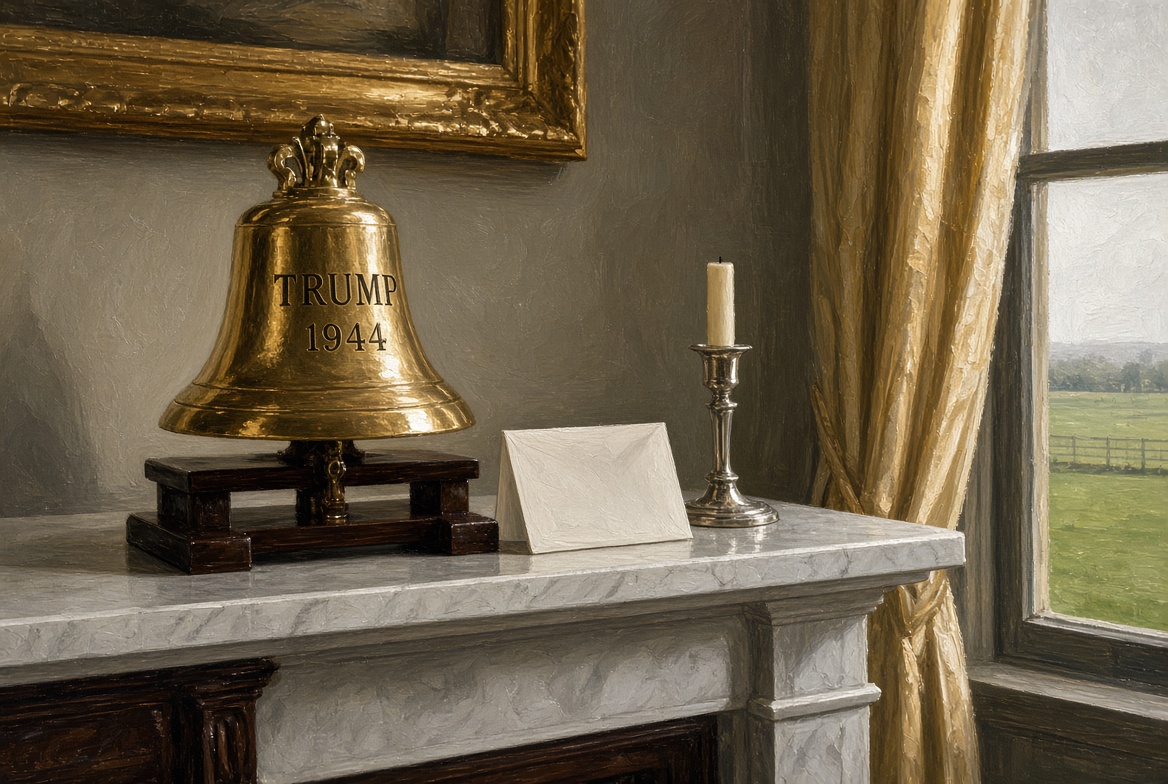
Artist's visualisation. The conning tower bell of HMS Trump, T-class, launched 1944, presented by King Charles III to the President of the United States at a white-tie state dinner in the East Room on 28 April 2026. The official description calls it Admiralty-pattern. The submarine was broken up in Wales in August 1971, fifteen days before the dollar's last formal link to gold was closed. A vessel's bell is what a vessel is identified by and mustered to.
VIII. Ad Astra: The Last Jurisdictionless Ocean
Above the atmosphere, there is only the law of the sea.
The admiralty tradition that has governed every act of Anglo-American commercial and imperial expansion since the Portuguese rounded the Cape of Good Hope is the only legal tradition that has ever functioned in genuinely jurisdictionless space. A vessel beyond Earth's atmosphere is in a more complete state of maritime legal reality than any vessel on any ocean, because the oceans at least have coastal states with jurisdiction over their margins. Space has no coastlines. It has vessels, flags, and the contracts signed before departure.
No genuinely democratic polity has produced a serious deep-space programme by democratic means. The Apollo programme ran as a military-adjacent hierarchy under existential competitive pressure with a budget no peacetime legislature would have authorised. What SpaceX is doing is not democratic in its decision-making architecture by any meaningful definition. A permanent settlement beyond Earth will require binding multi-generational commitments that democratic electoral cycles cannot sustain and material hardship that consumer societies structurally resist. The sea-law empire does not go to the stars from a fragmented political order. It goes from a consolidated continental fortress, with a unified resource base, a cleared hemispheric perimeter, and an operational doctrine shaped by five centuries of practice in the spaces between sovereignties.
The technocratic class that has operated in those spaces since the Lombards established themselves on that London street in the thirteenth century is structurally pre-adapted for the environment above the atmosphere in a way that democratic land-law civilisations are not. Whether it is trustworthy in that environment is the question this essay has been circling and cannot close, because it is the question that the structure of concentrated power generates permanently and for which the historical record provides exactly one answer.
In 193 AD the Roman Praetorian Guard put the Roman emperorship up for public auction. Didius Julianus won with a bid of twenty-five thousand sesterces per man. He was emperor for nine weeks before Septimius Severus had him executed. The Guard had not become corrupt. It had become what all praetorian guards become when the civic substrate that constrains them erodes: an autonomous power centre serving itself and selling its loyalty to whoever offers the best terms. Not a failure mode. The default mode, interrupted only by civic formation strong enough to prevent it.
The formation that prevented it in Sparta was the Agoge, self-administered, universal, and ultimately unsurvivable. The formation that is supposed to prevent it in the contemporary Western order is democratic accountability, which has been sufficiently hollowed by partitocracy, regulatory capture, offshore architecture, and the dissolution of the boundary between private intelligence contractors and state power that it now constrains the praetorian class approximately as effectively as the instruction not to look directly at the sun constrains the sun.
The people who run the world are so confident in their safety that they do not bother with proper operational security. They are right to be confident. The mechanisms designed to constrain them have ceased to function.
The physician to the king stands closest to sovereign power at its moment of greatest vulnerability. His descendants, four generations on, are tracked to their deaths by the software of the empire that replaced the empire that employed him, inside vessels operating outside the law of the land. The Loyalists who fled the new republic for the Exumas ran chicken farms and smuggled contraband for two centuries before the jurisdictionless space they had learned to inhabit became the financial and intelligence architecture of the world they had once fled. The monk in the Vatican outlasts the emperor he advises. The family in the Venetian palazzo outlasts the republic that made them noble. The banking house on Lombard Street outlasts every sovereign it has ever financed.
Seward bought the ice. Ranhofer baked the Alaska. The dessert is still on the menu.
Same as it ever was.
Same as it ever was.
HOW THE IRISH SUMMER CAMP FIASCO CONCLUDED
September 2026. A brief postscript on Palantir chairman Peter Thiel's hacked invitation-only Dialog retreat at Powerscourt Estate, Ireland, August 12 to 16.
What happened? It never happened.
The hotel cancelled the booking in early July after weeks of press scrutiny, political opposition criticism in Eire’s Dail (parliament) and a national campaign of protest. Powerscourt Estate issued a statement saying it was relieved and pleased to announce the event had been called off.
Then Dialog sued. Stonebrick LLC, trading as Dialog, has brought proceedings against the hotel operator and the two companies that own the thousand-acre estate, claiming the cancellation was wrongful. The statement of claim notes that Thiel is co-founder of Dialog and a founder of Palantir, and had no involvement in organising the Powerscourt event.
Read that last sentence twice. A network that grades its members A, B and C, scores them on value added and builds AI dossiers before admission now states in a public court filing that its co-founder had nothing to do with the retreat. Exposure turned proximity into a liability inside eight weeks.
The hacktivist who found the open directory observed that it was remarkable how the people who run the world do not bother with opsec. She was right about the confidence. The summer tested whether it was earned, and the answer came back as a writ.
Which is the telling part and perhaps a matter of concern somewhere. Power and Wealth of the kind this essay has traced does not litigate over a cancelled booking. It keeps quiet. It is the Master of its silence. The Colonna and the Orsini absorbed the loss of whole territories without filing anything, because the one asset a private network cannot buy back is the silence it has already lost, and suing for a ballroom advertises the loss twice. The praetorian class that proposes the Spartan model for everyone else could not manage the discipline of ignoring a hotel.
That is not the techno Sparta the twenty-first century was promised.
An Orsini of yore (or present) would have discretely shrugged:
“Te la magni e stai zitto.” (ie. Suck it up and Shut Up)
ADDENDA: THE CLUB WITH NO NAME
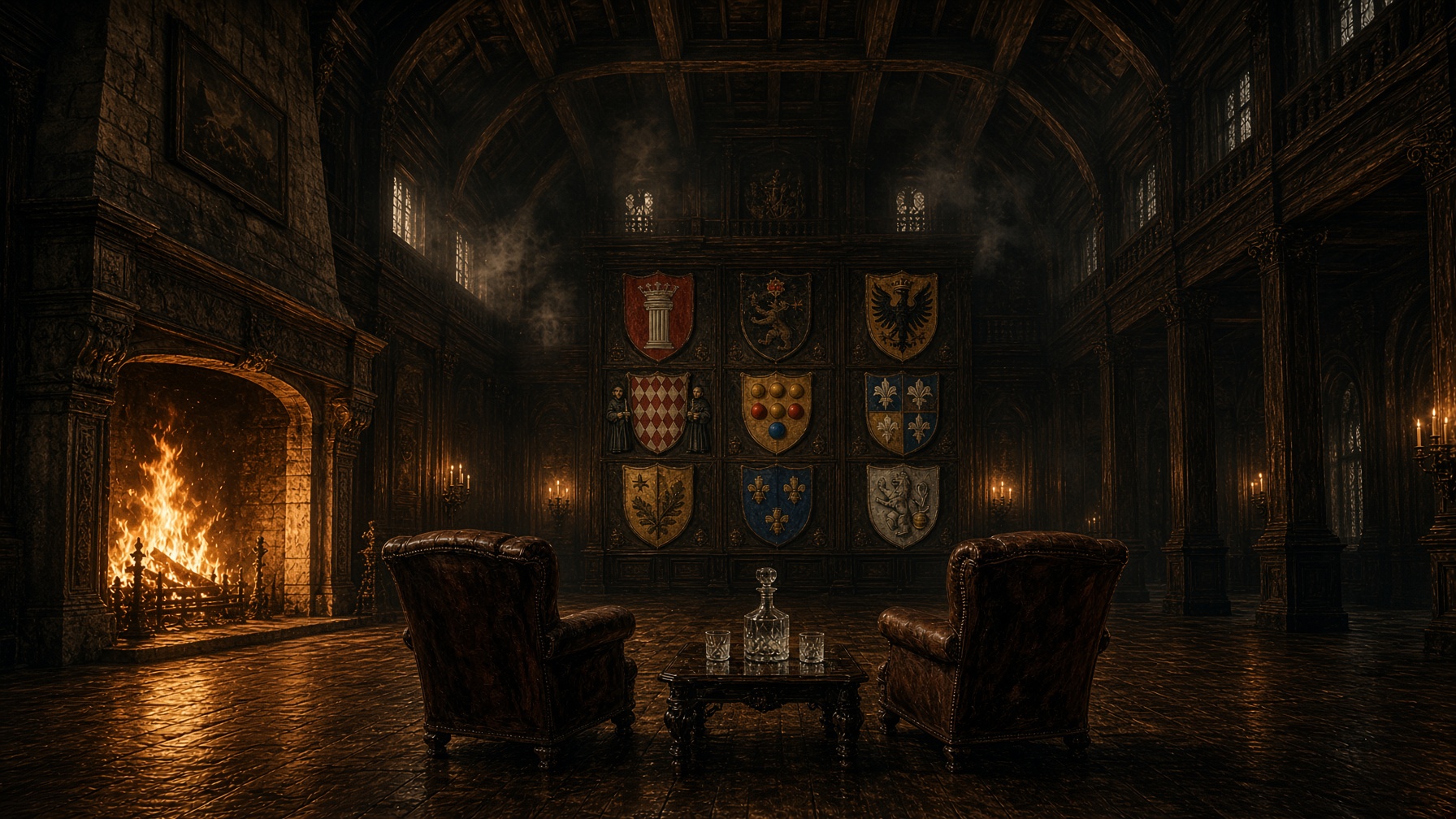
No members present. None expected.
A very special place, made known to you by invitation and no other way. You, dear reader, are not a member and never will be. Nor am I. It sits in an elegant street in a European town. There is no brass plaque outside. It does not require one. Inside there is a grand stately hall, a salon, and a wall with nine shields. Every house on that wall was old before the Bank of England opened its doors, and every one of them was still in business when it did. They are not arranged by wealth. They are arranged by the date they stopped needing to explain themselves. They quietly run the world, same as it ever was.
THE WALL
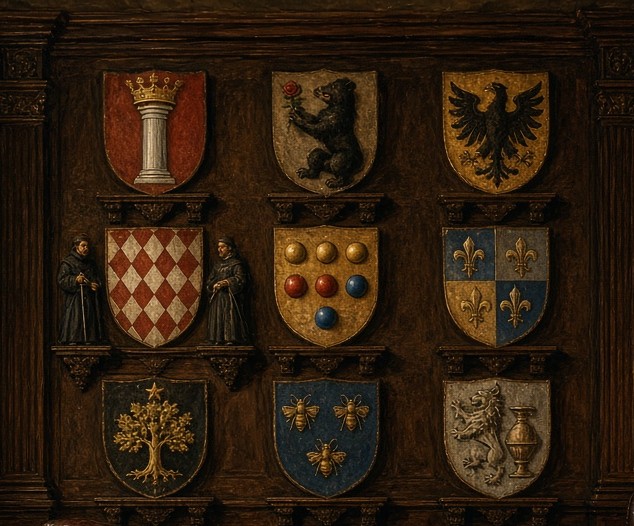
Artist's visualisation. Nine houses, one Old Wealth club. Members only. No current openings.
1. Colonna. A crowned column. Roman, papal, a thousand years facing the Orsini across the same city and still in place.
2. Orsini. A bear with a rose. Three popes, more cardinals than any other Roman house, every political transition absorbed rather than resisted.
3. Doria. The imperial eagle. Genoa's admirals, Habsburg patronage, the sea lanes of the sixteenth century Mediterranean.
4. Grimaldi. Lozenges of red and white, flanked by two monks with swords beneath their habits. The only sovereign house on this wall, and the only arms that admit how the ground was taken.
5. Medici. The six palle. Four popes, two queens of France, and the banking network that financed the Renaissance as a political operation.
6. Fugger von der Lilie. Lilies counterchanged on gold and blue. Augsburg, and the capital that bought an imperial crown in 1519.
7. Chigi. The oak and the star. Sienese bankers to the Holy See, whose palazzo is now the seat of the Italian prime minister.
8. Barberini. Three bees. Urban VIII, the trial of Galileo, and the bronze stripped from the Pantheon.
9. Odescalchi. A lion and an urn. Innocent XI, who financed William of Orange in 1688, six years before the Bank of England opened its doors.
THE OTHER WALL: NOVI HOMINES
Just past the club entrance, beside the cloakroom, there are nine portraits. Different texture, different world, same trade. What separates them from the shields is not the size of the fortune. A shield is inherited. A picture is taken, of a man declaring he has arrived. Even at the apex of world finance there is a pecking order, and this is it. All hail the Novi Homines.
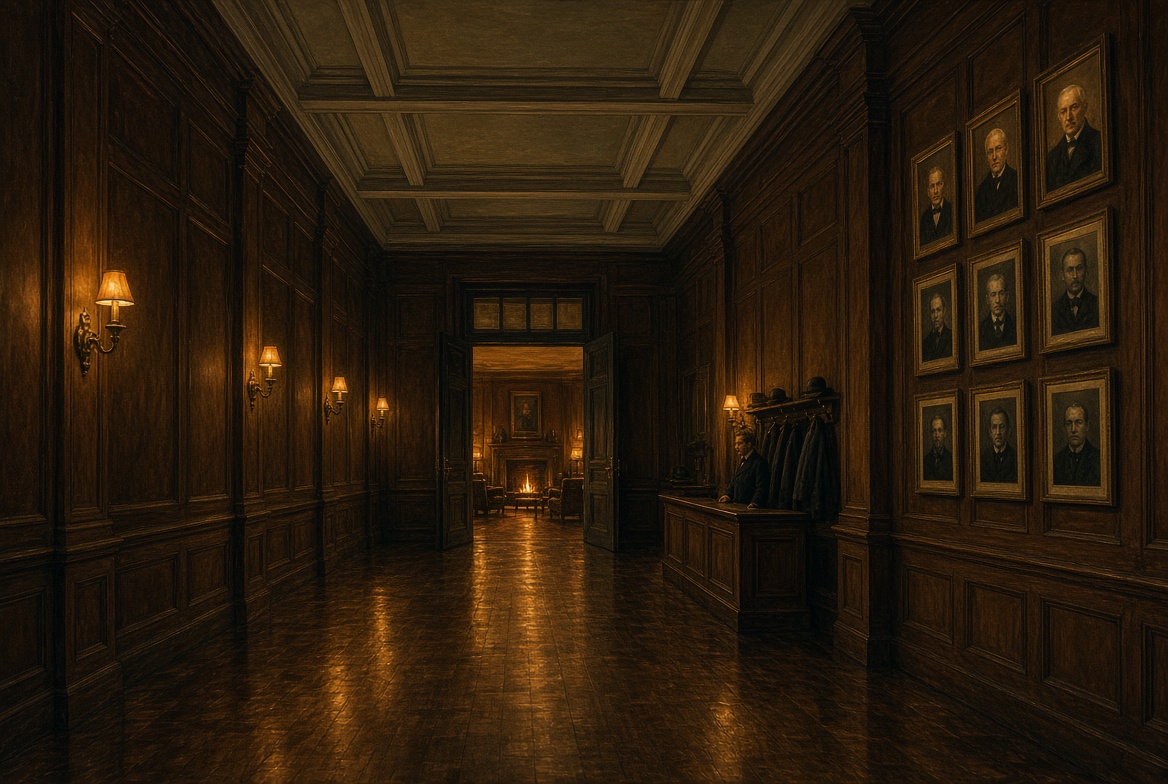
Artist's visualisation. Nine portraits by the cloakroom, where a man takes your coat before you are allowed in. Left to right, oldest first.
1. Éleuthère Irénée du Pont. Powder on the Brandywine from 1802, and the state as sole customer from the beginning.
2. John Jacob Astor. Furs, then opium, then Manhattan. The richest man in the United States at his death, and the only one on this wall whose fortune was in land.
3. Marcus Goldman. Commercial paper carried around lower Manhattan in the brim of his hat, 1869. The only house on this wall still trading under its own name, with junior partner Sachs, his son-in-law Samuel.
4. Andrew Carnegie. Steel, and then the most conspicuous programme of giving it away that the century produced.
5. John D. Rockefeller. Standard Oil. The template every monopoly argument since has been built on, and the fortune that outlived the company it came from.
6. Jacob Schiff. Kuhn Loeb. Railroad finance, and a private loan to Japan in 1904 that helped decide a war between two empires.
7. John Pierpont Morgan. Bailed out the United States Treasury in 1895 and again in 1907, because there was no institution capable of doing it.
8. Paul Warburg. In the room at Jekyll Island in 1910, on the Federal Reserve's first board in 1914.
9. Andrew Mellon. Aluminium, banking, and eleven years as Secretary of the Treasury under three presidents.
Nine names against the nine across the room. Photographs rather than shields, because a photograph is what you hang when you have no quarterings. The oldest of these houses opened in 1802. The youngest house in the members' room had been in business four hundred years by then.
THE THIRD TIER, OR THE FIRM THE CLUB HIRED
And below them, no wall for them in this building, the men the gossip channels hail as the richest on earth. Gates, Zuckerberg, Bezos and the rest. They are not at the children's table. They are not in the club at all. They are the frontmen the club hired.
The test for old money is whether the fortune outlives the vehicle. Rockefeller's outlived Standard Oil. Du Pont's outlived gunpowder. Nobody knows whether Zuckerberg's survives Meta, and the honest answer is probably not, because the asset is equity in a platform that depends on spectrum the state granted, patents the state protects, contracts the state awards and a currency the state issues. Remove any one and the fortune is notional. That is not a house. That is a very well paid chartered operator: the East India Company's staff, not its shareholders.
Hence the tells. The hundred and fifty metre yacht. The garish taste, the philanthropy announced at volume, the look at me, I am rich. The rocket that goes up and comes back down again, eleven minutes later, and cannot be opened from the outside by the man who built it. A pop star opens it from within. He arrives at the hatch, goes down in the dirt on live television, shuts it, and opens it again with his own hands for the cameras. I could not make that up if I tried. Generational wealth does the opposite, at all costs, because the first rule of those with the shields is that nobody outside knows the room exists. A man who needs you to see the big big boat is a man whose fortune could be a share price by Friday.
One tip of the hat
Musk is the exception, and for a structural reason rather than a personal one. He is not accumulating, he is building things a state cannot easily replace: launch capacity, a satellite constellation that has become a strategic communications layer, a neural interface programme if it ever works. That is not a tech fortune. That is a chartered company with its own navy, and it is the only thing on this board that could yet become a house rather than serve one. The rest are wide boys and shopkeepers. They get no portrait in this essay because they are replaceable cutouts, and the club has watched four hundred years of them come and go. Musk is the dark horse who may end up joining the club, or may end up opening his own on Mars.
Part Two: The Institutional Transmission. From the Templar suppression of 1307AD through the Freemason formation vehicle, the Round Table, the OSS, the CIA and the proprietary company architecture, to the current intelligence contractor complex and the question of what, if anything, still watches the watchmen.
Miguel A. Rozas Pashley is a veteran Madrid-based journalist, conflict and security analyst. He is the author of the book “On the Road to Transhumanism: Staring Into the Dark Side of Scientific Progress.” published by Amazon Kindle under the Quantum Wildchild imprint.