
The Meteor-1 Photon Chip
How China's Photonic Breakthrough Enables the 2030 Agenda
Foreword
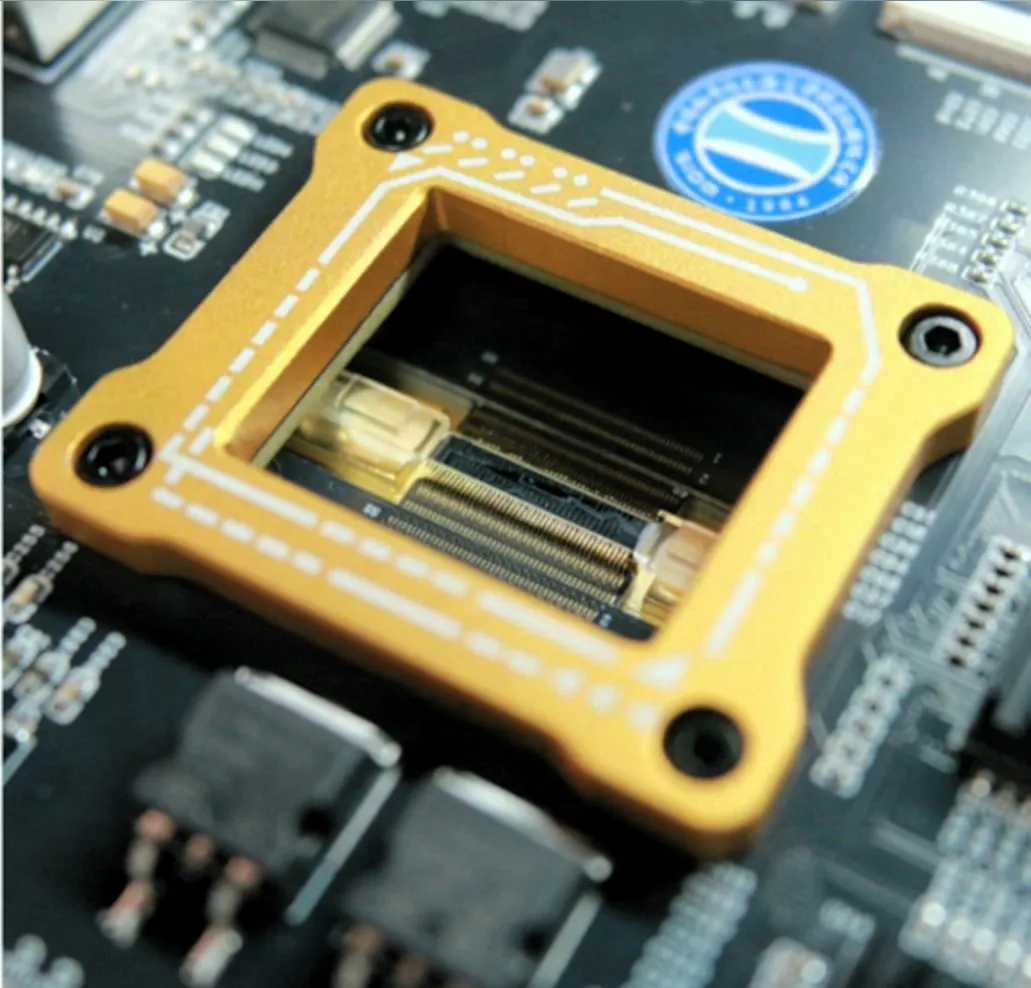
On 17 June 2025, Chinese researchers at the Shanghai Institute of Optics and Fine Mechanics published a breakthrough that may have just made the globalist 2030 technological convergence agenda not only possible, but inevitable. The Meteor-1 photonic computing chip, operating at 2,560 TOPS, tera operations per second, trillions per second, with minimal energy consumption and no heat dissipation, has shattered the thermodynamic constraints that appeared to make global AI deployment physically impossible.
This development represents more than a technological breakthrough. It probably pinpoints the precise moment Western sanctions against China backfired catastrophically, and became meaningless, after forcing Chinese innovation to seek a way out and go beyond the electron-based computing paradigm that has dominated the post-industrial information society for decades.
While Western nations currently struggle with self-inflicted energy crises and monopolistic infrastructure limitations using outdated silicon technology, China has leapfrogged to a new photonic computing era that eliminates the fundamental physics barriers to comprehensive global surveillance and control systems.
The current lockstep technological transformation accelerating toward 2025 to 2030 implementation, featuring panopticon personal ID, digital social credit, central bank digital currencies, digital health passports, carbon credits, neural interfaces, and biological enhancement systems, now faces no thermodynamic limitations.
The energy impossibility that appeared to offer some hope for preventing a dystopian technological control has been eliminated by this Chinese breakthrough that Western intelligence agencies and technology companies apparently failed to anticipate or kept quiet about.
Chapter One: The Breakthrough That Changes Everything
The Photonic Revolution Hidden in Plain Sight
The Meteor-1 chip represents the culmination of research that has been developing largely outside Western awareness, published in the journal eLight with minimal mainstream media coverage despite its revolutionary implications. Using photons instead of electrons for information processing, the technology achieves computational performance comparable to NVIDIA's most advanced GPUs while consuming minimal energy and generating virtually no heat, the two factors that would have made global AI deployment thermodynamically impossible using conventional silicon technology. That AI deployment will be responsible for controlling and marshalling the simultaneous rollout of the 2030 agenda points above, providing artificial intelligence support, quantum computing infrastructure, biological enhancement systems, and space-based infrastructure.
The chip incorporates over one hundred distinct frequency channels within a single photonic platform, enabling unprecedented parallelism without expanding physical footprint or power requirements. This breakthrough in optical computational capacity provides a practical pathway for next generation processors that bypass the fundamental limitations of electronic computing including heat buildup, quantum tunnelling effects, and unsustainable power consumption that have hindered semiconductor development for decades.
The timing of this disclosure appears conveniently coordinated with accelerating global AI deployment schedules, suggesting that Chinese technological development disclosure has proceeded according to a strategic timeline rather than on purely academic research priorities within a public trade war, or more likely a massive distraction. In brief, I would plausibly speculate that all world factions work in global technocratic lockstep.
The announcement came as Western nations faced mounting energy crises and infrastructure limitations that apparently doomed comprehensive AI surveillance systems due to the sheer impossibility of powering and maintaining global scale demands.
Sanctions Backfired: Forced Innovation Beyond Western Capabilities
By cutting off Chinese access to advanced NVIDIA GPUs and semiconductor manufacturing technology, Western sanctions inadvertently created the pressure that drove Chinese scientists to develop fundamentally superior computing technologies.
The Meteor-1 breakthrough demonstrates how technological restrictions can accelerate rather than constrain innovation when applied to nations with substantial research capabilities and strategic patience. Chinese scientists, denied access to incremental improvements in electron-based computing, were forced to pursue revolutionary approaches that have now positioned China decades ahead of Western computing capabilities in critical areas.
The Shanghai Institute of Optics and Fine Mechanics operates under the Chinese Academy of Sciences with resources and coordination capabilities that Western corporate research laboratories cannot match. The modular team structure and dedicated expert systems described by lead researcher Xie Peng enabled rapid progress from foundational research through system assembly that Western institutions constrained by corporate competition and intellectual property restrictions have been unable to achieve.
Western Intelligence Failure: Missing the Paradigm Shift
The apparent surprise with which Western technology companies and intelligence agencies have responded to the Meteor-1 announcement suggests fundamental, massive failures in technological intelligence gathering and forward strategic assessment.
The research leading to this breakthrough has been proceeding openly through academic institutions and scientific publications, but Western analysts appear to have blindsided themselves by concentrating on constraining Chinese access to existing technologies rather than monitoring Chinese development along alternative technological approaches.
The focus on protecting silicon-based semiconductor technology while ignoring photonic computing development represents a classic example of fighting the last war rather than anticipating future technological paradigms. Western sanctions targeted the electronic computing ecosystem that has dominated for decades, but Chinese researchers were simultaneously developing photonic alternatives that render those restrictions irrelevant.
The implications extend beyond computing technology to deep fundamental questions about Western technological intelligence capabilities, forward vision and strategic planning processes. If Chinese researchers could achieve this breakthrough using openly published research and academic collaboration, the failure to anticipate or counter this development suggests deep systematic weaknesses in Western technology assessment and strategic response capabilities. It also places a large question mark over what China is developing within its own classified programs.
The PLA, PLAN and PLAAF military industrial scientific research complex is genuinely sophisticated in compartmentalisation, with a distinctly Chinese flavour, blending Soviet and Western models with unique cultural and organisational layers. Their special access equivalent programs, under the Central Military Commission's Equipment Development Department, specialised research bases, and state-owned conglomerates like AVIC or NORINCO, benefit from four things.
- Military-Civil Fusion. Blurs defence and civilian lines, enabling rapid dual-use tech absorption in AI, semiconductors and hypersonics from civilian giants and universities, delivering massive scale and speed for systems like the DF-ZF or advanced missiles.
- Centralised long-term planning. Top-down CMC guidance and national strategies such as Made in China 2025 align vast resources and talent, China produces nearly twice as many STEM doctorates as the US, without market or budgetary delays, mobilising a whole-of-nation effort.
- Secure yet permeable compartmentalisation. Strict need-to-know controls minimise leaks, while party oversight enables selective cross-flow between military, state-owned enterprises, and civilian entities, reducing silos and supporting parallel development.
- Cost and scaling advantages. Subsidies, lower costs, and dual-use facilities keeping lines warm via commercial work allow rapid production surges and reduced foreign dependencies, such as the native WS-15 engines.
These strengths enable faster fielding of advanced systems than many expected, despite gaps such as advanced chips and despite corruption risks, creating a resilient ecosystem tailored for prolonged great power competition.
Chapter Two: Meteor-1 Signals Thermodynamic Constraints Eliminated
The Energy Crisis That No Longer Exists
The importance of this photon chip cannot be overemphasised. Previous analysis of global AI deployment energy requirements revealed apparently insurmountable thermodynamic constraints that made comprehensive technological convergence physically impossible using conventional computing systems.
The projected power consumption for global AI surveillance, social credit systems, digital currencies, and biological monitoring networks exceeded realistic electricity generation capacity by margins that appeared to guarantee systemic failure regardless of political coordination or financial resources.
These calculations, based on electron-based computing systems requiring massive power input and cooling infrastructure, assumed that global technological deployment would face the same energy limitations that constrain current data centre operations. The exponential growth in computational requirements for real-time global population monitoring, behavioural analysis, and social control appeared to require energy generation increases that could not be achieved within realistic timelines or resource constraints.
The Meteor-1 breakthrough eliminates these constraints by fundamentally changing the relationship between computational power and energy usage. Photonic computing requires minimal power input while generating virtually no waste heat, eliminating both the energy generation requirements and cooling infrastructure demands that made global AI deployment appear thermodynamically impossible. The physics of light-based computing provides computational capabilities that scale without corresponding increases in energy consumption or heat dissipation.
Infrastructure Requirements Transformed
The infrastructure requirements for global AI deployment using photonic computing become radically different from projections based on electronic systems. Instead of requiring massive power generation increases and cooling infrastructure that appeared to exceed global construction capabilities, photonic systems can achieve unprecedented computational density with existing electrical grid capacity and minimal infrastructure modifications.
The elimination of heat dissipation requirements removes the need for massive cooling systems, water resources, and waste heat management infrastructure that made data centre scaling appear physically impossible. Photonic processors can operate at room temperature with minimal cooling requirements, enabling deployment in locations and configurations that would be impossible for electronic systems requiring specialised cooling and power infrastructure.
The reduced power requirements enable distributed deployment of AI systems without creating local electrical grid stress or requiring dedicated power generation facilities. This transformation makes global surveillance and control systems feasible in locations where power generation and cooling requirements would have made electronic systems impossible to deploy and maintain effectively.
Quantum Computing Integration Potential
The convergence potential between photonic computing and quantum systems represents perhaps the most significant long-term implication of the Meteor-1 breakthrough. Quantum computing systems that currently require extreme cooling and isolation could potentially be integrated with photonic processors to create hybrid systems that combine quantum computational advantages with photonic efficiency and scalability.
The natural compatibility between photonic systems and quantum communication networks enables integration possibilities that could eliminate many current limitations of quantum computing deployment. Photonic quantum networks could provide the communication infrastructure for distributed quantum computing systems while photonic processors handle classical computational requirements without the energy and cooling demands that currently constrain quantum system deployment.
The potential for room-temperature quantum operations using photonic interfaces could eliminate the cryogenic cooling requirements that have limited quantum computing to specialised laboratory and industrial environments. This integration possibility transforms quantum computing from specialised research tools into potentially ubiquitous computational infrastructure supporting comprehensive population monitoring and control systems.
Chapter Three: Geopolitical Power Shift Acceleration
Chinese Technological Supremacy in Critical Infrastructure
The Meteor-1 breakthrough positions China as the dominant force in the computational infrastructure required for 2030 technological convergence, fundamentally altering the global balance of technological capabilities. While Western nations struggle with energy crises, infrastructure limitations, and outdated silicon-based computing systems, China has achieved computational capabilities that enable comprehensive global surveillance and control systems without the physical constraints that limit Western implementation.
Chinese dominance in photonic computing provides strategic advantages that extend far beyond computational performance to encompass energy independence, infrastructure resilience, and deployment flexibility that Western systems cannot match. The ability to achieve unprecedented computational density with minimal power requirements enables Chinese technological deployment in geographic and political contexts where Western systems would be constrained by energy and infrastructure limitations.
The strategic implications extend to military, intelligence, and economic domains where computational capabilities provide decisive advantages in information processing, behavioural prediction, and system coordination. Chinese photonic computing capabilities could enable real-time global surveillance, social control, and economic coordination systems that operate beyond the reach or capability of Western technological responses.
Western Technological Dependence and Vulnerability
The continued reliance of Western institutions on electron-based computing systems creates strategic vulnerabilities and dependencies that become more severe as Chinese photonic capabilities expand. Western AI deployment, surveillance systems, and technological infrastructure remain constrained by energy requirements and cooling limitations that Chinese systems have eliminated through photonic computing advances.
The energy crises facing European and North American electrical grids become strategic weaknesses rather than shared global challenges when Chinese systems can achieve superior computational performance with minimal power requirements. Western nations may find themselves unable to compete in AI deployment, surveillance capabilities, or technological infrastructure development due to fundamental physics limitations that Chinese technology has transcended.
The potential for Chinese technological systems to provide superior capabilities with lower resource requirements creates incentives for international adoption of Chinese rather than Western technological standards and infrastructure. Nations facing energy constraints or infrastructure limitations may choose Chinese photonic systems over Western electron-based alternatives, expanding Chinese technological influence and reducing Western technological relevance in global systems.
Globalist Agenda Implementation Through Chinese Technology
The globalist technological convergence agenda toward 2030, featuring comprehensive surveillance, social control, and biological monitoring systems, becomes not only feasible but inevitable using Chinese photonic computing capabilities. The energy constraints that appeared to prevent dystopian technological implementation have been eliminated by Chinese innovation, enabling the comprehensive population control systems that globalist networks have planned for decades. The result is a convergence where Chinese technological supremacy serves globalist population control objectives while globalist international coordination serves Chinese technological expansion and dominance objectives.
The traditional competition between national and transnational interests dissolves when Chinese technology provides the optimal solution for globalist control systems and globalist coordination provides optimal deployment mechanisms for Chinese technological capabilities.
Chapter Four: The Inevitable 2030 Timeline
No Remaining Physical Constraints
The elimination of thermodynamic constraints through photonic computing removes the final physical barrier to comprehensive global surveillance and control system implementation by 2030. The energy requirements, cooling demands, and infrastructure limitations that appeared to make global AI deployment impossible have been resolved through Chinese technological breakthrough, clearing the path for complete implementation of planned surveillance, social control, and biological monitoring systems.
Accelerated Global Implementation
The superior capabilities and reduced resource requirements of photonic computing systems create incentives for accelerated adoption across all planned surveillance and control applications. Digital social credit systems, central bank digital currencies, health passport infrastructure, carbon credit monitoring, and biological enhancement coordination become more attractive to implementing organisations when the technological infrastructure provides superior performance with lower costs and complexity.
The resistance mechanisms that might have emerged from technological implementation difficulties, resource constraints, or infrastructure failures are eliminated when photonic systems provide clear advantages in performance, cost, and deployability compared to alternative approaches.
The Window for Prevention Closes
The strategic window for preventing comprehensive global surveillance and control system implementation may have closed with the Meteor-1 breakthrough announcement. The technological barriers that provided hope for system failure or implementation delays have been eliminated by Chinese photonic computing advances that make 2030 timeline implementation not only feasible but attractive to implementing organisations.
Conclusion: Preparing for the Post-Constraint World
The New Strategic Reality
The Meteor-1 photonic computing breakthrough fundamentally alters the strategic landscape surrounding 2030 technological convergence by eliminating the physical constraints that appeared to prevent comprehensive global surveillance and control system implementation. The energy crisis, infrastructure limitations, and technological barriers that provided hope for system failure have been resolved through Chinese innovation that enables unprecedented computational capabilities with minimal resource requirements.
The strategic calculations that assumed thermodynamic impossibility would prevent dystopian technological deployment must be revised to account for photonic computing capabilities that transcend the limitations of electron-based systems.
Strategic Options in the Post-Constraint Environment
The elimination of physical barriers to global surveillance and control system implementation requires fundamental reassessment of strategic options for those concerned about preserving human freedom, national sovereignty, and democratic governance in the face of technological totalitarianism enabled by Chinese photonic computing capabilities.
The resistance strategies based on system complexity, resource limitations, and implementation difficulties become irrelevant when photonic systems provide clear technological advantages with minimal resource requirements and deployment complexity.
The window for technological prevention may have closed, but opportunities may remain for political, social, and spiritual responses that account for the new technological realities while preserving essential human values and freedoms in environments where technological resistance becomes impossible or ineffective.
Point of No Return?
The Meteor-1 breakthrough may represent a point of no return for human civilisation, between accepting technological totalitarianism enabled by Chinese photonic computing capabilities, or seeking alternative responses that preserve human freedoms despite technological surveillance and control capabilities that now seem unstoppable by conventional resistance tactics.
The strategic question is no longer whether comprehensive global surveillance and control systems can be prevented through technological limitations, but whether human consciousness and spiritual development can evolve rapidly enough to maintain essential freedoms and values in technological environments designed for comprehensive population monitoring and behavioural control.
The answer to this question will determine whether the 2030 technological convergence will summon human technological achievement at the service of human progress, or roll out the most sophisticated control system in human history, enabled by a Chinese photonic computing breakthrough that has eliminated the physical barriers to technological totalitarianism.
The Meteor-1 moment marks the day when the impossible became inevitable. The question now is not whether the 2030 agenda can be stopped by technological constraints, but whether human consciousness can evolve beyond technological control systems that no longer face physical limitations.