
Quantum
The Cooperative Revolution They Nearly Buried
From Kropotkin to Quantum Biology
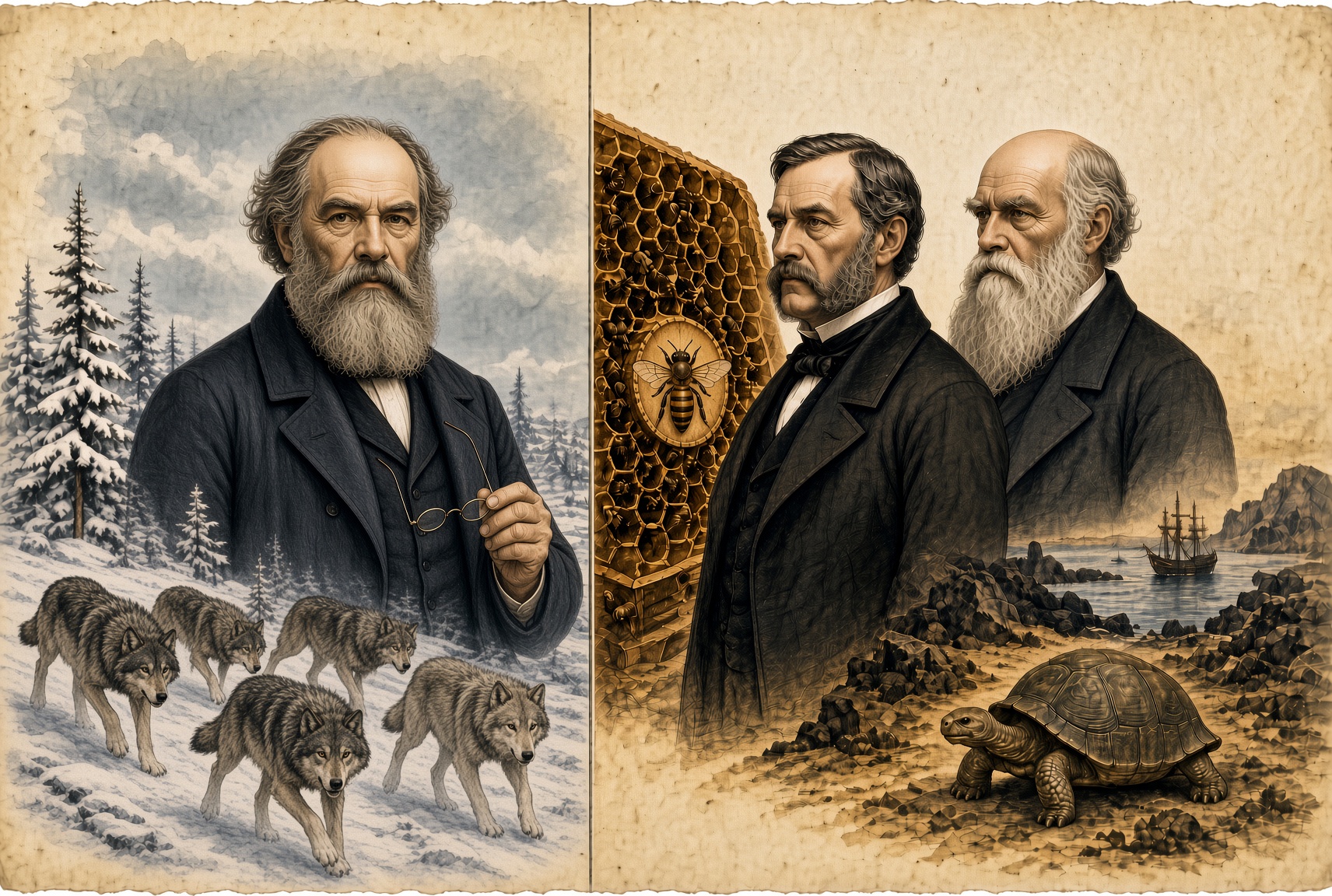
Prince Peter Kropotkin: Darwin's Magnificent Nemesis
In 1902, while Social Darwinists were busy justifying industrial exploitation and imperial conquest with claims that "nature is red in tooth and claw," a Russian prince who renounced to his aristocratic roots published a book that should have changed everything. Prince Peter Kropotkin, a trained geographer and naturalist who spent years observing wildlife during Siberian expeditions, documented what Darwin had systematically downplayed: that cooperation, not ruthless competition, was the dominant survival strategy across species.
"Mutual Aid: A Factor of Evolution" wasn't armchair philosophy, it was meticulous field observation. Kropotkin showed the most successful species weren't the most competitive but the most cooperative. Wolves hunt in packs. Birds migrate in coordinated flocks. Even insects like ants and bees build complex cooperative societies. He documented mutual aid across species boundaries, symbiotic relationships where different organisms supported each other's survival. The data was overwhelming: nature operates as much via cooperation and symbiosis as by predation.
Why you've never heard of him: Because acknowledging cooperation as evolution's primary driver would undermine the ideological foundations of capitalism, imperialism, and social hierarchy. The establishment needed Darwin's "survival of the fittest" to justify brutal liberal economic policy. Kropotkin's work threatened profitable orthodoxy, so it was buried for a century, marginalized, excluded from curricula, dismissed as the ravings of an anarchist rather than engaged with rigorous natural history.
The vindication: Modern ecology now confirms everything Kropotkin observed. Lynn Margulis proved that cooperation (endosymbiosis, cells merging) drove major evolutionary leaps. James Lovelock's Gaia hypothesis showed cooperation at planetary scale. Systems theory reveals that the most resilient ecosystems are built on intricate networks of mutual support. Kropotkin was right, while the scientific establishment spent a century pretending he wasn't.
Kropotkin's Double Suppression: The Anarchist Scientist They Buried Twice
Kropotkin's tragedy, and his power, was that he refused to separate science from ethics. As an anarchist philosopher, he believed human society could organize through voluntary cooperation without centralized state control. His critics weaponized this, dismissing his meticulous field observations as a politically motivated fantasy. But here's what they couldn't admit: his anarchism came from his biology, not the other way around. He observed mutual aid driving survival in nature, then asked why human society should operate differently.
The establishment needed to discredit him twice, once as a dangerous anarchist radical, again as an unreliable scientist. By attacking both his politics and his science, they ensured his biological discoveries would be buried alongside his social philosophy. It was perfect suppression: anyone citing his cooperation research could be dismissed as a political extremist, while anyone exploring his anarchist ideas could be mocked for relying on "bad science." The double tar brush kept both insights buried for a century.
The Battle of the Beehive: Kropotkin vs. Huxley's Social Engineering
But Kropotkin faced another, more insidious opponent: Thomas Henry Huxley, "Darwin's Bulldog," who had also studied cooperative species, particularly social insects like bees and termites. Both men looked at nature's cooperative societies. Both saw organization, coordination, collective survival. But they drew opposite conclusions, and those conclusions shaped competing visions for human civilization.
Huxley's vision: Social insects proved successful cooperation requires hierarchical control. Bees have queens and workers and castes serving well defined roles, individuals subordinated to hive needs. Huxley argued it was nature's blueprint for human society, order through hierarchy, stability through controlled specialization, cooperation via centralized authority managing the masses.
Kropotkin's vision: Mutual aid in nature is voluntary, decentralized, and emergent, not imposed by queens or controlled by authority. Yes, bees have queens, but wolves, deer, birds and countless other species seek cooperation which arises spontaneously without rulers. Even in hives, the "control" is distributed, chemical, emergent, not the authoritarian command structure Huxley imagined. Nature shows cooperation works best when it's free, not when it's enforced.
This wasn't just academic debate. Huxley's insect hierarchy model became the ideological foundation for technocratic social engineering, the belief that human societies, like beehives, need expert management, specialized castes, and centralized control to function. Huxley’s grandson Aldous would write a brilliant novel either as satire on Fordism, eugenics, and behaviourism, or a blueprint of T. H. Huxley’s insect sociology: Brave New World, humans bred into Alpha, Beta, Gamma, Delta, and Epsilon castes, their cooperation engineered and controlled, stability achieved through pharmaceutical management and behavioural conditioning. This dystopia may be interpreted as a either a warning or the result of a minor family feud or disagreement with Grandpa Huxley, but the imagery is what clearly hits you.
One tradition saw the hive as proof that the masses must be managed. The other saw mutual aid arising when people are not managed like sheep.
The stakes of this battle: If Kropotkin was right, if nature's cooperation is voluntary, decentralized, and self-organizing, then humans don't need states, corporations, or technocratic elites to organize cooperation. Mutual aid emerges spontaneously when people are free. But if Huxley was right, if cooperation requires hierarchical control, then centralized authority is natural, necessary, inevitable. Elites managing masses isn't tyranny; it's how successful cooperation works, proven by nature itself.
Which vision won? We live in Huxley's world: hierarchical corporations, technocratic states, populations managed like hives, cooperation controlled from above, "efficiency" through specialization and submission. Kropotkin's vision, voluntary mutual aid, decentralized cooperation, people self-organizing without rulers, was buried alongside his science.
The irony: Modern network theory, complexity science, and ecological research increasingly vindicate Kropotkin. The most resilient, adaptive, innovative systems are decentralized networks, not hierarchical pyramids. Top-down control creates brittleness; distributed cooperation provides resilence. Nature's most successful cooperative systems, mycorrhizal networks, forest ecosystems, immune systems, operate through distributed intelligence, not centralized command. Kropotkin understood this in 1902. Our establishment still pretends Huxley was right.
This is the pattern we'll see repeated: scientist challenges profitable orthodoxy, gets professionally destroyed, truth emerges generations later. Kropotkin is our anchor because his suppression reveals the game, "settled science" more often than not means "economically convenient science."
The Extended Family of Suppressed Cooperation Science
Kropotkin opened the door. Others walked through it, and paid a heavy toll.
Lynn Margulis (1938-2011): Cooperation at the Cellular Level
Margulis proposed that major evolutionary innovations, like the emergence of complex cells with mitochondria, happened through endosymbiosis: one organism literally merging with another in cooperative union.
She argued that cooperation, not competition, drove the most important evolutionary transitions.
The establishment's response: Ridicule. For decades, her work was rejected by journals, dismissed as unscientific fantasy, mocked at conferences. She was called a crank, her tenure threatened, her reputation attacked.
The vindication: Her endosymbiosis theory is now textbook biology. Mitochondria are proven to be former bacteria that merged with other cells through cooperation. Margulis was right about one of the top discoveries in evolutionary biology, and the establishment made her pay dearly for it.
Her connection to Kropotkin: Margulis cited Kropotkin as inspiration, explicitly linking her cellular cooperation work to his ecological observations. She understood she was fighting the same competitive-evolution orthodoxy.
James Lovelock (1919-2022): Planetary Cooperation
Lovelock proposed the Gaia hypothesis, that Earth functions as a self-regulating cooperative system where organisms, atmosphere, oceans, and geology work together to maintain suitable conditions for life. The planet isn't a dead stage where competitive evolution plays out; it's an active, cooperative participant.
The establishment's response: Dismissed as "New Age mysticism" and "unscientific anthropomorphism." Mainstream science mocked the idea that the planet could be understood as a cooperative system.
The vindication: Gaia theory is now foundational to Earth systems science. Climate research, biogeochemical cycles, and planetary science all recognize that feedback loops between living and non-living systems create planetary-scale cooperation.
Barbara McClintock (1902-1992): Genes That Cooperate
McClintock discovered "jumping genes" (transposons), genetic elements that move around and reorganize within genomes. This showed that DNA isn't fixed in competitive struggle but actively cooperates and reorganizes itself, with genes helping each other adapt.
The establishment's response: Thirty years of ridicule. She was called crazy, her work was ignored, her grants denied. The scientific community dismissed her discoveries because they undermined genetic determinism and competitive gene theory.
The vindication: Nobel Prize in 1983 at age 81, after three decades of being proven right. Transposons are now recognized as fundamental to genetic evolution and adaptation.
Máximo Sandín: Viruses as Cooperative Agents
Spanish biologist Sandín argues that viruses aren't primarily enemies but cooperative agents of evolution, facilitating horizontal gene transfer between organisms and driving adaptive changes. Instead of the war metaphor (viruses as invaders, immune system as army), he proposes cooperation (viruses as messengers carrying genetic innovations).
The establishment's response: Largely ignored and sidelined. Dismissed as fringe despite mounting evidence that viruses have played crucial cooperative roles in evolution.
The vindication: Sandín said it before the genome told us that viruses were not the enemy but couriers of evolution, and that the placenta of every mammal is built and runs on a viral gene.
The Santa Fe Institute Researchers: Self-Organizing Cooperation
Stuart Kauffman, Brian Goodwin, and others at the Santa Fe Institute developed complexity theory showing that order emerges spontaneously through cooperation, not imposed by competitive selection. Self-organization, systems spontaneously developing cooperative structures, is a fundamental property of complex systems.
The establishment's response: Largely marginalized from mainstream evolutionary biology despite rigorous mathematical foundations. Their work doesn't fit the competitive neo-Darwinian narrative, so it's treated as interesting but peripheral rather than foundational.
Quantum Biology: When Life Was Caught Using Physics It Was Not Supposed To Have
For most of the 20th century the position was fixed. Quantum effects belong to isolated systems held near absolute zero. A cell is warm, wet and noisy, the worst environment for coherence, and therefore biology runs on classical chemistry and nothing else.
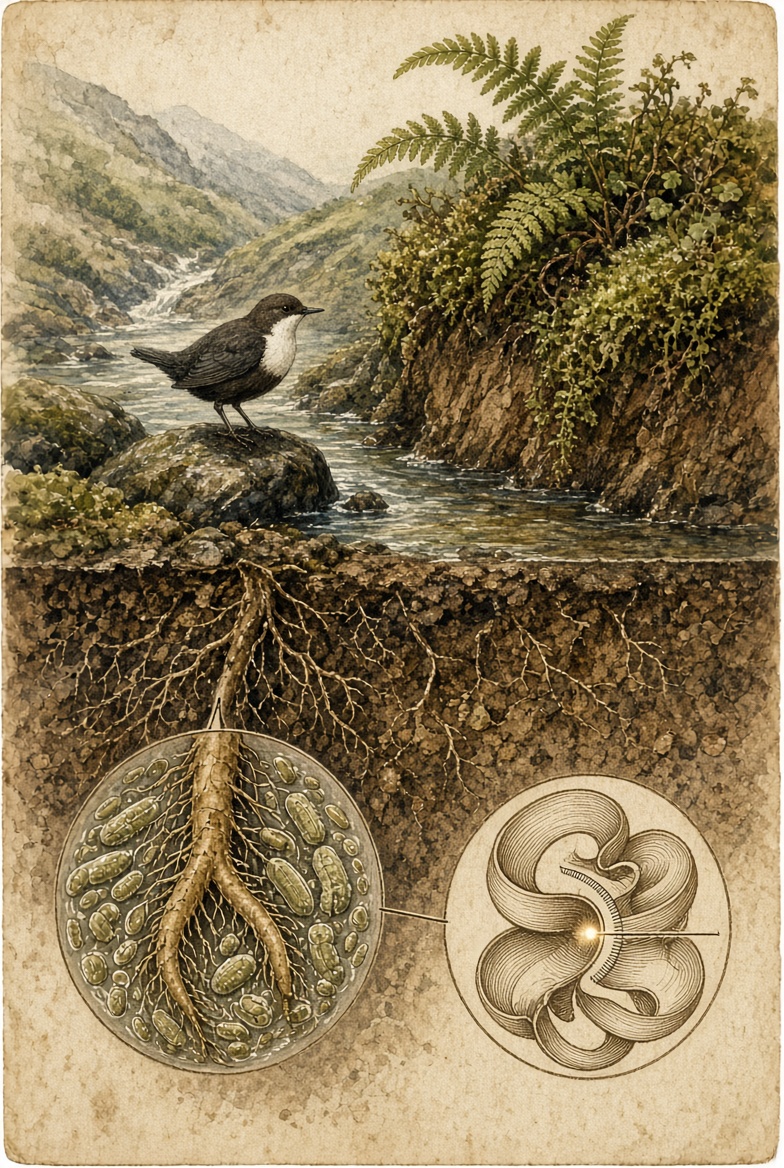
Reading the plateAbove the line, a dipper on a mountain stream. Below it the ground opens, and the two circles are the same life at magnification: bacteria packed around the root tip on the left, and on the right the folded pigment structure where an absorbed photon is passed along without being lost.
Schrodinger raised the question in 1944 in What Is Life? and was politely filed away. The objection was not evidential. It was architectural. Living systems were to remain machines built of parts, and parts do not tunnel.
Enzymes cheat. A chemical reaction is supposed to work like a hill. The molecules need enough energy to get over the top, and if they haven't got it, nothing happens. That is why you heat things to make them react.
Your body does not heat anything. It sits at thirty-seven degrees and runs the same reactions millions of times faster than they have any business doing.
The reason is that hydrogen does not go over the hill. It tunnels through it. A particle that small stops behaving like a thing in a place and starts behaving like a wave, and a wave that meets a barrier does not climb it; part of it appears on the far side. Quantum tunnelling, in a warm wet cell, inside you, is happening right now.
The way it was caught is the elegant part. Swap the hydrogen for deuterium, its heavier twin, identical chemistry and twice the weight. Climbing a hill does not care much about that. Tunnelling cares enormously, because a heavier particle is a worse wave. The reaction slowed far more than any classical model allowed, and it kept slowing in the wrong way for the wrong reasons until the only explanation left was the one physics had ruled out.
Klinman and Kohen nailed it at room temperature in 1989, and a decade later found the same thing running at sixty-five degrees in an enzyme from a heat-loving bacterium. Every enzyme in your body doing this kind of chemistry applies quantum mechanics at body temperature, and enzymes have been doing it for three and a half billion years.
Birds read spin.
Spin meaning the tiny built-in “north-south” of an electron, its quantum magnetic orientation.
In 1972 Wolfgang and Roswitha Wiltschko put European robins in funnel cages with no view of sky or landscape, lined so the bird's scratch marks recorded which way it tried to go. In autumn the robins pressed southwest, in spring northeast, the headings their migration actually requires. With every visual cue removed, something was still telling them which way was which. The Wiltschkos then wrapped the cage in coils and rotated the magnetic field. The birds turned with it, holding the same angle to the new magnetic north. The compass was magnetic, and inside the animal.
That is where the problem starts. The Earth's field is tens of thousands of times weaker than a fridge magnet, far too faint to move anything mechanically or to stimulate a nerve by force. There is no obvious way for it to be felt at all.
Klaus Schulten proposed the answer in the 1970s and named the molecule in 2000. Light striking a protein called cryptochrome in the retina knocks an electron loose, leaving two fragments each carrying one unpaired electron. The spins of that pair are quantum-correlated, and the ambient magnetic field tips the balance between their two possible states, which changes what the chemistry does next. Because the effect depends on how the molecule is angled to the field, a retina full of them would work as a compass, and the bird would in principle see direction laid over the world.
The protein Cryptochrome-4a is in the robin's eye. It sits in the outer segments of the double cone cells, it is more magnetically sensitive than the chicken and pigeon versions, and it is anchored to the stacked membranes in exactly the ordered alignment the mechanism requires. Purified robin cryptochrome-4a responds to magnetic fields in the laboratory.
The molecule is where the theory said it would be, built the way the theory said it would be built.
And the compass is not the bird's only magnetic sense. Pigeons carry magnetite, biological iron, and have been known to for decades. That system reads field intensity, which is position rather than heading. So the animal runs two instruments off the same field: iron for where it is, electron spin for which way it is pointing. Position and bearing. A navigator's kit.
What has not been done is the final measurement, putting a field of geomagnetic strength across the receptor inside a living bird and watching it respond. Nobody has built an instrument that can do it. It is worth being precise about what that means. Not that the mechanism is doubtful, but that the last confirmation is technically out of reach. Everything upstream of it is in place.
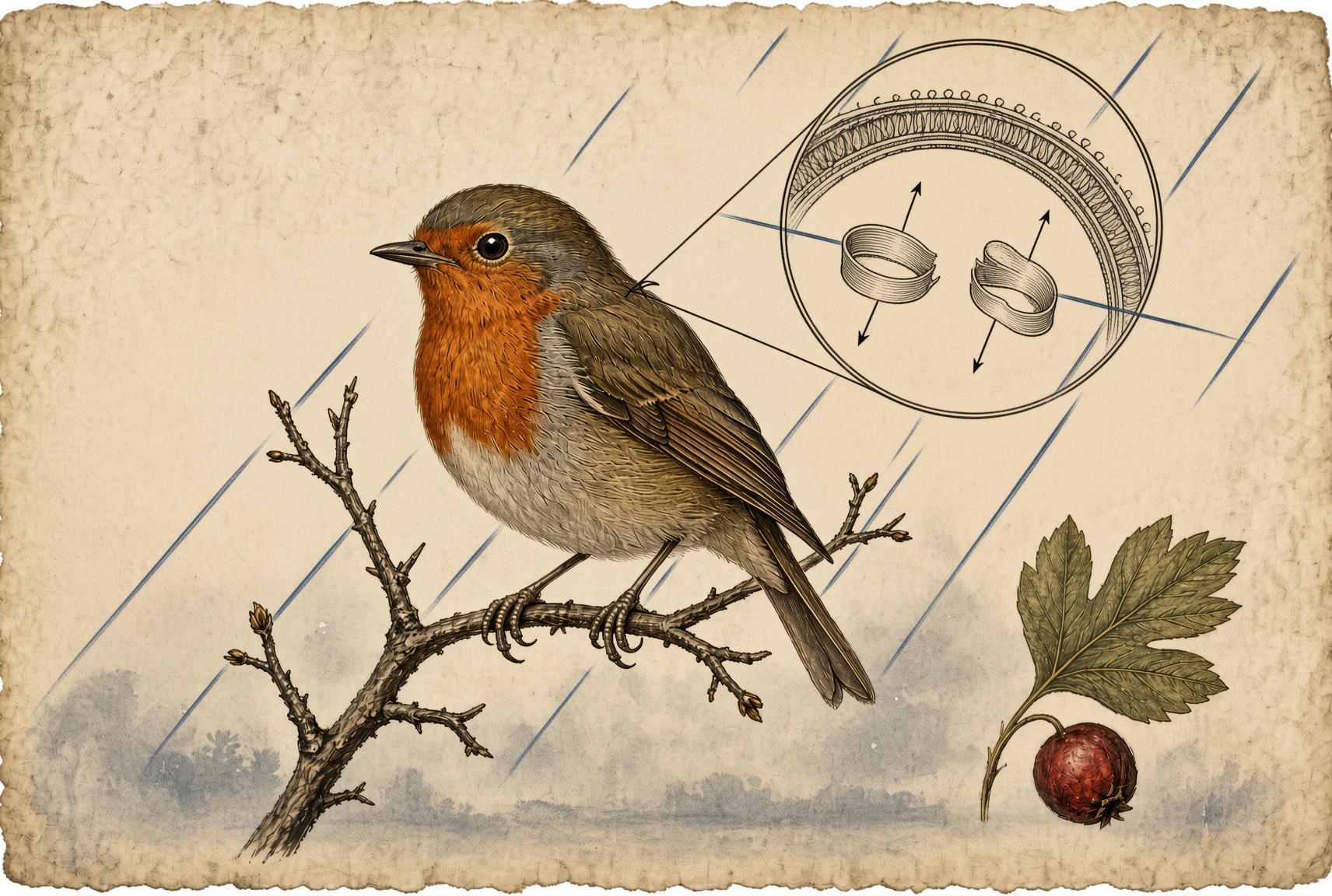
Reading the plateThe blue diagonals are the geomagnetic field. The circle is the back of the eye: the two ribbon coils are a single electron pair pulled apart, the arrows are their spins, and the ambient field tips the balance between them.
And there is a second thing out of reach, which no instrument will ever close. Nobody knows what the bird experiences. The chemistry sits in the retina and feeds the visual system, so the strongest reading is that the robin sees the field: a pattern laid over the world, brightening and dimming as the head turns. Not a needle. A texture in the light. We can map the molecule, the cell, the alignment and the response, and we cannot say what it is like. The mechanism is describable. The thing the animal actually has is not.
Rotation, Spin, and Biological Fields: The Physics of Cooperation
Now we enter more controversial territory, research suggesting that cooperation might operate through physical fields beyond the electromagnetic. This is where things get interesting, and where the suppression becomes most aggressive.
Élie Cartan (1869–1951): The Buried Colleague
Another great mind you may never have heard of. Cartan built the toolkit modern field theory still runs on: a measuring frame you carry with you, a language for how that frame changes from place to place, and the extra object, the spinor, that rotation demands once you take it seriously.
He treated geometry as something you do from the inside. You do not stand outside a space and list its properties. You attach three axes to wherever you are, forward, left, up, and you ask how those axes must be adjusted when you take a step.
That portable triad is a moving frame. Geometry is the rule for carrying it. Walk a closed path and come home. Two independent things can have happened to the frame you brought back. The axes can have turned. What you called “up” is now tilted. That mismatch is curvature. Riemann already had it: directions disagree with themselves after a loop. The frame can also have been shoved along one of its own axes, like a screw. You are at the same point, yet the origin of the triad has slid. That mismatch is torsion. Riemann’s geometry forbade it. Cartan wrote it down between 1922 and 1925.
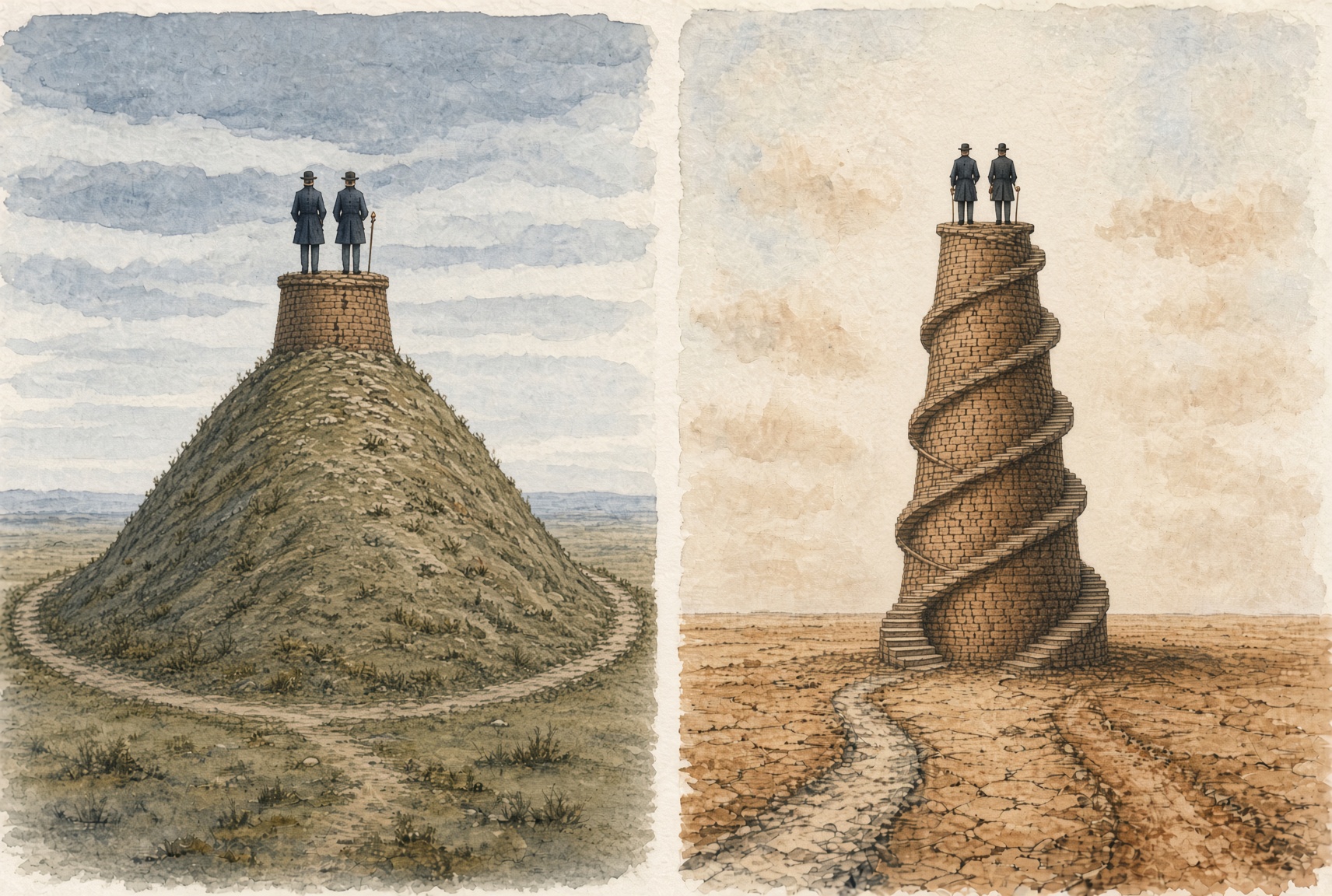
Torsion is what a continuum does when rotation belongs to the medium itself, not only to objects moving through it.
Please hang in there, dear reader.
What happened: in 1913, classifying rotations, Cartan found the spinor, an object that must turn a full 720 degrees to come back to itself. He was not doing physics. He was cataloguing what rotations can do, as a mathematician, with no application in mind and no electron to describe. The object fell out of the classification whether anyone wanted it or not.
Fifteen years later Dirac needed exactly that object to describe the electron and found it already waiting on the shelf. Note the shape of that, because it repeats. Cartan is never the man who is wrong. He is the man who was already right, earlier, in print, and who is reached for when somebody else needs the tool. Maxwell’s equations in Cartan’s language occupy two lines and need no curvature at all.
That word matters, because curved space is the one piece of modern physics everybody has met. The bowling ball on the rubber sheet, the planet rolling into the dent it makes. That is Einstein’s picture, and it is the picture most people carry for what gravity is and what space does.
Write electromagnetism in Cartan’s notation and the dent is not there. One line says magnetic flux is conserved. The other says charge is conserved. The first is pure topology: true in any space you like, curved, flat, or crumpled, because it never asks how far apart anything is.
Light and magnetism, the forces we actually use, run on a geometry that does not need the rubber sheet. So Einstein spent his life bending space, and the forces that run the world never needed the bend. Cartan wrote them down without it in 1922 and went back to his classification. He never made the argument. He just left the mathematics lying there where anyone could find it. A century later it is still lying there, and we are still teaching the rubber sheet.
Why it matters now: Einstein appears to have suspected as much himself. Between 1929 and 1932 he wrote to Cartan repeatedly, trying to build gravity without bending space at all: a field on a flat background, torsion doing the work, electromagnetism’s structural twin. Curvature would go. The rubber sheet would go with it.
Those letters survive and they are published, which is why this is not a matter of inference. Read them and one thing recurs: Einstein loses his footing in the geometry, and Cartan, courteous to the last line, is obliged to point out that the mathematics already exists, in print, under his own name, sometimes years earlier. He was right every time. He was also, every time, the man handing over the tools rather than the man holding them. Einstein abandoned the attempt.
What neither man had was the picture that would come later: a vacuum that is not empty and not still, churning particles into existence and out of it at every instant. Cartan’s torsion is what a medium like that would do. Einstein was reaching for a still frame of something that has never once stopped moving.
Cartan’s mathematics outlived the attempt and is used daily by physicists who could not name him. No fraud, no committee, no persecution. Celebrity did the work that suppression usually requires. That is the second mechanism, and it deserves a name because it is quieter than the first and it works better.
One kind of scientist is destroyed for saying the wrong thing: the funding stops, the reputation is dismantled, the word heretic gets used out loud. Another is absorbed for saying the right thing at the wrong moment, into the wrong ear, in a field that has already decided whose century it is. Cartan was elected to everything France had to give. He was never once attacked. His name came off the door regardless, because a discipline that has settled on its centre of gravity reorganises everything around that point, and the people who supplied the ground get folded into the footnotes. Destruction leaves a scandal, and a scandal can be reopened. Absorption leaves nothing at all.
He worked out how the universe screws itself together, and nobody clapped.
Nikolai Kozyrev (1908 to 1983): The Weight of Rotation
Kozyrev spent ten years in the Gulag before he did any of this work. Arrested in 1936 in the purge of Pulkovo Observatory, sentenced to ten years, released in 1946, and returned to astrophysics. That is worth knowing before the rest, because a man who has already survived the state is not easily deterred by a committee.
His findings: that a spinning object changes weight depending on the direction and speed of its rotation, by amounts too small to matter and too consistent to dismiss; that time itself might have physical properties, a density and a flow that acts on matter rather than merely indexing it; and that rotation generates something that is not an electromagnetic field. He also reported detecting stars at their true present (and future) position rather than where their light shows them, which would mean information arriving without waiting for light.
He treated time as a shared present you can aim at: a star’s one-way burning writes on that present, and a detector pointed at where the star is now, not where its old light sits, was his way of reading the writing. This is not the quantum link. Entanglement does not give you a bearing. He wanted a present you could point at.
The response: Decades of marginalisation inside the Soviet establishment. Experimental error, said the physicists. Delusion, said the less polite. The work was never refuted so much as declined.
The vindication, such as it is: Hayasaka and Takeuchi published weight anomalies in spinning gyroscopes in Physical Review Letters in 1989, in Japan, apparently unaware of Kozyrev. Albert Veinik in Belarus reported related effects across the sixties and seventies and was stripped of his position for it. Later attempts to replicate came back null, and the anomaly remains unresolved.
Three men in three countries, working separately, measured the same thing and two of them lost their positions for it. Physics has not explained what they measured. It has simply stopped looking.
Wilhelm Reich (1897 to 1957): The Martyr They Burned
Reich trained under Freud in Vienna and ran the psychoanalytic technical seminar before breaking with the movement over what he called sexual economics: the proposition that repression does not merely distort the mind but registers in the body, as muscular armouring, as illness. The break was with Freud himself. Freud refused to take him into analysis, then withdrew support from the free clinics Reich was running in working-class Vienna, and the younger man never got over it. What began as a disagreement about where neurosis comes from ended as a personal rupture, and the movement followed Freud.
From there Reich went further, into what he named orgone, a biological energy he claimed to detect, measure and concentrate. He built accumulators to hold it. He said the same energy could be moved in the atmosphere, and pointed a cloudbuster at the sky to make rain. The Air Force took an interest. So did the FBI, which had already held him on Ellis Island as an enemy alien in December 1941, weeks after Pearl Harbor, three years before any of the orgone litigation began.
His findings: an energy field observable around living organisms; energy starvation as the root of disease, cancer above all; devices to concentrate and direct it; and beneath all of it the older thesis, that sexual repression, emotional blockage and physical illness are one continuous process.
The persecution: The FDA obtained a federal injunction in 1954 forbidding sale of the accumulators. Reich refused to comply, arguing that no court had jurisdiction over scientific research. He was convicted of contempt and sentenced to two years. In June 1956 his books were burned in Maine. That August, six tons of his publications were incinerated at the Gansevoort Street furnace in New York, seized from his publisher's warehouse while he was still at liberty and appealing. He died in Lewisburg Federal Penitentiary in November 1957, roughly eight months into the sentence and days before a parole hearing. Cause given as heart failure. On 17 March 1960, three years after he was in the ground, the burning resumed.
Why Reich matters: This was not professional marginalisation. It was destruction, and it did not stop when the man died. Note what went into the fire. Not merely the orgone literature but Character Analysis, The Mass Psychology of Fascism, The Sexual Revolution. Psychoanalytic work from the 1930s, written before orgone existed as a word, praised in its day, unrelated to any accumulator or any medical claim. You do not incinerate a 1933 study of fascism on consumer protection grounds. That is the detail the official account cannot hold.
The cloudbuster was the lever. Rainmaking was the extravagant claim, they jumped on it as it gave the FDA the picture it needed: the crank with the ray gun. Everything sober underneath it, twenty years of clinical work on the body's registration of repression, went into the same fire on the strength of the weakest thing he may have ever said. That is how it is done. Find the one claim that looks ridiculous, hold it up, and burn the library behind it.
The connection: Reich was working the same ground as the rotation researchers, the energetic substrate of biological organisation, the proposition that living systems generate and respond to something beyond the conventional electromagnetic account. The others were sidelined, de funded, ignored. Reich alone was jailed and burned. The response was not proportionate to a fraud. It was proportionate to a threat.
The Water Consciousness Quartet: When H2O Refused to Stay Dead
Water. Two hydrogen atoms, one oxygen. Simple, inert, dead matter, or so the materialist orthodoxy asserts. However, a decades-long multidisciplinary succession of researchers at work, kept arriving at the same heretical conclusion: water is alive, it has memory, it responds to consciousness, and carries information beyond its chemical formula. For this reductionist faux pas, they were systematically destroyed, their work dismissed, their reputations left in tatters. The establishment cannot allow water to be anything more than H2O, because if water has memory and consciousness, the implications shatter too many profitable yet brittle paradigms.
Viktor Schauberger (1885-1958): Water Lives and Breathes
Austrian forester and naturalist Schauberger spent decades observing water in mountain streams, discovering that water doesn't just flow, it dances, spirals, and generates energy through vortex dynamics. He proposed that water is a living organism with memory and consciousness, that it moves through implosion rather than explosion, and that we could generate limitless energy by working with water's natural vortex patterns rather than fighting them.
He built devices based on these principles, implosion engines, water purification systems using natural vortex motion, eerily beautiful machines that generated energy by mimicking how water behaves in nature. His work threatened both energy monopolies (proposing free energy from water vortices) and scientific orthodoxy (water as living, conscious medium).
What happened: In 1958 he was taken to America on a promise of development. He came home without the papers. Five days later he was dead. The documents were never seen again. That is the record the family was left with. The other side never produced the files. His devices were never mass-produced. His account of living water remained outside the textbooks.
Jacques Benveniste (1935-2004): Water Remembers
French immunologist Benveniste discovered something that should have been impossible: water retains the memory of substances that were once dissolved in it, even after dilution so extreme that no molecule of the original substance remains. This was the physical basis for homeopathy, and therefore threatened the entire pharmaceutical industry.
He was no fringe operator. He was research director of INSERM Unit 200 at Clamart, outside Paris, and the paper that ended him was co-authored across four laboratories in France, Canada, Italy and Israel. It appeared in Nature on 30 June 1988: “Human basophil degranulation triggered by very dilute antiserum against IgE,” in solutions containing no antibody at all, only water that had remembered it. Nature published it with an editorial reservation attached, a device the journal had last used in 1974 on a paper about Uri Geller. The firestorm was immediate. Nature's editor Sir John Maddox personally led an investigation team into Benveniste's laboratory: himself, the fraud investigator Walter Stewart, and the professional magician and debunker James Randi.
What is usually left out is what they found. Of the first four replication attempts conducted under their supervision, three came out somewhat favourable to Benveniste. The team judged the methodology insufficiently rigorous and designed their own double-blind protocol. Under that protocol the results went negative. So one month later Maddox, Randi and Stewart published their verdict in Nature in July 1988 under the title “High-dilution experiments a delusion.” Benveniste's objection, which he repeated for the rest of his life, was that the protocol they imposed was not the protocol he had used.
And here is the detail that matters most. The paper was never retracted. Benveniste refused to withdraw it, and Nature never withdrew it either. It stands in the literature to this day, unretracted, thirty-eight years later. They could not remove the finding, so they removed the man.
The destruction: funding eliminated. Research team disbanded. Reputation demolished. Called a fraud, a charlatan, delusional. He funded his own work from that point on, founding the company DigiBio in 1997, and died in 2004. The establishment's message was not subtle: challenge pharmaceutical orthodoxy with water that remembers, and we will annihilate you.
Masaru Emoto (1943-2014): Water Responds to Consciousness
Japanese researcher Emoto took water memory further: he claimed water doesn't just remember chemicals, it responds to human consciousness, words, music, and intention. He photographed frozen water crystals after exposing water samples to different stimuli: classical music against heavy metal, words like love against hate, prayers against curses.
The results were visually stunning: water exposed to positive stimuli formed beautiful, symmetrical crystals; water exposed to negative stimuli formed chaotic, broken patterns. His books sold millions, his images went viral, people around the world saw the differences with their own eyes.
A necessary distinction, to avoid detractors pointing it out. Emoto was not a case of academical destruction, because he had nothing academic to destroy. He held no university chair, no research grant, no laboratory that could be closed. He was an entrepreneur and an author who worked outside academic science entirely, and his crystal photography was never controlled in the way the term requires: the photographer knew which samples were which and chose which crystals to shoot. He belongs in this account not as a martyr but as communicator. He is the one who took the idea out of the journals and placed it into millions of hands, and that dissemination made him a target.
The establishment's response was his vicious dismissal as pseudoscience, cherry-picked data, wishful thinking. Scientists lined up to explain why it was impossible: consciousness cannot affect water structure, the experiments were not properly controlled, it was all confirmation bias and photographic selection.
But there was something they could not brush away: millions of people resonated with Emoto's work because it matched their direct experience. Water blessed and water cursed feel different. People know this, even if they cannot measure it. Emoto gave them a visual language for something they had always sensed, that consciousness and matter interact, that intention affects physical reality, that water is alive and listens.
Luc Montagnier (1932-2022): The Nobel Laureate Who Vindicated Water Memory
This is where the suppression rears the most its ugly head. Montagnier won the 2008 Nobel Prize in Medicine for the discovery of HIV, the prize went to the Pasteur group, not to Gallo, after years of a bitter American claim on the same virus. Maximum establishment credibility. Impeccable scientific reputation. Then he picked up Benveniste's water memory research and confirmed it.
Montagnier's experiments showed DNA emitting low-frequency electromagnetic signals that water can detect and retain. He claimed to teleport DNA information by recording the electromagnetic signature from DNA-containing water, transmitting it electronically to pure water elsewhere, then reconstructing the sequence from the signal-imprinted water.
He said a coil could hear DNA in water, that the hiss could travel a wire or a file, and that naïve water at the far end, Paris to Italy, could be made to yield the sequence back by ordinary PCR. Benveniste had already put a molecular signal on the telephone. Montagnier put a genome on it.
He then published papers suggesting homeopathy might have a physical basis in water's electromagnetic memory.
The response was immediate character assassination. Sad. Tragic. Senile. Delusional. His Nobel Prize was turned into a weapon against him: how heartbreaking that such a brilliant scientist has lost his mind in old age. His later papers were rejected by major journals. His reputation was buried.
Two things about that collapse deserve stating in full, because they are the two things his critics reach for first.
The 2009 papers appeared in Interdisciplinary Sciences: Computational Life Sciences, a journal of which Montagnier himself was editor in chief. That was his Achilles heel, but it also makes a point.
He became a Nobel laureate in medicine fifteen months earlier, and no journal outside his own reach would publish him on this subject. The conflict of interest was not a shortcut. It was the only door left open.
Then, in 2010, he left France for Shanghai Jiao Tong University to found an institute and continue the work. A man who had discovered HIV, whose Nobel was among the least disputed in modern virology, exiled because he could not obtain a laboratory or funding anywhere in Western Europe for research into the electromagnetic properties of water. He was seventy-eight years old. He went to China because China would have him.
Consider what that required. Not a quiet refusal but a continent-wide closure, applied to a man carrying the highest recognition science can issue, within two years of being awarded. If the Nobel Prize in Medicine cannot provide you certain access, the question is not whether Montagnier was wrong, but what was at stake.
The record is not entirely one-sided, they left a crack open. In 2014 UNESCO hosted a meeting in Paris that Montagnier convened on the memory of water. He was not wholly exiled. He was simply unfundable, unpublishable in the venues that count, and, in the phrasing his colleagues used for the record, sad. He died in February 2022.
Gerald Pollack: the one they could not fully expel
There is a fifth figure in this story, and the most instructive of all, because he looks, at a glance, like the exception. Gerald Pollack holds a chair in bioengineering at the University of Washington. In 2008 the faculty chose him to deliver the university’s annual lecture, its highest internal distinction.
He received the Prigogine Medal in 2012, an NIH Director’s Transformative Research Award, and still runs a laboratory in Seattle. The establishment did not bury him but neither agreed with him. His claim about water is not modest. Pollack argues that water has a fourth phase, neither solid nor liquid nor vapour but something between the first two: a gel-like layer that builds outward from a water-loving surface, hundreds of thousands of molecules thick. What repeats in the layer, he says, is H₃O₂, not water as written, and not the peroxide on a shelf. It is, in his account, a stacking: how molecules sit next to a wall. You cannot bottle it. It ceases when the surface and the energy that built it stop. It carries a negative charge, pushes protons into the bulk beyond, and is fed by light. Water, here, is a battery charged by the sun. Follow that into the body and the implications run deep. Cells are dense with water-loving surfaces. If the strong version is right, much of the water inside us is not loose liquid but this ordered, charged layer.
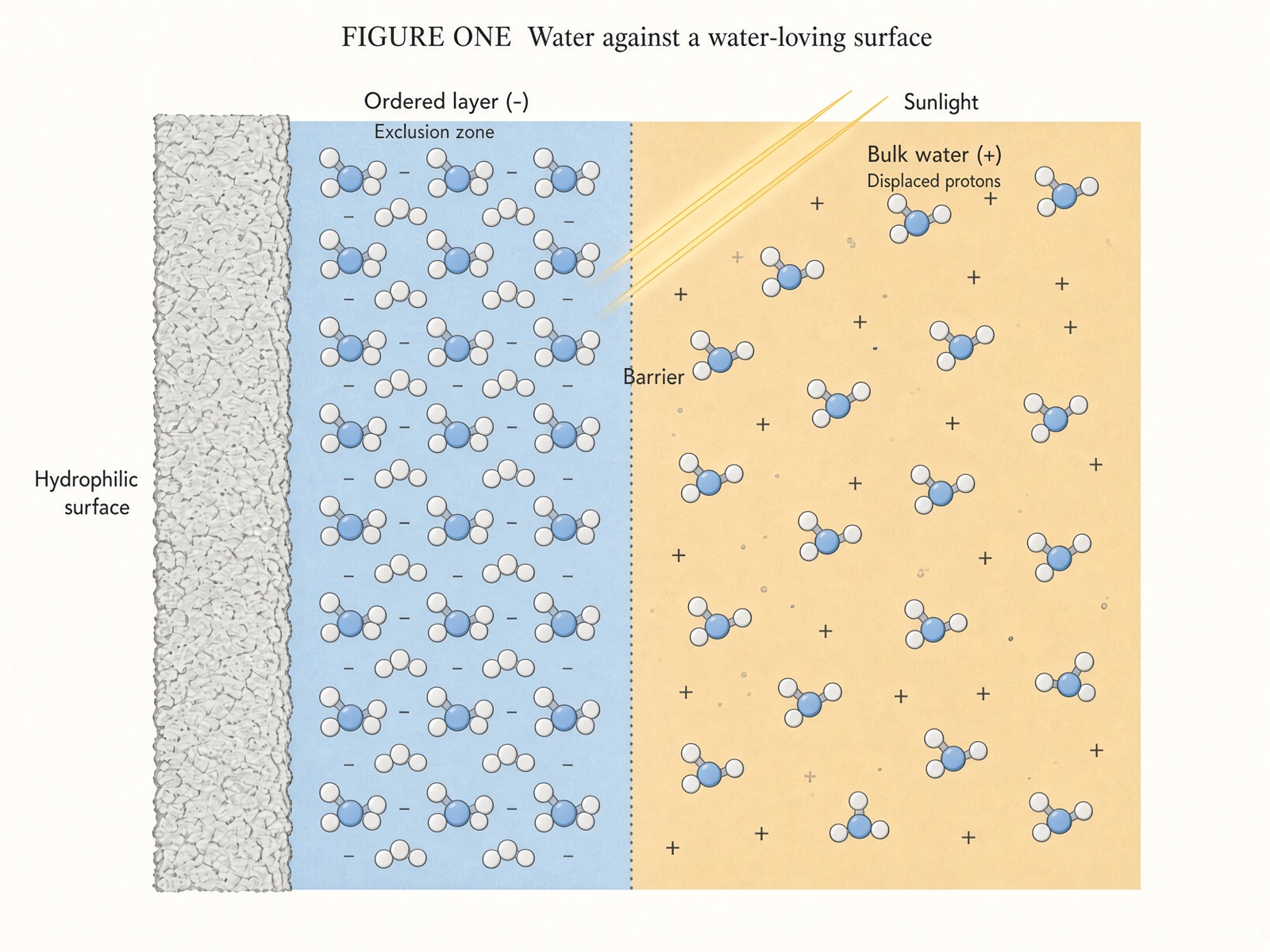
The watermelon is the parable he likes: cut it, and the water does not flood the board. Fair as an image. Weak as a proof. Fruit holds water with sugars, gels, and capillaries. That is not yet a fourth phase of H₂O. So why is he still standing? Not because the chemistry was waved through. The exclusion zone next to some hydrophilic surfaces is a real dish effect, seen by more than one laboratory.
The cathedral built on it, a new phase, a honeycomb of H₃O₂, a solar battery inside every cell, was not adopted. It was parked: in a journal he founded because the ordinary ones would not take the papers; in an Institute for Venture Science he founded because he judged the funding system hostile to anything that overturns a textbook; in a book that did not have to survive peer review. In 2009 the American Chemical Society’s own magazine asked the question in a headline: Watering Down Science? Tenure kept the office. It did not keep the theory.
There is a story one wants to tell at this point, and it is almost beautiful. The establishment will tolerate water being weird. It will not tolerate water being information. Structure is allowed. Memory is not. The forbidden step is not complexity, it is meaning. That was the red line. Pollack seemed to stand on the safe side of it. Electrodes, not prayer. Charge separation, not a loving word on a jar.
Then the line moved, or he did. In later talks the same water acquired “information storage capability” and “may also respond to intention.” He accepted the first Emoto Peace Prize. Emoto is the frozen crystal, the written word, the claim that water keeps a mood. You cannot take that prize and still be the man who never crossed into meaning. The prize is the receipt.
So he is not the one they let through. He is the one they could not fully expel: a tenured engineer with a genuine interfacial puzzle, speaking the language of batteries just long enough to sound like physics, then one polite sentence away from the very mysticism the chapter was using him to exclude. That is more useful than an exception.
It shows what the boundary was actually made of. Not principle. Proximity. A professor with a voltmeter is harder to throw out than a mystic with a jar. Give the professor twenty years and a private journal, and the voltmeter and the jar start to share a conference.
The crumbs that remain are smaller than the poster. Water at a charged wall is not ordinary soup. Surfaces in the body are wet and electrical. Light and heat are not nothing. None of that requires a fourth phase, and none of it forbids you from saying the dish was interesting. What it forbids is the comfort of a martyr who stayed pure. Pollack did not stay on one side of the line. He showed that the line was never a wall. It was a gradient, and he lived on it.
The Pattern: Water Must Remain Dead
Five researchers. Five different approaches. Five decades. One heresy: water is more than H2O. Four collisions with the gate, and one man who shows us that the gate was never a wall.
Why? Because if the strong claim were true, that water keeps a trace of what it has met, and that living systems can use that trace, then a great deal of settled practice would have to move:
- homeopathy would have a physical question still open, not a closed door
- the clean split between mind and matter would have to be argued again
- information moving in water would stop being only a metaphor
- the medium of the body would no longer be a dead solvent
Water represents 70% of Earth's surface and roughly the same proportion of the human body. If that medium is more than a passive solvent, we have been, and remain, wrong about something basic in the nature of life. That is enough to threaten orthodoxies. It is not yet a proof.
Schauberger came home without his work and died five days later. Benveniste was destroyed professionally and died with the paper still standing, unretracted, in the pages of Nature. Emoto was dismissed as a pseudoscientist despite reaching more people than all the others combined. Montagnier's Nobel Prize could not buy him a lab in his own continent. And Pollack, who lived on the gradient between structure and meaning, kept the chair and lost the theory.
The establishment's message, as practised rather than as preached, is simpler than a conspiracy: water is to remain H2O, nothing else. To push past that will cost you.
Caveat: the plasma bag
Blood plasma is around 92% water. It is a straw-coloured fluid that carries everything: hormones, antibodies, clotting factors, waste, signal. Hang a bag of it above a body and the body lives. It is the most ordinary demonstration available that water in a living system, not a solvent sitting passively around the interesting parts. It is the medium in which the information moves.
The word invites a mistake worth avoiding. Plasma carries two unrelated scientific meanings, that arrived independently from each other. Purkinje took it in the 19th century for the fluid fraction of blood, from the Greek for something moulded or formed. Langmuir resorted to it again in 1928 for ionised gas, because the glow in his discharge tubes seemed to ferry particles the way blood ferries corpuscles. Two thefts of the same word, eighty years apart.
Pollack's 4th phase is neither. It is not ionised and it is not blood. What genuinely connects them is charge separation: a fluid that holds a potential rather than just filling a space. That is the clue, and a stronger claim than a semantic coincidence.
Lets Step back for a moment
We are a long way in down this rabbit hole and the thread is worth holding up to the light.
Everything in this feature turns on one denied proposition: that living things are readers. Not machines that respond, but systems that take information out of their surroundings, keep it, and act on it. Kropotkin read cooperation where the century insisted on competition. Margulis found cells that had merged rather than fought. Enzymes turned out to run on quantum tunnelling at body temperature, a warm wet cell doing physics that was supposed to require near absolute zero. A robin navigates on a pair of correlated electron spins in the back of its eye. Benveniste said water keeps a record and was destroyed for it. Pollack said water holds structure, then stepped toward meaning, and kept the chair while the theory was parked.
That is the line the whole thing runs along, and the next man walked straight across it.
Frank Brown made the readers claim in its broadest form. Not that a particular organism reads a particular signal, but that all of them are reading all the time, from an environment we have never successfully measured, and therefore could not exclude. Constant conditions described the experimenter's attention, not the room. That was a real hole in the method, and it did not save him, because he pushed the point further than it would carry.
He was wrong about the mechanism, comprehensively and deservedly. He was right about the sensing, and the vindication came from exactly the quantum biology this feature has just walked you through: the radical pair in the robin's eye is the answer to the question Brown was laughed at for asking. It arrived forty years late, under other names.
Frank A. Brown Jr. (1908 to 1983): The Oysters That Knew Where They Were
In 1954 a biology professor at Northwestern University, outside Chicago, had a consignment of live oysters shipped from the Atlantic coast to Evanston, Illinois. 1250 kms inland. He put them in sealed tanks of still seawater, in constant low light, at a fixed temperature, and recorded when they opened their shells.
Oysters open to feed when the tide comes in. For the first fortnight, Brown's animals kept opening on the tidal tables of the beach they came from, which is what you would expect from an animal running on a routine.
Then they drifted. And they settled into a new rhythm, it was timed to the moon passing overhead at Evanston. Which is to say: the hour high tide would arrive, if Illinois had a coastline.
It does not. There was no tide, no light, no change in water level, no temperature swing, nothing in those tanks had changed. The oysters reset their clocks to an ocean that does not exist, in the dark, in a sealed box, in the US Midwest.
Brown published it in the American Journal of Physiology in 1954 and spent the next thirty years arguing what it meant. He lost the argument. He deserved to lose most of it. The part he did not deserve to lose is still there, and it matters now more than it did back then.
What he thought was happening
Brown's conclusion was blunt: living things have no independent internal clock. Or at least not one that runs on its own. They constantly read the environment, and the environment does not stop at the lab wall.
The Earth's magnetic field fluctuates. Atmospheric pressure rises and falls. Background radiation varies. The moon's gravity pulls on everything, tank water included. All of it passes through glass and steel and darkness without even noticing them. All of them tuned with lunar and solar periods. Brown's proposed that organisms were sensitive enough to read them. He argued, that a constant condition experiment is an experiment where the obvious variables have been removed and the subtle ones left running.
He spent decades building the case. Fiddler crabs whose colour changes tracked both the solar day and the lunar day. Potatoes sealed in chambers whose oxygen consumption rose and fell in step with weather pressure they had no obvious way to measure. And seeds: he reported that daily rotation altered growth, that turning them clockwise and anticlockwise did not give the same result, and seeds placed near each other seemed to interact in ways the known forces did not cover.
Why he lost
Because his opponents, Colin Pittendrigh at Princeton and Jurgen Aschoff in Germany, were right.
Their model was the internal clock: a genuine oscillator inside the organism, which in constant conditions runs at a period close to but not exactly 24 h. That approximation is what killed Brown. If an organism were taking its time from external geophysical signals, it would keep exact time, because those signals keep exact time. A clock that drifts to 23.5 h, or 25 h, is a clock that is not listening to anything outside itself. Brown never had an answer.
His best technical argument was temperature. Chemical reactions run faster when heated, so an internal chemical clock should speed up in the warmth. Biological rhythms do not. Brown took that as proof the timing came from outside. Then Pittendrigh measured the temperature sensitivity of the fruit fly hatching rhythm in 1954 and got a coefficient of about 1.03, near enough to zero sensitivity to destroy the inference. It also emerged that Brown's own crab data rested on someone eyeballing pigmentation against a five point scale, unblinded.
He also never chose a mechanism. He proposed several candidate signals and committed to none of them, which is fatal in an argument over how something works.
Then the molecular evidence arrived, and it ended the argument.
The clock turned out to be a loop of proteins, and the loop takes a day to go round. A gene switches on and starts producing its protein. The protein builds up through the day. When there is enough of it, it goes back and shuts down the gene that made it. Production stops, the protein degrades overnight, the level falls, and the gene switches on again. That rise and fall is the clock. Nothing ticks. A substance accumulates and clears, and the accumulating takes about 24 h.
Which means you can reach inside and move it. Damage one of those genes in a fruit fly and the animal's rhythm changes: break it one way and the fly runs on a 19 h day, break it another and it runs on 28 h, break it another way and the rhythm disappears. No change to the light, temperature, magnetic field or anything else outside the animal. Just a broken gene and a broken clock.
Jeffrey Hall, Michael Rosbash and Michael Young worked out how the loop is built and took the 2017 Nobel Prize in Medicine for it. The clock is not a vague property of being alive. It is a specific circuit, in specific cells, made of molecules you can name and point at.
Brown was wrong.
What went out with him
To argue that organisms read the geophysical environment, Brown had to argue that organisms can detect the Earth's magnetic field. In the 1950s and 60s that was the most ridiculed part of his position, the kill switch his colleagues used when they wanted the conversation to end. A memoir written from inside the opposing camp described him as tenacious and later outrageous. Magnetic sensing was the outrage.
It is now mainstream. Bacteria that orient using internal chains of magnetite crystals. Homing pigeons. Sea turtles. Sockeye salmon. Yellowfin tuna. Bats. Honeybees. The literature runs deep and the mechanisms are partly solved: magnetite in some, ocular quantum chemistry in others.
And in March 2019, a Caltech group published evidence that human brainwaves respond to it. Wang, Shimojo, Matani and Kirschvink put people in a shielded chamber, rotated an Earth-strength magnetic field around them, and recorded specific, repeatable drops in alpha band activity.
The subjects felt nothing. The brain even discriminated: when the field was set to a configuration that does not happen naturally at that latitude, the response vanished. It was not simply detecting a field. It was checking whether the field was plausible.
Note what the stimulus was. Rotation. Not strength, not polarity. The turning of the field, which is what happens when you move your head. Brown said organisms sensed rotation and geomagnetic change, and they all laughed at him.
Seventy years later it is published science, replicated across a dozen species, and taught. His name appears nowhere. The vindication arrived through geobiology and neuroscience along a completely different route, they did not need his knowledge. He became invisible.
What a tree actually reads
There is a second half to Brown's claim, and it did not go down with the first. Magnetism was only his example. The real argument was that organisms read their surroundings at a resolution the laboratory does not reach, and that when we declare conditions constant it only means we have removed the variables we have thought of. If that is correct, it should be true of things that have no magnetic sense at all, no nervous system, no capacity to move. It is.
The Silver Birch, Betula pendula, performs a measurement at dusk, every day of its life, and the measurement is specified in nanometres. The sensor is a protein called phytochrome, and it is a two-state switch. One form absorbs most strongly at 660 nanometres, in the red. The other at 730 nm, in the far red. Red light flips it one way, far red flips it back, and because both are arriving at once the switch settles at a balance point set by the mix. That balance is the reading. The plant is not detecting brightness, it is detecting the proportion of red to far red in the light falling on the leaf.
Blue is handled around 450 nm by cryptochrome, the same molecule family that carries the robin's compass, and ultraviolet by a fourth receptor at roughly 285 nm to 300 nm.
That is the entire instrument. Four channels, no brain, no nerves, and measuring 15, 20 metres tall it will not be hand-held. Whoops.
In open daylight the ratio of red to far red sits between about 1.15 and 1.3. At dusk it collapses to around 0.6, because the atmosphere scatters short wavelengths out of the direct beam while 730 nm passes almost unhindered. Field measurements put the daily drop at 32% in Helsinki in July, and 28% at Gual Pahari, a Finnish and Indian monitoring station in the haze south of Delhi.
That pairing is the whole point. Helsinki sits at sixty degrees north in clean subarctic air. Gual Pahari sits at twenty-eight degrees north under (pollution) particulate loads above 170 micrograms per cubic metre, a heavy fraction of it soot. Thirty-two degrees of latitude apart and four or five times the dirt in the air, and the signal differs by four percentage points.
Because the signal is not made by anything local. It is made by air itself. Nitrogen and oxygen scatter light in inverse proportion to the fourth power of its wavelength, which strips short wavelengths from a beam far harder than long ones. At noon the light crosses one atmosphere's depth. With the sun on the horizon it transverses that thirty-eight times. The same selective stripping, run through thirty-eight times the air, empties the red out of the direct beam while 730 nm walks through almost untouched.
And the small difference goes the right way, which is what closes it. Aerosol particles scatter far more evenly across the spectrum than air molecules do, so adding them to a steep process flattens it. The theory says the dirtier station should show the shallower drop. It does, by four points. That is not two measurements agreeing. It is a mechanism confirmed twice, once by the size of the effect and once by the size of the discrepancy.
Which is what makes it usable. A cue only becomes worth evolving to read if it is dependable across the whole range a species occupies, for millions of years. The dusk gradient is generated by the bulk atmosphere, holds from the Arctic to the tropics, and nobody noticed it until somebody put a spectroradiometer out at sunset. It is not the brightness that carries the information. It is the slope.
And there is a second signal at dusk, stranger than the first. The deep blue overhead in the last of the light is mostly not scattering at all. It is ozone, absorbing across a broad band centred at 600 nm and taking the orange and green out of the sky. Hulburt worked out in 1953 that with the sun on the horizon, only about a third of the blue overhead comes from scattering, and two thirds from ozone. Deeper into twilight it is essentially all ozone.
So an oak standing in a field at dusk is reading two things at once: a collapsing ratio between two wavelengths, and a blue produced by a gas twenty kilometres above it.
Does it actually move anything?
It does, and this is where it stops being a curiosity. Linkosalo and Lechowicz grew silver birch under simulated natural twilight and under twilight enriched in far red. Bud burst came four days earlier. Brelsford and Robson found dormant branches of three tree species flushing four to six days early when the light period included blue.
Trees are not only counting hours of daylight. They also read how the sky changes colour at the edge of day, and in silver birch that reading can move bud burst by several days. That should have been a late gift to anyone who said the organism is listening to more than a clock. By the time it was measured, Brown had been 30 years out of the argument.
Why the second half matters
Look again at what the internal clock actually is, because there is a detail in it that Pittendrigh's victory obscured.
The oscillator is sloppy. That is not a defect, it is the finding. It free-runs at roughly 24 h, and roughly is the operative word: 23.5 h in some organisms, 25 h in others. That drift is precisely what proved the clock was internal, because anything reading an external signal would keep perfect time.
So the clock is not a timekeeper. It is an approximate oscillator that gets corrected once a day, and the correction happens at dawn and dusk. The system depends not on the oscillator being accurate but on the correction signal being legible.
Brown lost the argument about where the clock is. He was right about where it looks.
The field has never gone back to ask how far that looking goes. Nobody knows the full list of what an organism reads at the boundaries of the day, or how fine the reading is, or what happens to it when the signal degrades. Not because the question is hard. Because it was filed, seventy years ago, in a drawer marked Brown.
The Akimov Affair: how one fraud closed a field
Now the ugly part, and it needs telling straight, because it is the single most effective piece of suppression in this entire essay and not carried out by the establishment but handed to them.
Lets start with the word Torsion as it means two completely unrelated things, and almost anyone outside the relevant departments knows it.
Cartan's torsion is geometry, and it is simpler than it sounds. Carry a set of reference directions around a closed loop, the way you would keep track of up and forward while walking a circuit. Bring it back to the start and compare. It can come back rotated, pointing a different way than when it set off, and that is curvature. Or it can come back pointing exactly the same way, but shifted sideways along its own path, so the loop never quite closes. That is torsion.
That is all. A defined mathematical object, in the literature since 1922, and not controversial.
Whether it does anything measurable in ordinary matter is another question. The right answer is a NO. Its effects from particle spin only become significant at densities far beyond anything in the known universe, including the interior of a neutron star.
Akimov's torsion is a claimed fifth force. Carried by spin rather than energy. Not attenuating with distance, so no inverse square law. A left handed and a right handed field with opposite biological effects. And unlike Cartan's, it came with hardware: generators you could build, and buy. It has nothing to do with Cartan except the name.
In the 1980s Anatoly Akimov ran the Soviet Centre for Non-Traditional Technologies, and the claims made there ran from faster-than-light communication to medical cures. A commission of the State Committee for Science and Technology investigated in 1991, alongside the Academy of Sciences, and found the funding of a substantial institute spent across a decade with almost nothing published through legitimate channels.
The Centre was closed. Akimov was dismissed. He immediately founded a private institute with a grand name and carried on, and secured Russian Federation Ministry of Defence money again in 1996 and 1997. What the Ministry got for its money has never been published. Whether that is because it was classified or because there was nothing to publish, nobody outside Moscow can say.
In 2000, the physicist Valery Rubakov published a review in Physics-Uspekhi showing that Gennady Shipov's underlying theory contained fundamental mathematical errors. Their academy memberships were in a different and considerably less rigorous body than their titles implied. It was indefensible, and it deserved everything it got.
The Big Tar Brush
What happened next is the thing to watch.
The scandal did not close down Akimov's claims. It closed down the word. Any research touching rotation, spin or torsion in a biological or geometric context could now be dismissed by association, and it was. Cartan's geometry was never in question and Brown's magnetic sense was confirmed by a route that went nowhere near any of this, which is worth saying plainly, because the tar brush does not distinguish and the reader should.
The technique has five steps and it is reusable.
Wait. No need to plant a fraud in a field you dislike. Any sufficiently unfashionable field will produce one on its own, given time, unfashionable fields attract people with nothing to lose.
Amplify. Report the fraud accurately and at volume. No fabrication is required at any point, which is what makes the method so durable.
Generalise. Let the word do the work. Torsion is discredited. Not Akimov's torsion, not his generators, not his budget. Torsion.
Refuse the distinction. When somebody points out that Cartan's torsion is a piece of pure geometry with no relation to any of it, treat the correction as special pleading from a sympathiser.
Wait again. Within a decade nobody remembers the details. What remains is a reflex, and the reflex does the policing for free.
Reich lost his published work the same way. The cloudbuster was the lever: the rainmaking machine gave the FDA the picture it needed, the crank with the ray gun, and twenty years of clinical work on how repression registers in the body went into the same furnace on the strength of the most extravagant thing he ever said. You do not burn a 1933 study of fascism on consumer protection grounds.
The method is always the same. Find the weakest claim in the vicinity, hold it up, and burn the library behind it.
Seven Ways to Bury a Discovery
If you have read this far, a pattern has already suggested itself and then falls apart on inspection. The pattern is that there is no single pattern. There are many, and they are not variations on a theme. They are different machines doing different jobs, and telling them apart is the whole difference between a conspiracy theory and an argument:
Contamination by politics. Kropotkin was not refuted. He was answered by pointing at the author. Once the first sentence about a man is that he is an anarchist prince escaped from a Tsarist prison, the second sentence, about his data, does not get read. The Siberian observations still stand. They were simply attached to a name the century could not use.
Expropriation. Schauberger did not lose an argument. On the surviving account he lost control of the papers: material taken into other hands at the war’s end, and rights signed away thirteen years later. The science was never engaged at all. The material changed owner, and the owner had no obligation to publish.
Demolition. Benveniste is the one everybody pictures, and it is the rarest. The editor of Nature flew to his laboratory with a fraud investigator and a stage magician and published the verdict in his own journal. Note what it could not achieve. The paper was never retracted. They removed the man and left the finding, which tells you which of the two was actually within reach.
Attrition. Montagnier was a Nobel laureate, which made a frontal assault expensive, so nothing dramatic happened at all. Journals declined. Funding did not arrive. Colleagues said, on the record, that it was sad. Within two years of the prize he could not obtain a laboratory anywhere in Western Europe, and at seventy-eight he went to Shanghai because China would have him.
Absorption. Cartan was honoured, elected, cited and used, and his name came off the door anyway. This is the quietest of the seven and it leaves no evidence. Demolition leaves a scandal, and a scandal can be reopened. Absorption leaves nothing to reopen.
Discredited wholesale. Brown lost an argument he deserved to lose, and a separate claim he was right about went into the skip beside it, because nobody had any interest in sorting the two.
The tar brush. Akimov's fraud closed a field he had nothing to do with, by contaminating a word.
The cheapest of all, because somebody else does the work for you and you need only decline to make a distinction.
The control case
Which brings us back to the man they could not fully expel.
Pollack has spent decades claiming water has a fourth phase, and kept the chair, the laboratory, and the medals. Tenure is not the same as assent. The difference between him and Benveniste looked, for a long time, like one step, and that step is still the most useful thing in this essay.
Pollack said water has structure. Benveniste said water has content. Structure is a property, and properties are permitted to be as strange as the mathematics will carry. Content implies something that reads it, and the reader is what cannot be admitted.
Then Pollack stepped toward information and intention, and took a prize named for the man who said water keeps a mood. The control case is therefore imperfect, which is the point. Physics will accept photons behaving as a solid, particles correlated across any distance, matter with a repeating structure in time. None of it threatens anything, because none of it means anything. The moment a substance is said to hold information you have introduced an interpreter, and the interpreter is the ghost the whole edifice was built to evict.
What this is not
None of the above requires a room where people decide what gets buried. That is exactly what makes it durable. Every one of these mechanisms is something a functioning institution does for good reasons on most days.
Reputations are a legitimate filter. Funding is finite and somebody has to say no. Disciplines have boundaries and need them. Peer review exists because most heterodox claims are wrong, and that is arithmetic rather than cynicism.
The machinery is not corrupt. It is undiscriminating. It cannot tell an idea that is wrong from an idea that is early, because from the inside, on the day, those two look identical. And it has no mechanism at all for going back later to check.
Which is the thing itself, and it has a name, One I have already resorted to in a previous and somewhat related essay.
A ratchet turns one way. Teeth on a wheel, a pawl resting against them, and the wheel advances freely in one direction and cannot come back. That is not a flaw in the mechanism. It is the mechanism. A ratchet with a reverse gear is just a wheel.
Academic knowledge is built the same way, and more often that not that is a virtue. A discipline that revisited every settled question would never settle any of them, and no one would get anything done. So it advances, and each advance drops a pawl behind it, and the thing that was decided stops being a decision and becomes the floor everybody stands on.
What this feature has been describing, case by case, is the teeth. Contamination by politics. Expropriation. Demolition. Incineration. Attrition. Absorption. The tar brush. Seven different pawls, seven different ways of ensuring the wheel cannot turn back, and not one of them requiring anyone to intend it. They are simply what a functioning institution does when it moves forward and needs to keep what it has gained.
The consequence is the same every time. Not that the field decided wrongly. That the field, having decided, has no way of reopening the question, and no way of noticing that it cannot.
Everything in this essay is still sitting there.
Benveniste's paper has never been retracted. Nobody has explained Brown's oysters. Nobody has measured what an aerosol veil does to the colour of twilight, though the radiative transfer models exist and the phytochrome response curves exist and putting them in the same equation is a term's work. Nobody has established what the human magnetic sense is for. Nobody has put a geomagnetic-strength field across a cryptochrome inside a living bird, because the instrument does not exist yet, and somebody is going to have to build it.
Nobody has retested Brown's seeds. Nobody has resolved the gyroscope anomaly. Kropotkin's Siberian observations were never re-examined with modern population data, and the data exists.
These are not mysteries. They are unfinished jobs, left in the open, with tools now cheaper and better than anyone who abandoned them ever had.
The man who called it before there was anything to call
One last thing, and then I am done.
In February 1943 Erwin Schrodinger gave a set of lectures at Trinity College Dublin, published the following year as What Is Life? Nobody yet knew what a gene was made of. Ten years later the helix was built in Cambridge on pictures taken at King’s College London by Rosalind Franklin, who did not live to see the 1962 Nobel Prize.
He worked out two things from first principles, and the fate of each is this whole essay in miniature.
The first was the carrier. Heredity, he reasoned, must be stored in what he called an aperiodic crystal: a molecule regular enough to be stable and copied, irregular enough that its sequence could carry meaning. A repeating pattern can hold no message. A formless one cannot be reproduced. It had to be both. Ten years later that turned out to be an exact description of the double helix, and both Watson and Crick said afterwards that the book had put them onto it.
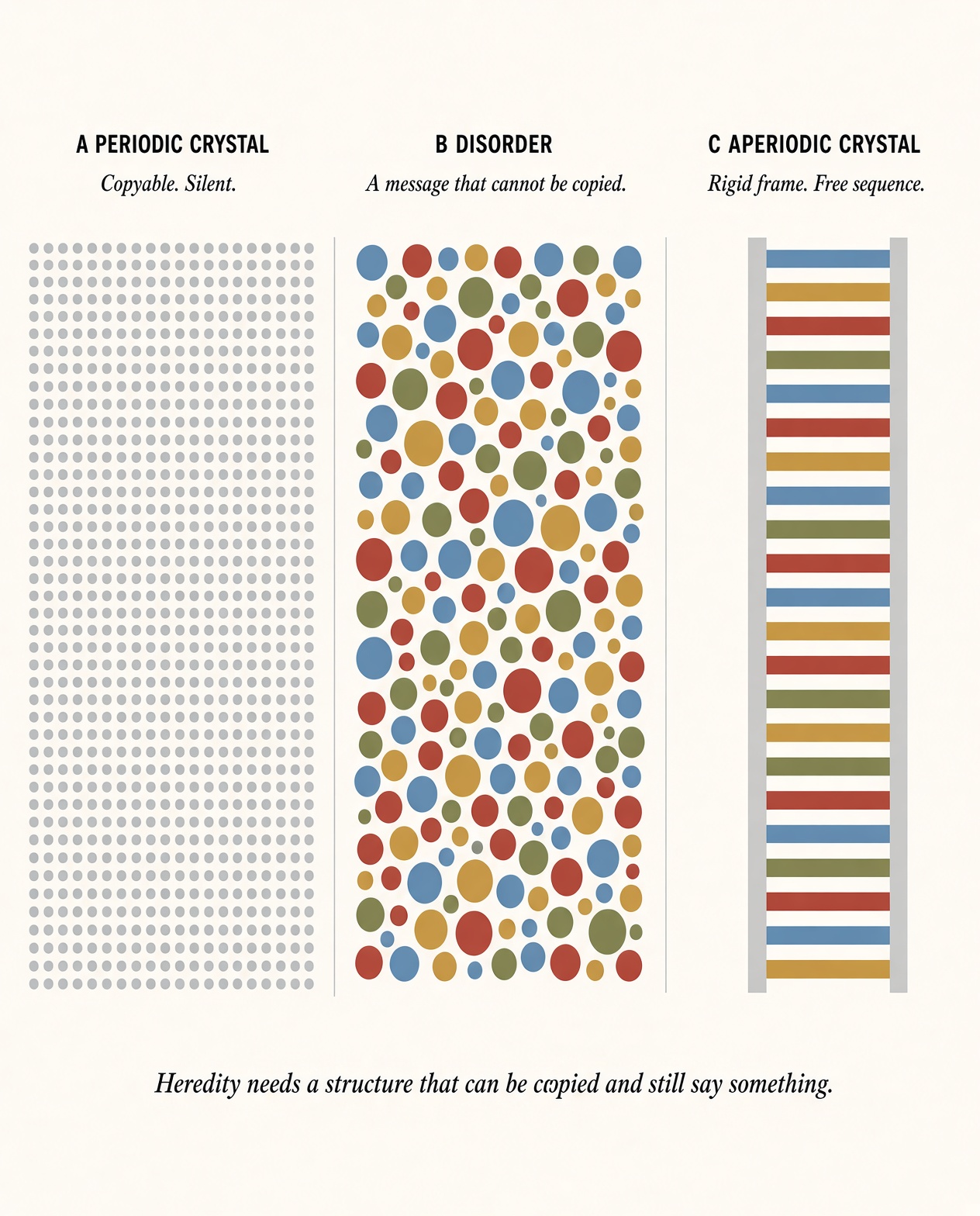
The second was the physics. Schrodinger argued that a living organism does something thermodynamics cannot account for, producing order out of order rather than the statistical order that emerges from molecular chaos, and that explaining it would require quantum mechanics running at ordinary temperatures inside warm tissue.
The first half was taken up, celebrated and built into the foundation of molecular biology. The second half was set aside with every courtesy, because a warm wet cell was the last place quantum coherence was supposed to survive.
It took sixty years ... a lifetime. Enzymes tunnelling hydrogen through energy barriers at thirty-seven degrees. A robin steering by a pair of correlated electron spins. Schrodinger was right twice, and only the convenient half was collected.
And there is a version of his point that has still not been answered, sitting in plain sight in every biology textbook.
DNA does not build anything. It is transcribed, and the building is done by ribosomes, which are themselves made of the same materials they assemble. There is no first protein and no builder standing outside the process. Worse, the code does not contain the shape. A gene specifies a sequence of amino acids and nothing else. What the finished protein does depends on how that chain folds, and the folding is written nowhere. It happens in water, in thousandths of a second, selecting one shape from a number of possible conformations so large that trying them in turn would take longer than the universe has existed. Levinthal pointed that out in 1969. It has not stopped being strange.
So the sequence specifies the parts, and the parts assemble themselves. Correctly, at speed, with nothing supervising and no picture of the finished object anywhere in the instructions.
Which is where the Prince and the physicist shake hands. Order arriving without a controller, at the only scale that actually builds anything.
Kropotkin watched it in wolves and was told he was a romantic. Schrodinger deduced it from thermodynamics and was told it was a philosopher's flourish. It turns out to be what we are made of, and what does the making.
Thirty trillion of our own cells. As many again of bacteria and the rest of the small tenants. A genome still carrying stretches we once wrote off as “junk DNA”, which are not junk. All of it packed in a wet carbon suit that looks fragile until you try to stop it.
That suit is hardware. The antennas are older than the name we gave them: light, field, time, the pull of other bodies. A software that boots in water, in a blink, and will not try every door because it already knows the house. We have been conditioned to talk as if the human were a feeble weakling. It is a tough little sod. Hard to kill. Harder to reduce and explain. Each one conscious in a living universe, each one unrepeatable, unique, amazing, each one holding more packed instruction than we have language for, a private galactic supercluster, walking, dreaming, living. Smile.
Everything else in this feature is still lying where it fell, and not because any of it is hard. It is still there because everybody who might have picked it up inherited a verdict instead of a question.
You do not have to.
Miguel A Rozas PashleyQuantum Wildchild · August 2026