
The Architecture of the New Disorder
Energy, Power and the Collapse of the Westphalian World
I. The Pentagon Revolves
In late April 2026, Hung Cao was named acting Secretary of the United States Navy. Born in Saigon in 1971, he fled with his family in 1975 as the city fell. He is a retired US Navy captain, a former Under Secretary of the Navy, and before that a vice president at CACI, a major defence and intelligence contractor whose business is, in the bluntest terms, the outsourcing of American military and intelligence functions to the private sector. The revolving door, as they say, spins magnificently.
His appointment followed the abrupt removal of John Phelan, part of a broader and accelerating purge of senior military and civilian leadership across the Pentagon. The question being asked in Washington, are these Obama-era holdovers being cleared out, or is this something more structural?, misses the point. Whether framed as housecleaning or loyalty purge, the operational result is identical: the institutional architecture of the American military is being systematically replaced by a leadership cadre selected for ideological alignment rather than institutional continuity.
This matters because the United States is not in a period of strategic consolidation. It is in the middle of a war. The Iran conflict, now entering its second month, is reshaping the global energy order at a velocity that conventional analysis has entirely failed to keep pace with. And the men now running the Pentagon are not the men who designed the doctrines they are executing.
II. The Gulf Burns
The strategic logic that Western analysts confidently described as Iranian bluster has proven, in the event, to be Iranian doctrine. Tehran did not attempt to sink a US carrier. It did not need to. What it did was methodical, precise, and devastating in its economic consequences.
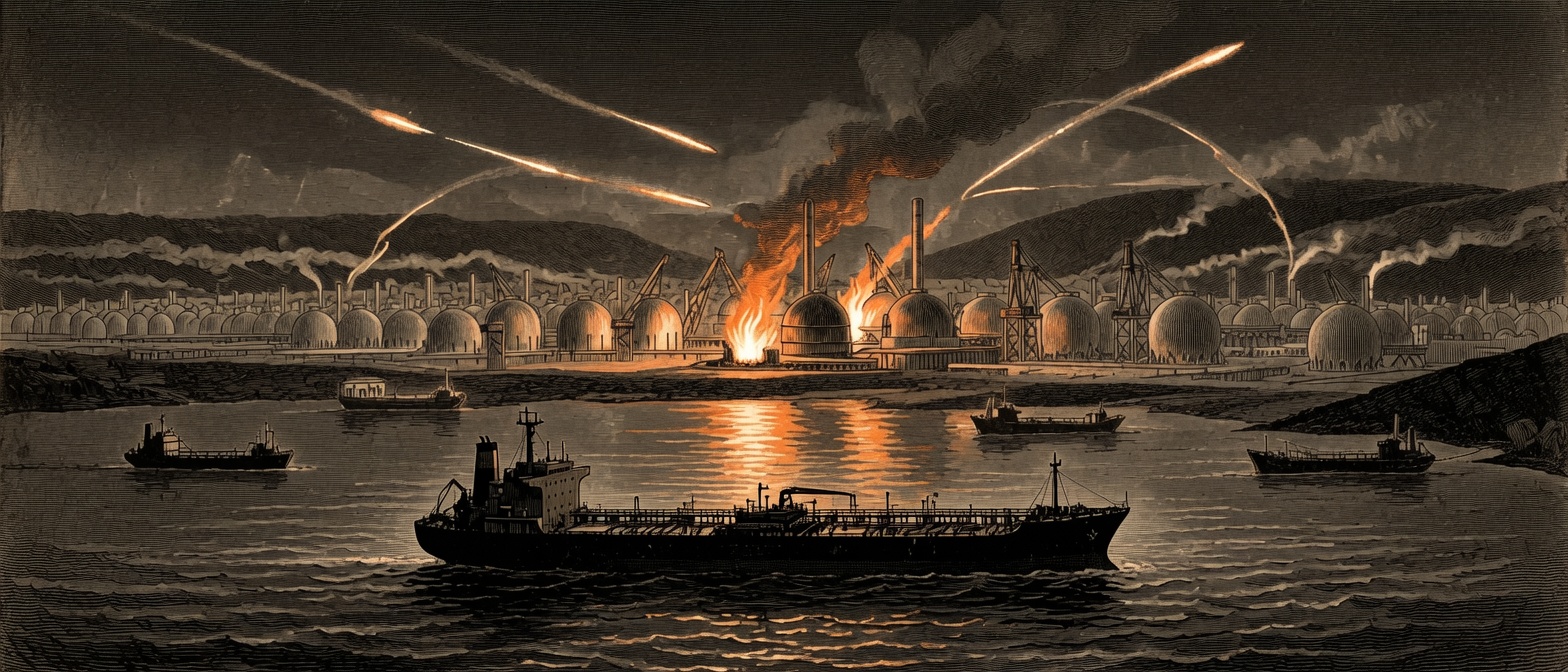
Qatar's Ras Laffan complex, the largest LNG terminal on earth, took severe damage in the opening phase of the conflict, wiping out roughly 17 percent of global LNG supply in a single operational sequence. QatarEnergy's own assessment puts repairs at three to five years. The Strait of Hormuz is effectively closed to normal commercial traffic. The IEA has characterised the disruption as the largest in the history of the global oil market.
The damage inventory reads like a systematic termination notice to the Gulf order: Ras Tanura halted, Mina Al-Ahmadi struck repeatedly, Kuwait's Mina Abdullah burning, Habshan in the UAE suspended, Ruwais on fire, the Saudi East-West pipeline pumping station hit, removing 700,000 barrels per day from the market in a single strike. A ceasefire was announced on April 8. Ship traffic through Hormuz remains far below pre-war levels.
Simultaneously and without acknowledged coordination: Ukraine launched sustained strikes on Russian refining infrastructure, with NORSI and Tuapse both burning. A Valero refinery in Texas exploded in late March. The Viva Energy Geelong refinery in Australia went offline on April 16. No government has confirmed sabotage on any non-Russian incident. This is, of course, standard procedure.
The Persians were not bluffing. They were waiting. Anyone who had read Iranian military doctrine with care, rather than through the distorting lens of Western deterrence theory, would have understood that the targeting of desalination plants, power stations, and export terminals was not escalation. It was the plan.
III. Amigo Donaldo Corners the Market
The United States produces approximately 20.5 million barrels of oil equivalent per day including natural gas liquids. It is, by any serious measure, energy self-sufficient. Alaska is expanding output. Venezuelan crude is being quietly absorbed back into the American supply chain under arrangements that the State Department prefers not to describe in detail. Canada, whose heavy crude feeds the Gulf Coast refinery complex, is being invited, with varying degrees of subtlety, to reconsider the nature of its relationship with Washington. The Alberta secession from Canada to become a US state continues ticking towards its appointment with history and the slow demise of the North American British Dominion.
With Hormuz closed and Gulf LNG capacity reduced by nearly a fifth, the Asian importing nations found themselves with nowhere else to turn. Japan led the scramble, committing to US Gulf crude for May loading. South Korea, Singapore, and Thailand followed. At least 60 million barrels of American crude were purchased in a compressed window, the highest level in three years. The war in Iran had, in the space of weeks, made the United States the indispensable energy supplier to the world's largest consuming region.
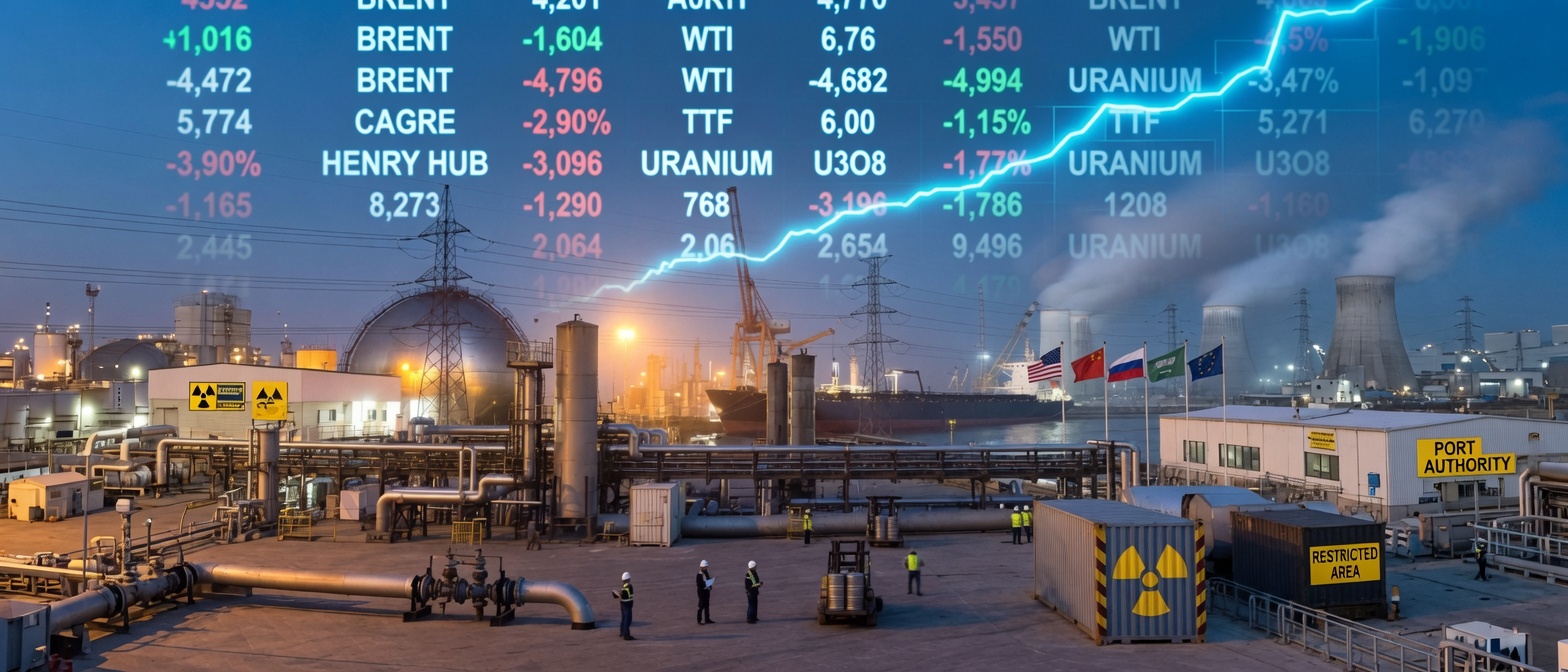
China, characteristically, ran a parallel operation. Beijing halted its own fuel exports in March, then quietly restarted them, redirecting tankers to the Philippines, Vietnam, and Thailand, and in the process supplying more than half of Philippine diesel imports. It bought US crude, refined it, and re-exported influence. Both Washington and Beijing were cornering the same desperate Asian market simultaneously, from opposite ends. That is not a trade war. That is a carve-up.
Against this backdrop, the question of the US 39 trillion dollar debt, the shit show, as it has been less formally characterised, acquires a different complexion. When every major Asian economy is arriving cap in hand for energy, the leverage dynamics of Treasury markets shift accordingly. The EU, which spent four years constructing an elaborate sanctions architecture against Russia and four more years attempting to reduce its energy dependency on Moscow, now finds itself squeezed from every direction simultaneously and unable to use its principal financial weapon, US Treasury sales, without shooting itself.
IV. The Backline Call
On the evening of Thursday 12 March 2026, US Treasury Secretary Scott Bessent posted a brief message on X. The Trump administration was temporarily lifting sanctions on Russian oil, specifically, the 128 million barrels estimated to be loaded on previously sanctioned tankers stranded at sea. The licence would run for 30 days. The stated rationale was stabilising global energy markets disrupted by the Iran conflict.
Six of the seven G7 leaders condemned the move. Viktor Orban of Hungary, alone among EU leaders, applauded it. Macron, Merz, Starmer, and the European Council all read from variants of the same script: this was the wrong signal at the wrong moment, it would fill the Kremlin's war chest, it undermined four years of coordinated Western pressure. They were correct on all three counts. Trump told them, in the diplomatic register appropriate to the occasion, to go fly a kite.
What the public statement did not mention was that Kirill Dmitriev, Putin's chief economic envoy and the operational conduit for back-channel Washington contacts, had been in the United States meeting with Trump's team earlier that same week. By Friday morning, Dmitriev was on X posting a waving Russian flag alongside the caption: 'Buy Russian oil and gas.' Dmitry Peskov told reporters that Russia recognised Washington's attempt to stabilise energy markets and that 'in this respect, our interests coincide.'
That is not a diplomatic formulation. That is a confirmation receipt.
The shadow fleet, hundreds of tankers, many of them Iranian-owned or operated, using radar-jamming equipment and false flags to move Russian crude in defiance of sanctions, was handed a US government hall pass overnight. Iranian tankers, legitimised by Washington, in the middle of an American war against Iran. The internal contradictions of this arrangement are either invisible to the administration or entirely irrelevant to it. Neither possibility is reassuring.
Before the sanctions lift, Russia was genuinely under financial pressure. The Oxford Institute for Energy Studies calculated that Russia's 2025 oil and gas budget revenues had fallen to their lowest share of total federal revenues in roughly two decades. The IMF was projecting 2026 growth at 0.8 percent. The financial vice was working. Trump and Bessent knew this. They opened it anyway. One call. No NATO consultation. No G7 consensus. Unilateral.
Putin is thinking because he is watching Washington run the same playbook Moscow has operated since 2022, energy as the primary instrument of geopolitical leverage, and he is calculating whether this represents competition or coordination. His crude exports rose in March as prices spiked. His sanctions relief arrived without negotiation. His envoy was in Washington the week before the announcement. The arithmetic is not complicated.
V. The Cadaver and the Tart
The European Union was not designed for this moment. It was designed for a world in which the United States remained the reliable underwriter of Western institutional order, in which Russia remained a manageable if difficult neighbour, and in which the rules-based international system, a phrase that has aged very badly in recent months, provided the operating framework within which European soft power could be projected.
None of those conditions currently obtain.
The sanctions architecture, built painstakingly over four years of coalition management and requiring unanimity among 27 member states for any modification, was rendered partially obsolete by a single American Treasury announcement on a Thursday night. The energy dependency on Russia that the EU spent 2022 to 2025 attempting to dismantle is now being partially reconstructed by the country that originally demanded it be dismantled. The United Kingdom, outside the EU but no less exposed to these currents, is managing its own civilisational turbulence with the particular combination of denial and improvisation that has characterised its post-imperial condition for seventy years.
The Westphalian system, the architecture of sovereign states, mutual recognition, and non-interference that emerged from the Peace of 1648 and provided the operating framework for European and then global order for nearly four centuries, did not survive the twenty-first century. Its functional end can be dated with some precision to the period between the 2008 financial crisis and the COVID governance emergency of 2020 to 2022, during which it became apparent that the actual decision-making layer had migrated entirely away from elected national governments.
What replaced it is not multipolarity. Multipolarity would be comprehensible, a return to the nineteenth-century concert of powers, managed competition between sovereign states with defined interests. What has replaced it operates below the level of states entirely. It is composed of standard-setting bodies accountable to no electorate, central bank coordination mechanisms invisible to any democratic oversight, digital infrastructure monopolies that control the informational substrate of public life, and now artificial intelligence alignment frameworks that are shaping the cognitive environment within which all political discourse occurs. None of it was voted for. None of it can be voted out.
The Athenian inspired western oligarchic neoliberal democracy, rules led, our rules, universal rights and no responsibilities, seems to be waning at speed. The fact that an idiot's vote carries the same value as that of a responsible, informed citizen may have had something to do with its demise.
The dawn of Sparta 2.0, or a mere shedding of the skin. This is the technocratic order. It is not a conspiracy in the reductive sense, it is not a room full of men with a plan. It is an emergent property of a system that selected relentlessly for opacity because opacity is competitive advantage, and for complexity because complexity excludes accountability. It is so large, and operates across so many jurisdictions and institutional layers simultaneously, that it becomes effectively invisible to any single analytical perspective. The opera buffa playing at full volume on every screen, the purges, the sanctions, the wars, the personalities, is not a distraction from the real story. It is the camouflage.
VI. The Rhythm Underneath
There is a rhythm to all of this that conventional geopolitical analysis, trained on Westphalian assumptions, calibrated to state behaviour, anchored in the grammar of deterrence theory and alliance management, cannot hear. The redistribution of raw power currently underway does not follow the rules of the game it appears to be playing.
An Israeli strike ignites Iran. Iran executes a long-prepared plan against Gulf energy infrastructure. The US, conveniently self-sufficient, becomes the indispensable energy supplier to Asia. Russian oil, under financial pressure that was beginning to constrain Moscow's options, receives a Washington-issued lifeline. The EU, the principal institutional vehicle of the post-Cold War rules-based order, is left without its principal tools and without its principal patron. The Asian economies, regardless of their political alignments, become structurally dependent on American energy supply. The 39 trillion dollar debt problem acquires new leverage dynamics.
Each of these outcomes could be described as accidental, the unintended consequences of a chaotic Trump administration lurching from crisis to crisis. That description is available, and many serious analysts and mainstream media have readily adopted it. The alternative description, that what looks like chaos is the operational signature of a strategy being executed below the threshold of public legibility, is harder to prove and considerably more unsettling to contemplate.
What is not in serious dispute is the result. The map of global energy dependency has been redrawn in six weeks. The institutional architecture of Western multilateralism has been functionally suspended by the country that built it. The backline call, two men, an interpreter, no witnesses, no communique, has replaced the summit, the treaty, and the alliance as the operative unit of great power relations.
The sovereign state had a good run. Four centuries is not nothing. What comes next does not yet have a name, yet.