
AFTER PUTIN
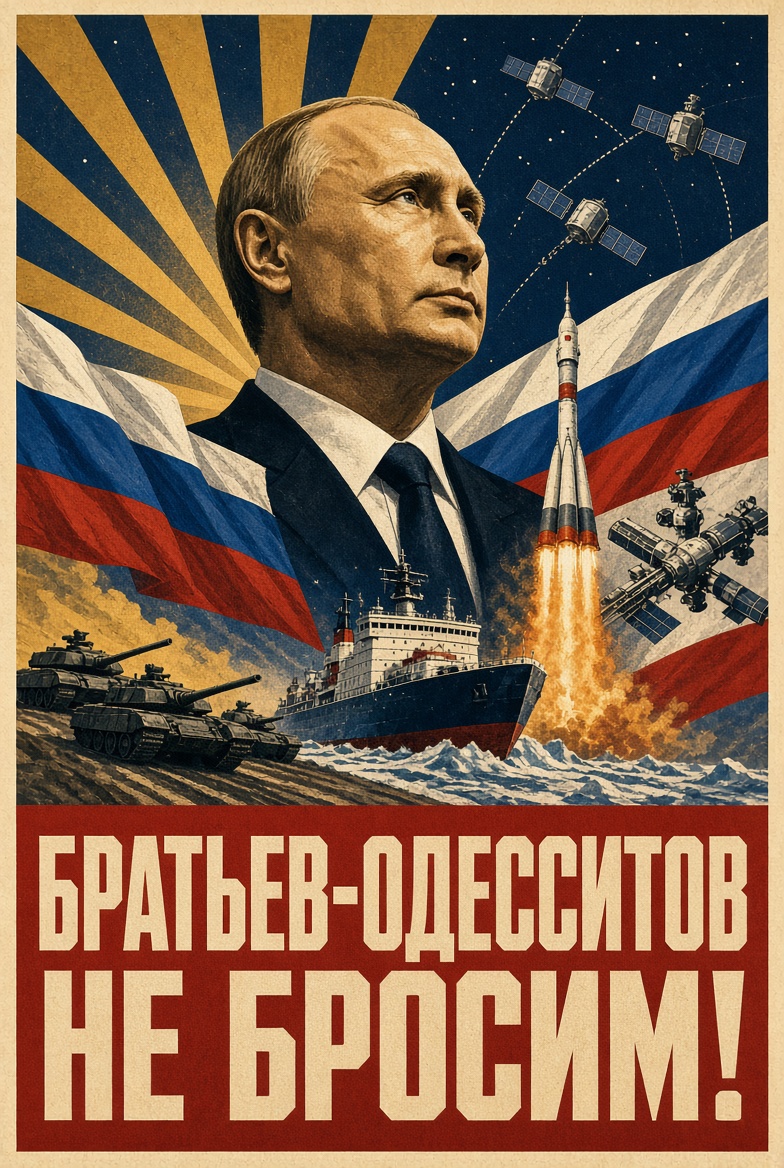
The question of what comes after Vladimir Putin is, at one level, the wrong question. It tempts analysts into the familiar game of Kremlinology, scanning the faces on the Red Square podium, reading the seating arrangements at military parades and state funerals, speculating about who stands closest to the patriarch at ceremonial occasions. That game produces names. It does not produce understanding. And after the September 2026 Duma elections the question has, yet again, been reset. A constitutional majority now sits until 2031, beyond the end of Putin's current term in 2030, and the constitution lets him stand again until 2036. The succession slides, we suspect, to sometime in the next five years, as Putin ratchets another half decade onto his personal scoreboard.
The more important question is structural: what kind of system survives Putin, and under what conditions does it survive at all?
Putin did not build a conventional strongman state with a clear line of succession. He built something more sophisticated and more fragile: a system of managed competition between powerful clans, siloviki (Men of steel,) technocrats, oligarchs, the military-industrial complex, with himself as the sole arbiter of their conflicts. Each clan controls rent-generating assets. Each is kept sufficiently strong to be useful and sufficiently weak to be dependent. The architecture is elegant. It is also catastrophically dependent on the continued presence of the architect.
Remove the arbiter, and the carefully calibrated tensions between clans become open warfare over resources, patronage networks, and physical survival. The men who served Putin know where the bodies are buried, often literally. In a post-Putin transition, that knowledge is simultaneously their greatest asset and their greatest vulnerability. The race will not be for the presidency. It will be for protection.
I. The Succession Paradox
Putin understands his own system better than any outside observer. He knows that naming a successor solves one problem while creating several worse ones. A named heir immediately becomes the focal point for every rival faction's ambitions and fears. He becomes a target before he has the power to defend himself. The unsuccessful contenders, and in Russia's system there are always contenders, have every incentive to move against him while Putin still lives, calculating that the old man's protection will prove insufficient against a coordinated elite challenge.
This is not paranoia. It is an accurate reading of Russian elite dynamics going back centuries. The Prigozhin mutiny of June 2023, a single warlord with a private army briefly threatening to march on Moscow, demonstrated how quickly the facade of Putinist stability can crack under pressure. Prigozhin's subsequent death in a plane crash, precisely 63 days after the mutiny, demonstrated the other side of that coin. In Putin's Russia, visible ambition is a terminal diagnosis.
The deeper paradox is generational. The inner circle that Putin trusts most are men his own age, shaped by the same Soviet security apparatus, sharing the same formative experiences of the 1990s collapse that Putin interprets as the defining catastrophe to be prevented at all costs. The youngest figures in the traditional inner circle are in their mid-sixties. The baton, as one senior Western analyst recently noted, should have been passed years ago. It was not. And the rush to inject younger blood into the system, war veterans, new bureaucrats, provincial administrators, has been happening under pressure rather than by design.
II. The Candidates: A Structural Reading
Western analysis of Russian succession tends to treat it as a personnel problem. The real question is which candidate best fits the structural requirements of the post-Putin moment, and that question has a different answer depending on whether the transition is managed or sudden.
In a managed transition, Putin choosing his successor while retaining sufficient capacity to oversee the handover, the most likely architecture mirrors the Yeltsin-Putin model of 1999. A trusted operational figure receives the presidency while the patriarch retains informal authority from a constitutionally upgraded position above the presidency itself. The State Council, whose constitutional status Putin enhanced in 2020, was designed precisely for this purpose. A successor manages the daily operations of power. Putin, from the State Council, remains the final arbiter. The system continues. The patriarch achieves a form of political immortality.
The figure most consistently identified as fitting this template is Alexei Dyumin, currently 54 years old and serving as Secretary of the State Council, the precise position from which such an arrangement would operate. Dyumin's biography reads like a careful construction for exactly this role. A former Putin bodyguard with documented personal loyalty going back decades. Military credentials including a reported operational role in the Crimea annexation. Tested as a regional administrator in Tula. Deliberately kept from positions so senior that they would mark him too visibly as heir apparent: Putin's instinct for maintaining ambiguity about succession is itself a feature of the system.
The bear anecdote, Dyumin firing warning shots to drive a bear from Putin's residence without killing it, exercising proportional judgment under pressure while protecting the principal, circulates in Russian political circles not as trivia but as a character reference. In Putin's system, that kind of story functions as a credential.
The rising figure of 2025 and into 2026 is Kirill Dmitriev, head of the Russian Direct Investment Fund and now Putin's special envoy for international economic cooperation. Dmitriev's star rose dramatically when he helped organize the February 2025 Riyadh talks between Russian and US officials, working through his longstanding relationship with Jared Kushner. He is associated with Putin's daughter Katerina Tikhonova's network, which itself represents a potential dynastic succession logic operating in parallel to the formal political succession. Dmitriev's trajectory points toward Foreign Minister at minimum. His ambitions, according to sources close to the Kremlin, reach further.
Mikhail Mishustin, the current Prime Minister, occupies a constitutionally significant position: he becomes acting president in the event of Putin's sudden incapacitation or death. But Mishustin is a technocrat without a power base. Competent, cautious, reportedly opposed to the Ukraine Special Military Operation decision, he represents continuity and stability rather than vision. As acting president he would be a pro tempore figure, useful precisely because he threatens nobody, which in the immediate aftermath of Putin's departure would be a genuine asset. Whether he survives as a long-term political figure is another question.
III. The 2026 Duma Elections as Succession Signal
The analytical community has largely underweighted what may be the most significant near-term indicator of post-Putin political architecture: the September 2026 State Duma elections. These are not elections in any Western democratic sense, if the yardstick is the Western model. The qualifier matters, because the yardstick itself deserves scrutiny.
What passes for democracy in the post-industrial West is, in most cases, partitocracy: oligarchically funded parties presenting closed lists of pre-selected candidates, allocated under D'Hondt or its cousins, so that seats bear a precise mathematical relationship to party preference and none whatever to the voter's view of individuals.
The candidate’s loyalty is to the party, not the voter. The voter picks a brand. The party delivers a list. The representative's loyalty runs upward to the apparatus, not downward to the constituent.
Above the parties sits a further layer: a transnational (globalist) managerial class trained in the same schools, passed through the same forums at Davos and the same Young Global Leaders programme, and returned to national cabinets carrying an agenda hammered out in rooms no voter ever enters.
The arithmetic flatters nobody. In July 2024 Britain's Labour party won 411 of 650 seats, close to two-thirds of the Commons, on 33.7 % of the vote and a turnout of 59.7 %: a landslide built on the active support of barely one adult in five.
The European Parliament that presides over half a billion people was elected in June 2024 on a turnout of 50.7 %, meaning 49 % of eligible Europeans did not vote at all, abstention running neck and neck with participation. The winning bloc, von der Leyen's EPP, took the most seats on 19.6 % of the votes cast, the mandate of barely one registered voter in ten. Its executive, the Commission, is not elected at all.
The woman at its head arrived trailing a record that in any accountable system would have ended a career. As Germany's defence minister from 2013 to 2019 she left the Bundeswehr a wreck, 39 of 128 Eurofighters and 105 of 244 Leopard tanks fit to fight, while her ministry steered hundreds of millions to McKinsey and Accenture without proper tender; when the Bundestag opened an inquiry, her service phone was wiped before it could be read. As Commission president she negotiated the largest vaccine contract in EU history, up to 1.8 billion doses, by private text message with Pfizer's chief executive, then declared the messages ungettable. On 14 May 2025 the EU's own General Court ruled against her Commission on every count, finding no plausible explanation for the vanished texts. They have never been produced. This is the figure now steering the Union toward confrontation with the world's largest nuclear arsenal, as Washington backs quietly out of the room.
Measured against that, United Russia's 58 % on a turnout close to 60 % is a mandate most Western governments can only dream of, whatever one thinks of how it was obtained.
The citizen's reward for participating in the Western set-up is the periodic sensation of democracy, an accelerating tax burden to sustain a welfare architecture designed for a demographic bell curve ageing faster than it can be funded, and the comfort of knowing that someone, somewhere, is running things on his behalf.
Moscow's managed pluralism and the West's managed consent differ in degree and in manners. Not in kind.
None of which makes the Duma a parliament of free choice. It makes the contrast less comfortable than Western commentary pontify about.
The Duma vote is realpolitik, a controlled process by which the Kremlin shapes the composition of Russian political institutions for the following five years, and the approach to those elections reveals significant information about succession planning.
The Kremlin's stated objective for 2026 was to inject nearly three-quarters of new faces into the Duma, with a significant proportion of those being veterans of the Ukraine war. Simultaneously, control of United Russia, the party of power, has effectively passed from the old Kiriyenko domestic policy bloc to a network associated with Moscow Mayor Sergei Sobyanin, characterized by administrative competence rather than political ideology. The war veteran integration is not emotional. It is the construction of a new loyalty architecture, a generation of politicians whose entire political existence owes to the post-2022 order rather than to the pre-war establishment.
The results, confirmed by the Central Election Commission on 25 September 2026, delivered on every count. United Russia took just under 58 % of the party-list vote and 349 of the 450 seats, the largest majority in its history, eclipsing the 343 of 2016 and sitting comfortably above the 300 required for a constitutional majority. Turnout rose to 59.8 %. Figures any Western leader would drool at. The Communists, the nearest thing the system permits to an opposition, fell from 57 seats to 37. A Just Russia scraped past the 5 % threshold. Yabloko, the one party Western capitals might have recognised, was struck off the ballot in August after a Supreme Court ruling; none of its constituency candidates won a seat.
The West likes its Russian opposition with a woman's face. Yulia Navalnaya took the stage at the Munich Security Conference on the day her husband died, and in August called on Russians to vote Yabloko, the party that had expelled him in 2007 for his nationalist videos. Within the week Yabloko was off the ballot. The Iron Maiden template is older and Ukrainian: Yulia Tymoshenko, the braided battle axe of the Orange Revolution, gas princess of the 1990s, twice prime minister, jailed in 2011 on multiple corruption charges and canonised in Brussels.
In Washington she had two godmothers: Hillary Clinton, who as Secretary of State demanded her release from prison, and Madeleine Albright, whose National Democratic Institute helped build and finance the Orange coalition that made her prime minister.
Her admirers prefer to forget the call leaked in March 2014, whose authenticity she confirmed, in which she spoke of taking up arms against eight million “damned” Ukrainian Russian speakers and suggested using nuclear weapons, the one passage she claimed was edited. Nuclear weapons, from a country that surrendered its last Soviet warhead in 1996, under a deal brokered in Washington, paid for by Washington, and burned for twenty years in US reactors.
Two Yulias, one casting call. One is a portrait. The other showed what she would do with the big guns, had Kiev not already sold them.
Under the 1994 Budapest Memorandum Ukraine's Soviet nuclear arsenal went to Russia, and through the US Megatons to Megawatts deal some 500 tonnes of Soviet weapons-grade uranium, Ukraine's share among it, was downblended and shipped to the US as reactor fuel. For two decades, until 2013, roughly one US light bulb in ten burned on dismantled Soviet bombs. Kiev was paid in NPP fuel assemblies.
The trade ran the other way too. Between 2009 and 2013 Rosatom took control of Uranium One and with it a fifth of US licensed uranium production capacity, cleared in 2010 by nine federal agencies, Hillary Clinton's State Department among them. The company's chairman, Ian Telfer, gave $2.35 million to the Clinton Foundation through his family foundation, undisclosed; Peter Schweizer, in the documentary Clinton Cash (2015), a book later filmed by Steve Bannon, tallied $145 million from investors tied to the deal. Bill Clinton collected $500,000 for a single speech in Moscow, paid by the Kremlin-connected Renaissance Capital in June 2010, while the deal was under review.
Western ethics: pure fertiliser, sold by the tonne.
Enough radioactive nostalgia. Klaus Meine wrote the Scorpions' Wind of Change after the band played the Moscow Music Peace Festival in August 1989; I met him and Rudolph Schenker in Berlin a few months later, when Scorpions opened Roger Waters' historic The Wall concert at Potsdamer Platz in July 1990 which drew 250.000 people to the former Cold War "No Man's Land", now a barren expanse, where HItler's Bunker was once located, and the concrete Berlin Wall had stood only months before.
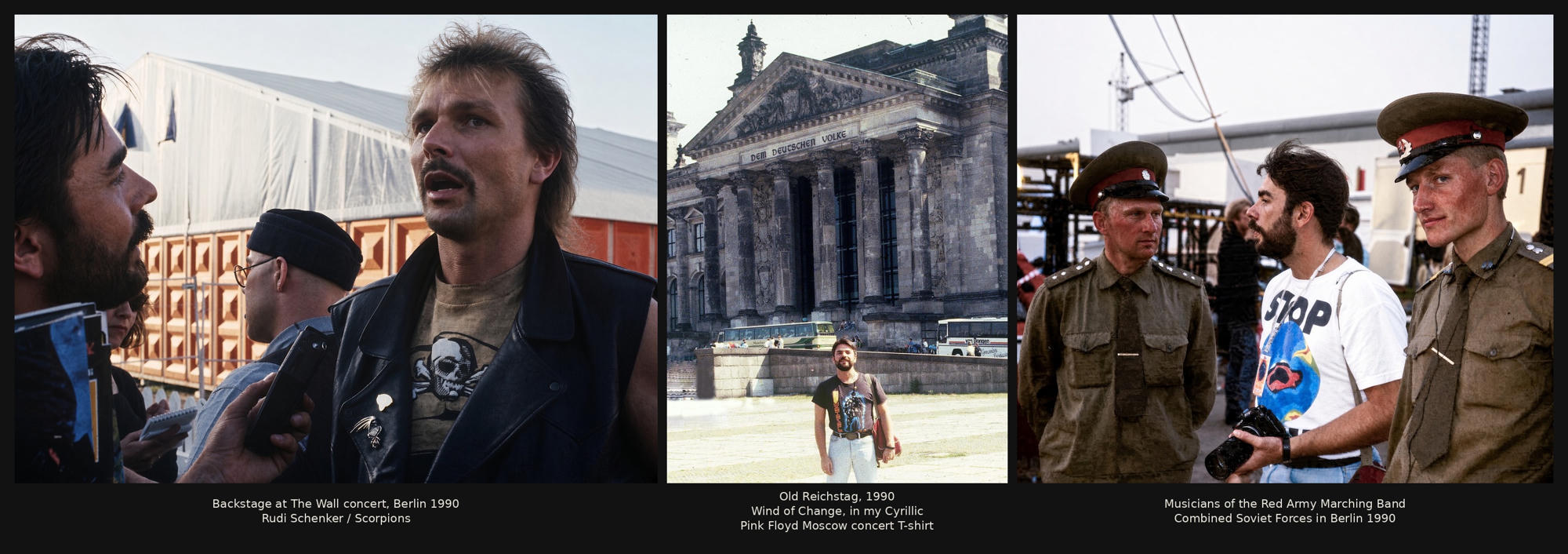
The Berlin wall is gone, the wind heralding a Peace dividend has long since blown itself out and the Moscow of 2026 is now a very different, and wiser, place.
The Duma renewal was substantial. Roughly half the chamber is new and the average deputy's age has dropped from 57 to 53. The veteran intake is where the signal lies. Officially, 46 participants in the special military operation now sit in the Duma, 41 of them for United Russia: a tenth of the chamber. Count those who financed, supplied or administered the war, and the tally reaches 148, roughly a third. United Russia's own election-night figure was 86, withdrawn within hours. The category is evidently still being defined.
Read together, these moves suggest a Putin who is actively preparing the institutional landscape for a transition he expects to survive long enough to manage, while simultaneously hardwiring enough loyalty infrastructure that the system retains coherence even in a less managed scenario.
IV. The Sudden Departure Scenario
RAND Corporation's October 2025 paper on post-Putin planning, titled with a directness unusual for institutional analysis, treats sudden transition as a strategic shock comparable to a major military event, requiring NATO and EU scenario planning at the same level of institutional seriousness as nuclear contingencies. This is not alarmism. It is an accurate assessment of what Russian elite dynamics look like without the arbiter.
The historical template is uncomfortably instructive. After Lenin's death in 1924, a period of collective leadership was announced, and Stalin spent the following years systematically eliminating every rival until sole power was consolidated. After Stalin's death in 1953, another collective leadership period produced Khrushchev through a process that included the arrest and execution of Beria within months of Stalin's death. The pattern: announced stability, covert maneuvering, eventual consolidation by whoever proves most resilent and strategically capable in the window of apparent consensus.
A specific Western concern in the Russian case is its nuclear command and control during the transition window. Putin has centralized nuclear authority to a degree that may create uncertainty about command chain continuity in the event of sudden incapacitation. This is not a theoretical concern. It is the primary reason Western defence establishments narrative has begun treating post-Putin planning as an urgent operational priority rather than a long-range strategic exercise.
For the Ukraine conflict specifically, a sudden Putin departure introduces a range of Western scenarios from accelerated settlement, a successor calculating that the war's costs outweigh its benefits and moving quickly to negotiate, to immediate escalation, as a new leadership seeks to establish credibility and doubles down on military objectives. The tactical nuclear demonstration that fills Western scenario papers says more about Article 5 chicken hawks than about Moscow.
Russian doctrine, revised in November 2024, reserves nuclear use for a critical threat to the sovereignty of Russia or Belarus, not for settling a succession.
V. The Digital Infrastructure Beneath the Politics
There is a dimension of post-Putin Russia that receives almost no serious attention in Western succession analysis: the degree to which the technocratic infrastructure of Russian digital governance has quietly become self-sustaining, independent of whoever occupies the Kremlin.
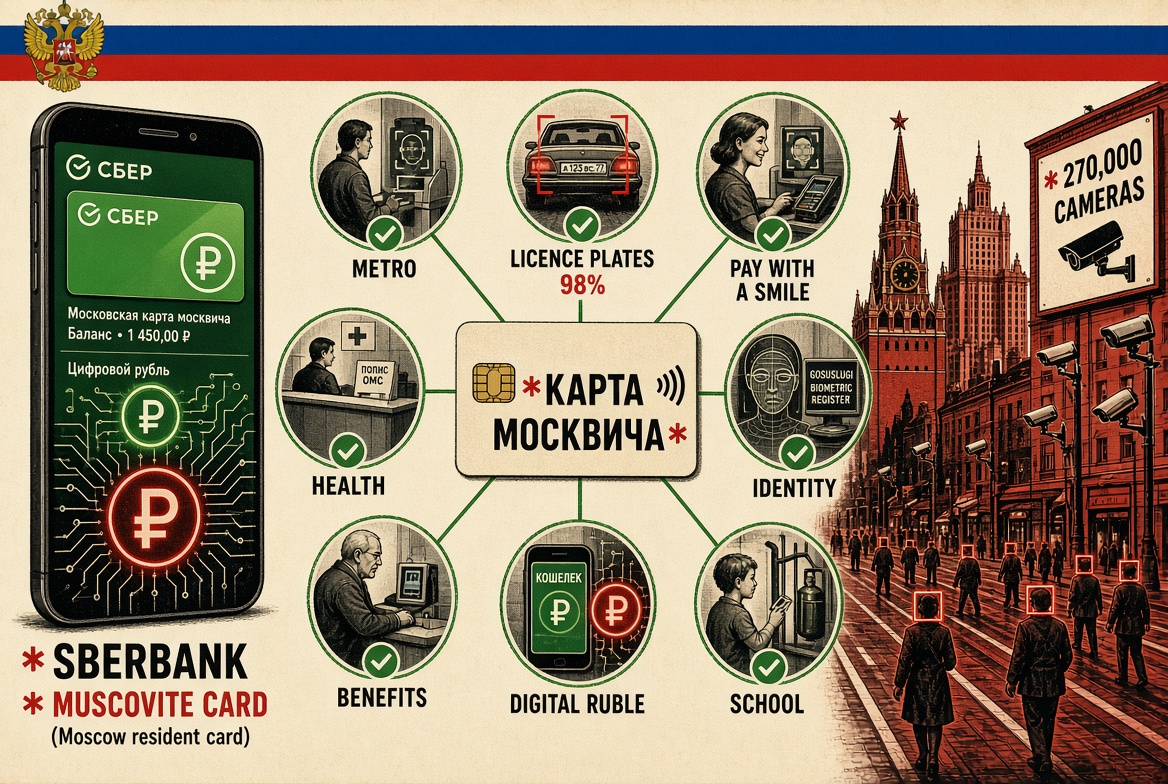
Moscow's CCTV density, among the highest of any city on earth, does not require Putin's continued presence to function. Sberbank's digital ecosystem, which has integrated itself into Russian daily life as a comprehensive financial and service platform, operates independently of political succession. The Safe Cities infrastructure rollout across Russian urban centers, the digitalization of government services, the biometric integration into public systems: none of this pauses for a succession crisis. The control architecture, once built, serves whatever configuration of power inherits it.
The instrument is a smart card, a multipass in all but name: the Moscow resident's card carries the compulsory medical insurance policy and the season ticket for the city and regional public transport; its holder can use it to book doctors and receive care, and as an identifier. Behind the card stands Sber. Its chief executive, Herman Gref, was invited by Klaus Schwab to join the World Economic Forum's board, the only Russian to receive the offer. From June 2026 registering a face for payment takes a selfie in the state services app, Gosuslugi, which then returns the user to Sber's own. In the first quarter of 2026 Russians paid by smile 38.7 million times, for a total of 33.6 billion rubles. Outside, the street completes the circuit: more than 270,000 cameras, all feeding one system, and, by the mayor's account, accurate recognition of faces and vehicles at 99.8 per cent.
The digital ruble belongs here. Its phased mass rollout began on 1 September 2026, obliging the largest banks and retailers to accept it, with smaller banks and merchants to follow by 2028. The ECB, on its own timetable, hopes to issue a first digital euro in 2029, and only if the Regulation passes this year. Moscow will have programmable state money roughly three years before Frankfurt. How extraordinary. The digital ruble runs through the existing banking apps, with no separate wallet to download, and the public has been told it is designed to fight corruption and deliver transparency. Now where have I heard that before. And the thread that ties West to East, our sworn adversary in Moscow and the capitals that arm against it, is none other than the Bank for International Settlements in Basel, where the relevant central bankers appear to be readying the same programmable, switchable CBDC. That upheaval, and what a switchable currency means for every one of us, would need a stand-alone essay.
This is the understated continuity in Russian governance that analysts focused on personality succession consistently miss. The clans will fight over revenue streams, patronage networks, and positional power. Nobody will dismantle the surveillance architecture: it protects all of them equally, and gives whoever controls it a decisive advantage over whoever does not. Post-Putin Russia will have a new face at the top of a system that, at the infrastructure level, continues to function as designed.
VI. The Emotional Reality: Diadia Vladimir and the Stability Myth
Any honest analysis of post-Putin Russia must account for a factor that no structural or personnel assessment captures adequately: the emotional weight of Putin's patriarchal function in Russian political culture.
Putin came to power in the aftermath of the 1990s, a decade Russians across the political spectrum experienced as national humiliation, economic catastrophe, and social disintegration. Genuine hunger returned to Russian cities. Life expectancy collapsed. The state simply ceased to function. Into that trauma stepped a figure who restored order and state capacity, and presided over 20 years of rising living standards fuelled by energy revenues. Moscow became, genuinely, a city of light, infrastructure rebuilt, consumer economy functioning, public spaces restored to something approaching dignity. Package after package of EU sanctions, twenty-one now and counting (…yawn), changed the labels on the shelves but never emptied them: the goods came in by other doors while Brussels drafted the next round. And it did so, by one of history's quieter jokes, in the very years the glow began to drain westward and the luminance rose in the East. The old Cold War postcard, bright West and dark East, was being reprinted with the tones reversed, and nobody in Brussels had ordered the new prints.
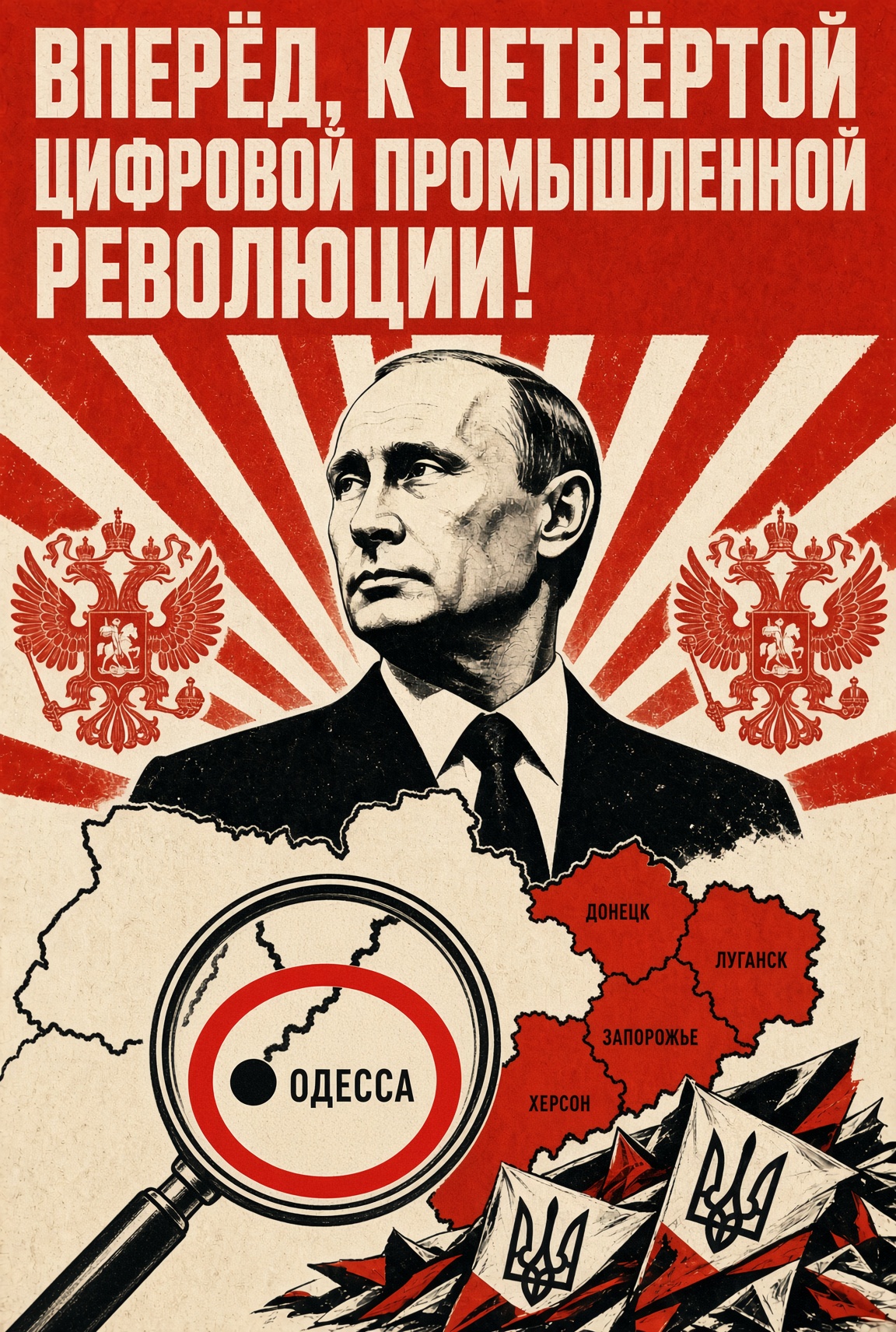
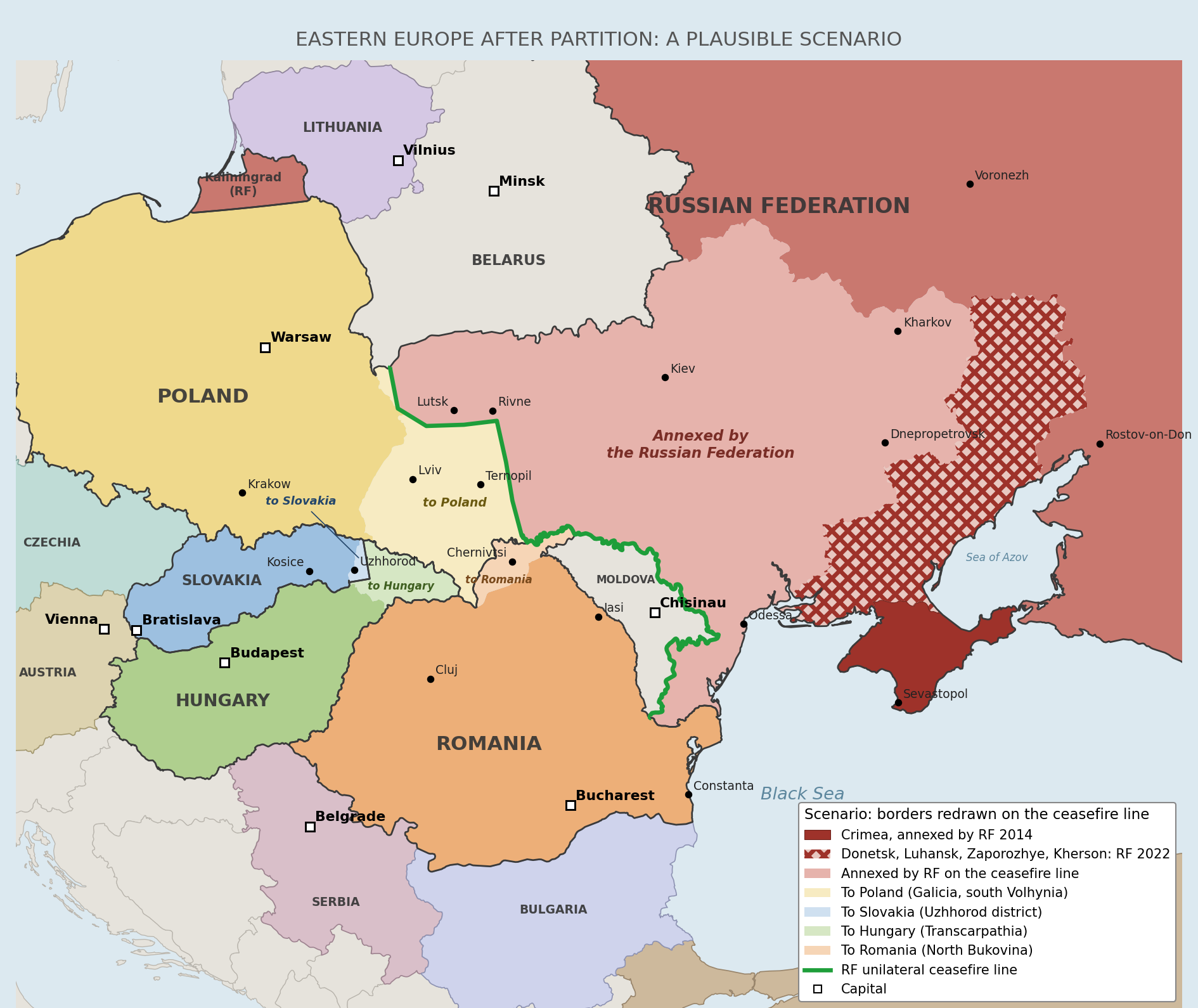
The Russian population's relationship to Putin is not simply political compliance. It carries the weight of that trauma and its resolution. Whatever his successor's technical qualifications, they will inherit a population for whom the 1990s remain the available counter-factual, the answer to the question of what Russia without strong central authority actually looks like. Any instability in the transition period will activate that memory with visceral force. The successor's first and most urgent task will not be policy. It will be the management of collective anxiety about returning to that decade, after a third of a century with Vladimir Vladimirovich firmly at the helm: the man who recovered Crimea and Novorossiya, and who may yet, in the not too distant future, recover Kiev and Odessa and close the century-old upheaval of the Soviet western borders, the long fuse of the Western-intel-backed Banderite madness.
The rest he should leave to history's other claimants. Galicia and Lviv were Austro-Hungarian until 1918, then Polish, and Stalin's from 1939. Northern Bukovina was Austrian, then Romanian, and Stalin's from 1940. Transcarpathia was Hungarian, then Czechoslovak, and Stalin's from 1945. Putin has called them Stalin's gifts, and he reminded Tucker Carlson in February 2024 that Warsaw, Bucharest and Budapest might one day want them back.
The war's deepest logic is not territorial but existential, and it is read that way in Moscow. Russia holds the largest resource base on earth: the timber, nickel, palladium, gas, oil and fresh water of a landmass spanning eleven time zones, from Kaliningrad on the Baltic to Kamchatka on the Pacific, held by fewer than a hundred and fifty million people. To a certain school of Western strategy that is not a country but an inventory awaiting an administrator. This is the thalassocratic reflex, the instinct of sea powers from Athens through the chartered companies of the Royal Adventurers and the East India Company down to Mahan and his heirs: the land is an inventory to be worked, the ocean the highway that carries off its wealth, and what the royal charter cannot secure the privateer will, letter of marque in hand, one flag's buccaneer being another flag's admiral. Break the central authority in Moscow, the thinking runs, and the pieces can be managed, their resources opened, their nuclear deterrent retired, and the last continental rival to a maritime world order removed for good.
The instrument was inherited, not invented. When the Reich fell in 1945, Major General Reinhard Gehlen, head of Foreign Armies East, the Wehrmacht's intelligence directorate on the Soviet front, surrendered to the Americans with his files and his networks intact, having buried the archive in the Bavarian Alps against exactly this moment. Flown to Fort Hunt in Virginia, he was back in Germany by 1946 running a US-funded spy service against his old enemy, the Gehlen Organization, staffed with former Waffen-SS, SS and Gestapo officers, men with first-hand experience of the Ostfront, and bankrolled first by the US Army and then, from 1949, by Allen Dulles's CIA. Among the assets it ran were the anti-Soviet emigre networks of Eastern Europe, including the Ukrainian nationalist underground of Bandera's OUN and its armed wing, kept in the field long after the war as a stay-behind force. In 1956 the whole apparatus was handed to the new West German state as the BND, with Gehlen at its head until 1968. It was, in every operational sense, the grandfather of Gladio, NATO's stay-behind network in Western Europe. The through-line from the Ostfront to the present bridgehead in Kiev is not a metaphor. It is an institutional inheritance, passed hand to hand.
And it is on the record at the summit of American strategy. In 1997 Zbigniew Brzezinski proposed in Foreign Affairs a "loosely confederated Russia" of three parts, a European Russia, a Siberian republic and a Far Eastern republic, as the natural end state of American primacy in Eurasia. In June 2022 the US Helsinki Commission convened a briefing titled "Decolonizing Russia: A Moral and Strategic Imperative," arguing that the Federation's very existence was the problem to be solved. Divide and rule, updated for the century, with Ukraine as the lever and the crowbar.
Seen from Moscow, then, the campaign in Ukraine is a spoiling attack on that project: to break NATO's eastward reach at the one line where Russian mass can still be brought to bear, to make the cost of the balkanization plan higher than any Western electorate will pay, and to demonstrate that the inventory has an owner. Recover Novorossiya, neutralise the Banderite bridgehead the West has spent eighty years cultivating, and the divide-and-conquer design loses the ground it needs to stand on. The far eastern expanse looks after itself; it is the western doorstep that has to be shut.
VII. September 2026: Beyond the Operation
The special military operation has outgrown its name. On 5 July Dmitry Peskov conceded that the SVO had become a "real war," and the legal scaffolding was already in place: a November 2025 law allowing reservists to be sent into combat without a declaration of mobilisation, a July 2026 bill opening contracts to men with active criminal records during formal mobilisation, Rosgvardia rules drafted for martial law and wartime. Putin has not tired of the war. He has tired of the format, a limited operation whose own restraint has become the brake on victory. The stated aims remain those of June 2024: the four oblasts in full, no NATO for Ukraine, no occupied land returned, the denazification of Kiev, and the trial of neo-Nazi and Banderite war criminals for crimes against the Russian-speaking population since 2014. After receiving Witkoff and Kushner on 5 September, the Kremlin said all aims would be reached by military means and the "root causes" addressed. The four oblasts first. Then the next phase. Odessa, and Kiev, stand in the logic of the thing, if not yet on paper.
What checks the final Russian offensive is orbital. US intelligence sharing with Kiev is back at its pre-freeze peak, satellite imagery, targeting and warnings included, feeding strike packages against Russian positions and against energy infrastructure deep inside Russia. No large build-up forms unseen. The drone war has come of age: 450 drones shot down over Moscow on the last night of the vote alone, more than 1,600 across the weekend, the Moscow Kapotnya refinery hit; Perm, 1,450 kilometres from the border, burning on 25 September; half of Russia's six largest diesel refineries cut or halted in September.
Washington apparently forgot that supplying orbital data for target acquisition by proxy is a two-way street. Moscow has answered on another front. Since March, US officials have reported Russian satellite data flowing to Tehran. Fourteen Russian reconnaissance satellites passed over Prince Sultan Air Base two days before the Iranian strike of 27 March that wounded twelve US personnel and destroyed an AWACS. A King's College London analyst called it payback with interest. The US is being given a taste of its own NATO medicine. Asked about it, Trump called the question stupid.
Hence the rapprochement that comes and goes. Witkoff and Kushner in Moscow; a 72-hour pause in strikes on Kiev; Trump telling Zelensky on 13 September to stop knocking out Russian diesel, because his Iran war has made diesel scarce; Trump asking him on 22 September to go to Moscow, and Zelensky replying "on a missile." Washington mediates with one hand and targets with the other.
Kiev, meanwhile, rots from the head, and the head sits atop a river of money. Since 2022 the West has committed well over 300 billion dollars to Ukraine. The United States alone appropriated some 195 billion in war-related spending, roughly 127 billion of it straight to Kiev's government, on top of a 20 billion dollar World Bank loan; the EU and its members have since overtaken Washington as the largest bloc of donors.
The scale of what leaks from that river is not measured in suitcases. Ukraine's own internal audits, leaked to the New York Times in September 2026, found that 1.2 billion dollars vanished to fraud, waste and mismanagement in defence procurement in 2024 alone. The living emblem of the disparity is Rinat Akhmetov, once the owner of the Azovstal steelworks that Russia besieged to rubble, still Ukraine's richest man. In 2024, while his country lived on Western transfusions, he took delivery of the Luminance, a Lürssen superyacht valued at around 500 million dollars, and closed on the most expensive apartment on earth, a Monaco penthouse at Le Renzo reported at some 550 million dollars. One man, two toys, a billion dollars, while the boys not yet of draft age are dangled bonuses to sign.
Akhmetov is not even the strangest of them. The volunteer battalions of 2014, Azov among them, were raised less by the state than by oligarchs with private armies, and their chief paymaster was Ihor Kolomoisky, then governor of Dnipropetrovsk, who funded Azov, Dnipro-1, Aidar and Donbas. His PrivatBank was nationalised in 2016 over a hole later put at 5.5 billion dollars; Washington sanctioned him for "significant corruption" in 2021; Kyiv arrested him on fraud and money-laundering charges in 2023. And it was Kolomoisky's television channel, 1+1, that aired Servant of the People, the sitcom in which a comedian named Volodymyr Zelensky played an accidental president, and then carried the real campaign that made him one. The same oligarch armed the militias and broadcast the king. That is the surreal core of the tragedy: a country bled white for a television president, made by the man who bankrolled the neo-Nazi Azov regiment and then went to jail.
Against that backdrop the political scandals read like receipts. Operation Midas forced Yermak out in November 2025, and in May he was charged with laundering millions through the Dynasty residences, with Mindich, the president's former business partner, allegedly coordinating. Halushchenko was pulled off a train to Poland in February. In August the deputy head of the President's Office, Iryna Mudra, was charged over a scheme to post his bail; the leaked charges point to a figure matching Kyrylo Budanov, now head of that same Office. In September the Prosecutor General, searched by NABU, resigned, lashed out with charges against NABU's own director, was dismissed and resurfaced in Vienna. A nail a day.
Dissent fares no better abroad. On 13 September 2026 Zelensky sanctioned his own former spokeswoman, Iuliia Mendel, who had served as his press secretary from 2019 to 2021, freezing her assets and stripping her state honours. Three days later, invited to speak at an event on European Parliament premises, she was barred at the door and forced to deliver her remarks by video. The chamber that lectures the world on free expression would not let a critic of Kiev through its gates.
The bar at the door is the retail version. The wholesale version came on 2 March 2022, when the Council of the European Union, by Regulation 2022/350, ordered every broadcaster, cable operator, satellite and platform in the Union to suspend RT and Sputnik: RT English, UK, Germany, France and Spanish, switched off across twenty-seven countries in a single administrative stroke, no trial, no verdict, the content prohibited before any viewer could weigh it. A continent that had spent the Cold War beaming Radio Free Europe over the Iron Curtain, in the name of the citizen's right to hear the other side, now built a curtain of its own and called it defence. One need not believe a word RT broadcasts to see the tell: a narrative confident of the facts does not need to unplug the opposing microphone. Censorship is what truth resorts to when it has stopped being sure of itself. The managed consent of the West and the managed pluralism of the East draw closer by the month, and they meet at the off switch.
And at the front, the army of the dead: men up to sixty taken, busification on the streets, bonuses dangled before boys not yet of draft age, a General Staff only now debating whether to stop drafting men over fifty. To the last Ukrainian is no longer a slogan. It is a manpower table.
At the margins the noise turns darker. A viral post in September from an account styling itself a rabbi declared Ukrainians were "being completely replaced," and Zelensky's 2022 promise of a "big Israel" is recycled as prophecy. Talk, of mad rabbis and madder algorithms.
From the grave ,Gore Vidal, borrowing from Charles Beard, would call it perpetual war for perpetual peace. The ledger now shows permanent war for permanent peace: a war that feeds its own constituencies on every side, and that neither Washington, Brussels nor Kiev's inner circle has any pressing reason to end.
VIII. Conclusions for the Ukraine Context
The Ukraine war will not end because Putin departs, always supposing it lasts that long, of which I have genuine doubt. The game looks all but over. Russia is one counter-electronic breakthrough away from ending the Eurodrone folly, and the day the swarms fall silent the old truth returns with them: no war was ever won by drones, only by boots on the ground. In Ukraine's case, tragically, many of those boots are already under the ground, where I sincerely hope they rest in peace. But should the war outlast the man, it will reconfigure around a successor's calculation of what continuation costs versus what settlement costs, in domestic political terms, in elite legitimacy terms, and in the hard currency of military capacity and territorial control. If, for some godforsaken reason, the war continues, a successor who needs to consolidate power rapidly may find it either an asset or a liability depending on the circumstances of transition.
What the succession question actually reveals about Ukraine is this: the conflict has already outlived its original strategic logic on both sides. It has become self-sustaining, generating its own economic interests, its own political constituencies, its own institutional inertia. Millions of Ukrainians have died, been crippled, widowed, or orphaned. Russia has absorbed casualties on a scale not seen since the Second World War. The territorial lines, long read as a frozen conflict, are thawing into something harder. Millions of Ukrainians have been granted Russian Federation citizenship, both in the four new RF oblasts and among refugees arriving from other parts of Ukraine or from the West. The West, for its part, refuses to release any refugee figures that may hinder its standard anti-Russian narrative.
Post-Putin Russia does not resolve this. It reframes it. The question shifts from what Putin will accept to what a successor needs domestically, and that calculation is, if anything, harder to read from outside than Putin's own position, because at least Putin's psychology and priorities have been observable for 26 years. His successor arrives as an unknown quantity, under pressure, making decisions at speed, with a traumatized population watching for any sign of the 1990s returning.
A plausible assessment: expect a period of managed instability lasting two to five years, though that would be substantially shorter if the front collapsed tomorrow and Ukraine simply lost the will to keep dying as NATO, the City and Brussels require. Bet on the surveillance and technocratic infrastructure continuing regardless of who sits in the Kremlin. Bet on Dyumin as the most likely survivor of the succession process if it is managed, and as one of several contenders if it is not. And prepare for the possibility that the transition produces someone whose name is not on any analyst's list, because that is what Russian history consistently delivers.
Few people would have named Nikita Khrushchev as Stalin's heir. And even fewer would have predicted Vladimir Putin in 1998.
Coda: Red Square, the Beautiful Square
A war chronicle should close on beauty, and Moscow keeps some in plain sight. In Old Russian красный meant beautiful. The root survives in красивый, in красна девица, the fair maiden, and in красный угол, the beautiful corner where the household icons hang. In Red Square, Beautiful and Red happen to share the same word. The square took the name in the second half of the seventeenth century, when the colour sense of красный was still secondary in Russian itself; red was then червлёный or чермный.
Before that it had been Торг, the market, and then Пожар, the Fire, after the blazes that kept levelling it. The name is Muscovite and Orthodox, two and a half centuries older than the Bolsheviks. Once 1917 made red the colour of revolution, the Western press had no reason to go back to the etymology. A Red Square full of tanks on parade told the story editors wanted. A Beautiful Square would have undercut it, and nobody in the Cold War business went looking for a Slavic poet under the parade ground.
The Border That Moscow Drew
The same twist runs through the map. The Greeks drew the first line, and it ran through water. Europe and Asia began as names for the two shores of the Aegean, the sailor's view from the deck: this side, that side. Herodotus already found the division arbitrary and said so, placing the limit on the Don more by habit than by reason. For two thousand years nobody fixed a land border at all. Only in the 1720s did Vasily Tatishchev, Peter the Great's geographer, propose the Urals. The Swedish officer Philip Johan von Strahlenberg, a prisoner of war in Siberia, published the same line in 1730. It was a political act as much as a geographical one.
Drawing the frontier at the Urals placed the Russian heartland inside Europe and turned Siberia into Russia's own Asia. The continent's eastern edge is an 18th-century decision, and Moscow wrote it. A western peninsula of Eurasia, no more a continent than the Indian subcontinent, was promoted to one partly to make Russia European. Three centuries later the West uses the same line to keep Russia out.
Why the Greeks? Because Russia inherited their quarrel. Moscow took its faith, its alphabet and its double-headed eagle from Byzantium, and after 1453 it called itself the Third Rome. Across three and a half centuries the tsars fought the Ottomans a dozen times, and Constantinople, Tsargrad, remained the prize. Catherine the Great had already stamped the claim on the map: the Black Sea coastline she conquered from the Ottomans became her Novorossiya, and she gave its new cities Greek names, Kherson, Odessa, Sevastopol, Simferopol, Mariupol, Nikopol, Tiraspol, Ovidiopol and more.
When the Greeks rose in 1821, a Russian squadron sailed with the British and French at Navarino in 1827. The Treaty of Adrianople in 1829 forced the Sultan to concede Greek autonomy, and the first head of the new Greek state, Ioannis Kapodistrias, had been the Tsar's foreign minister.
The Aegean line was never a line between peoples either. Greeks lived on the Asian shore (now Turkey) for three thousand years: Ionian cities from around 1000 BC, then Miletus, Ephesus and Smyrna, followed by the Hellenistic kingdoms, Byzantium, and the Pontic communities of the Black Sea coast. Constantinople fell in 1453. For almost four centuries after that, the Greeks lived as a subject Christian people under Ottoman rule, until the war of independence of 1821 and the birth of a small Greek kingdom, the modern Hellenic state, recognised in 1830. The massacre at Chios in 1822 made Europe look, a brief glance.
The end in Asia Minor came in a single decade. Between 1914 and 1923 the Young Turks, and then Mustafa Kemal's nationalists, emptied Anatolia of its Christians. For the Armenians and the Assyrians it was genocide: the Armenians marched to their deaths in the Syrian desert, the Assyrians slaughtered in the mountains of the southeast. The Greeks were worked to death in labour battalions and driven along the death roads of the Pontus. In September 1922 Smyrna burned. Among the refugees on the quay was a sixteen-year-old tobacco merchant's son, Aristotle Onassis. His family's fortune was gone and his city was ash. A year later he sailed for Buenos Aires on a Nansen passport, the travel document issued to the stateless. The Lausanne convention of January 1923 finished the job by law. It sorted people by religion, not language: about 1.2 to 1.5 million Orthodox Christians went to Greece and about 400,000 Muslims to Turkey. One in five people in Greece was now a refugee.
That is the source of a festering conflict in the region, both NATO members, the root of mutual hatred: four centuries of subjection, then expulsion from a Hellenic homeland older than Rome. The 1955 Istanbul pogrom and the 1974 invasion of Cyprus kept the wound open. Every Greek map of the Aegean is drawn over that loss, and every Turkish one over the fear of its return.
In the 1920s the Russian Eurasianists, Trubetskoy and Savitsky, exiles in Prague and Paris, argued the opposite: Russia as a world of its own, neither Europe nor Asia, held together by the steppe.
So Russia has always stood on both shores at once: European by the line it drew itself, Byzantine by faith, Asian by reach. The story of where Europe ends explains why Russia will not accept anyone else deciding where it begins and where it ends.
Russia now has the historical opportunity to draw a green line, a unilateral ceasefire, that would open an unheard-of chance to reconcile and rebalance the whole of Eastern Europe: to undo the effects of two globalist wars and two revolutions, the National Socialist and the Bolshevik, and to let every nation recover its disputed lands and bury the regional hatchet and its rancours. To each their own.
And the twist reaches the very name of the people. The Slavs called themselves словене, from слово, the word: the people who speak, the people who understand one another. Everyone beyond their western edge was немец (nemets), from немой (nemoy), mute, and a German is немец still, his language немецкий (nemetskiy), to this very day: not a man without a voice, but a man whose speech was noise, as the Greeks had heard bar-bar in the mouths of barbarians. The pagan tribes who coined the pair could not know what was coming. When Cyril and Methodius carried the Gospels to them in the ninth century, they rendered the Greek Logos as слово, and the Slav scripture opened В начале бе Слово: (In the beginning was the Word.) The people of the word received a faith in which the Word was God. Muscovy kept the other half of the pair. Its немцы, Dutch, English, Scots and Swedes alike, were heretics as well as foreigners, and in 1652 the tsar walled them into their own quarter, the Немецкая слобода, where the young Peter the Great would later go to learn the West.
Europe answered in kind. Byzantine chroniclers wrote the name as Sklavenoi, and Medieval Latin made it sclavus. For three centuries captives from the Slav lands were marched to Prague, castrated at Verdun and shipped from Venice to the palaces of Córdoba, where the Arabs called them ṣaqāliba. So many passed through the markets that the people's name swallowed the legal term: esclavo, esclave, Sklave, schiavo, slave. The Venetians who ran the trade greeted each other with s'ciavo vostro, your slave, and it survives as ciao. It is the deepest misreading of all. The people of the Word became the word for a man without rights.
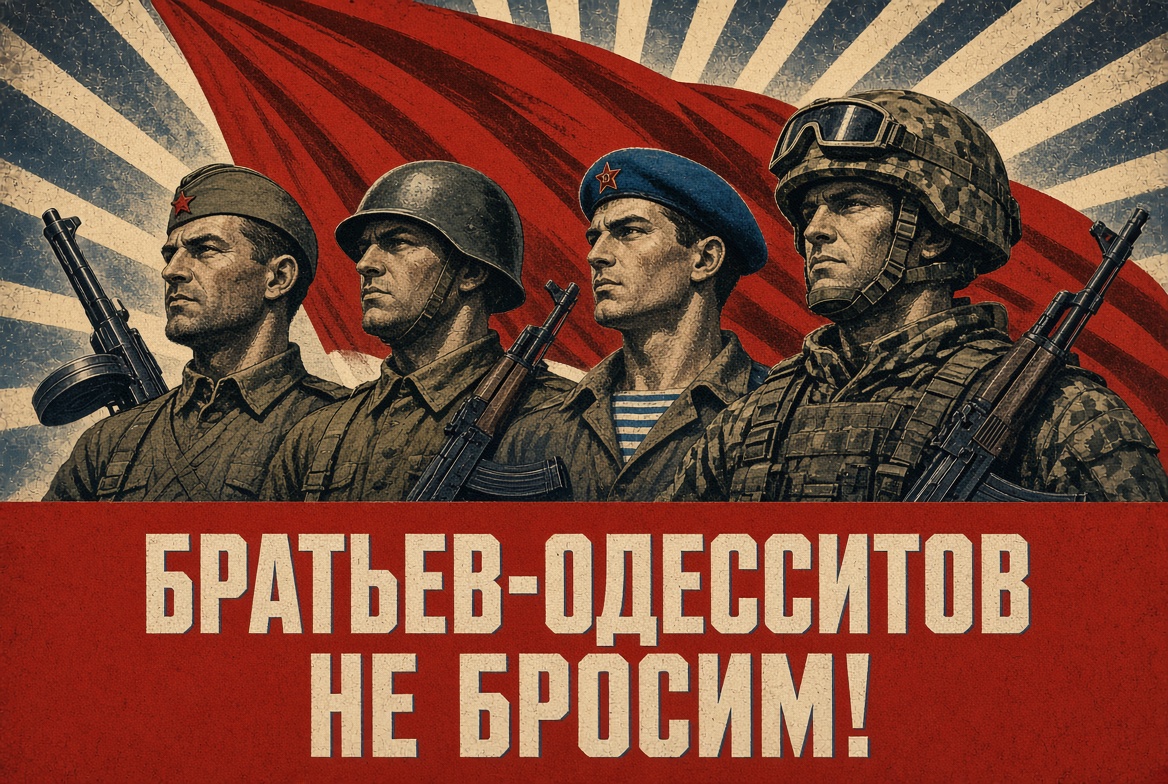
A nation that has outlasted the Mongols, the Poles in the Kremlin, Sweden's Charles XII, Napoleon and Hitler does not put the chains back on. Whatever the City, DC or Brussels may desire, the Slavs will never be enslaved again. Forget it.