
Universal Consciousness Field
Part Three. The Visual Companion

Nine plates, written for a reader who has no physics and is assumed to need none. Each plate states its case in as few words as it can. What follows each one is the background that makes those few words hold up: who did it, what the terms mean, and how anyone knows.
Plate One
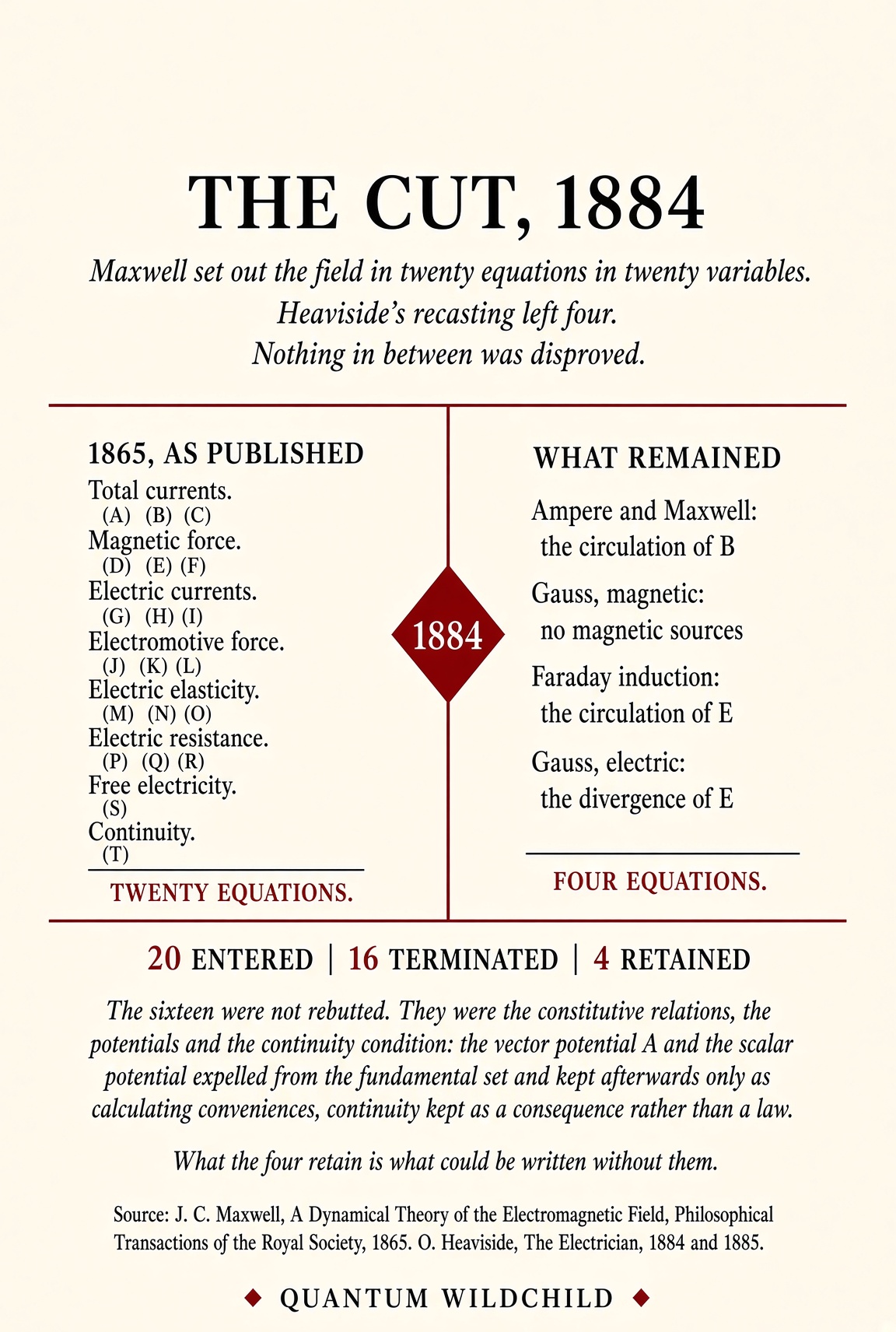
Oliver Heaviside was a self taught telegraph operator working alone in Devon, deaf from scarlet fever, with no university post and no salary. He read the treatise, called Maxwell heaven-sent, and then set about stripping it down, publishing the compressed version in a trade journal called The Electrician across 1884 and 1885. Josiah Willard Gibbs was doing much the same at Yale in parallel. Heaviside described what he had done without any embarrassment at all: "I never made any progress until I threw all the potentials overboard." Every electrical engineer since has worked with the result. That is the entire case for the reduction, and it is a case about progress in engineering, not about what was true.
What went out was not wrong, it was unnecessary for calculation. The potentials are the two quantities Maxwell used to describe the state of the field itself rather than the forces it produces, and he treated them as physically real. After 1884 they survived as bookkeeping devices, useful for getting to an answer and assumed to correspond to nothing. Among what went with them was the one quantity in the algebra that carries a size and a timing but no direction at all. Nobody argued against it. It was simply not needed to build a telegraph. He also threw overboard the breadcrumbs that could have led humanity to the dawn of a conscious universe, over a hundred and forty years ago. Such are the twists of fate.
Plate Two
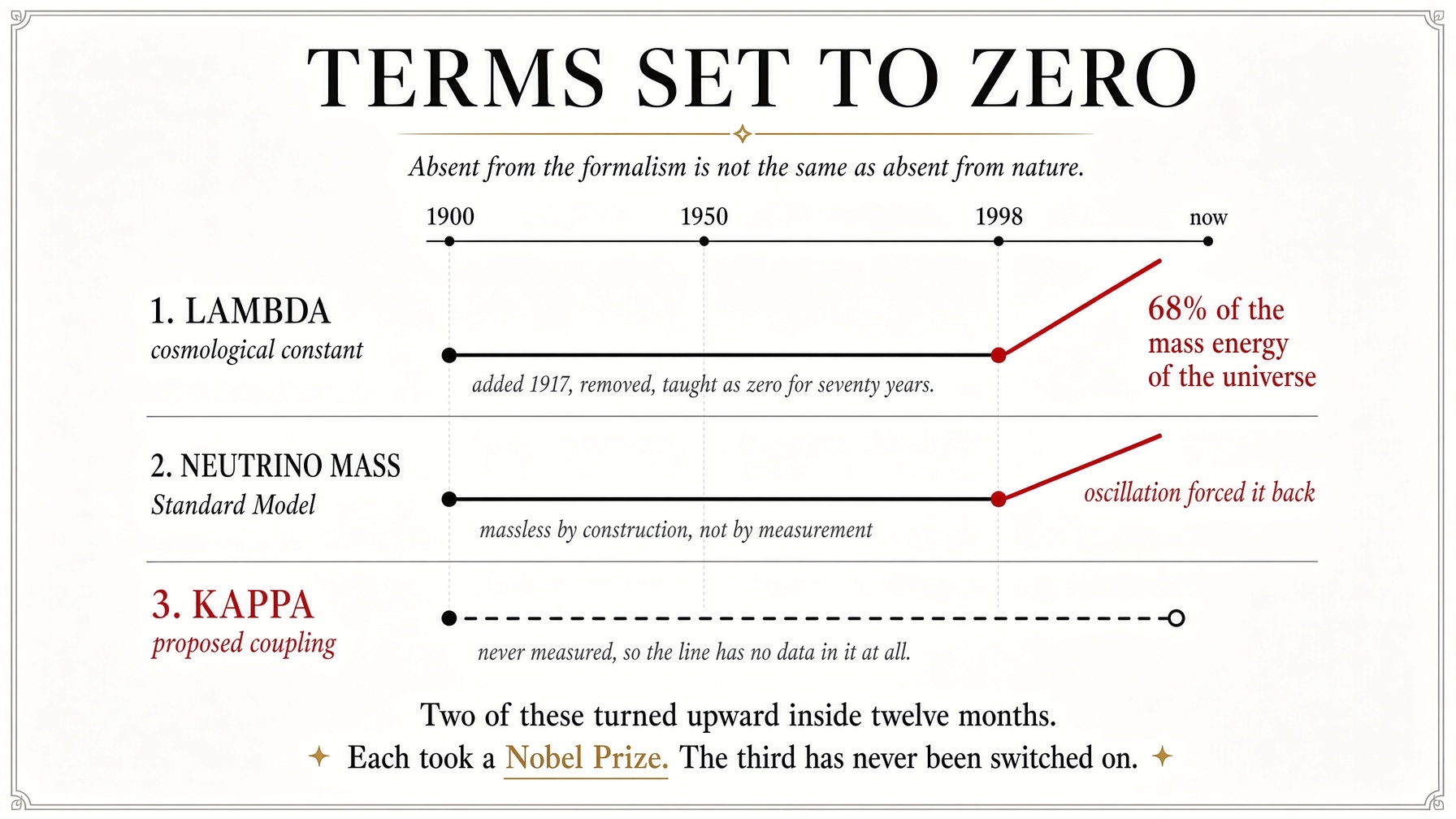
Einstein added the cosmological constant to his equations in 1917 for a single reason: without it the mathematics said the universe must be expanding or collapsing, and everyone knew the universe was static. When Hubble showed in 1929 that it was expanding after all, the constant was dropped and taught as zero for the next seventy years. In 1998 two teams measuring distant supernovae found the expansion was speeding up, which requires the term to be there. It now accounts for roughly sixty eight per cent of the mass energy of the universe, and the 2011 Nobel Prize in Physics was awarded for the discovery of accelerating expansion through distant supernovae.
Neutrino mass ran the same course. The Standard Model was written with neutrinos massless. Nobody had ever weighed one. It was simpler that way, and nothing known at the time said otherwise. Then it turned out that neutrinos change type in flight, switching between three varieties as they travel, and that switching is only possible if they have mass, since what drives it is the difference between one mass and another. Super-Kamiokande reported it in 1998, and the 2015 Nobel followed. Two terms, both set to zero by assumption rather than by measurement, and in both cases the assumption was wrong. The third line on the plate has never been measured at all.
Plate Three

Each of the four pressures on this plate is an ordinary feature of academic life, and none of them requires anyone to act in bad faith. A grant application is assessed by referees working inside the accepted framework, so a proposal that questions the framework reads as unqualified rather than interesting. A doctoral student choosing a thesis is choosing an employability, and a supervisor who lets them choose an unfundable subject has damaged them. A journal editor selects for what the field can evaluate. A textbook author writes what will be examined.
Run those four for a single generation and no policing is needed afterwards, because the people who would have asked the question were selected out before they were old enough to ask it. This is why the word conspiracy appears nowhere in these three essays. A conspiracy needs a meeting, a decision and someone who could confess. A ratchet needs none of them and is far harder to reverse, because there is nobody to hold responsible and nothing to repeal.
Plate Four
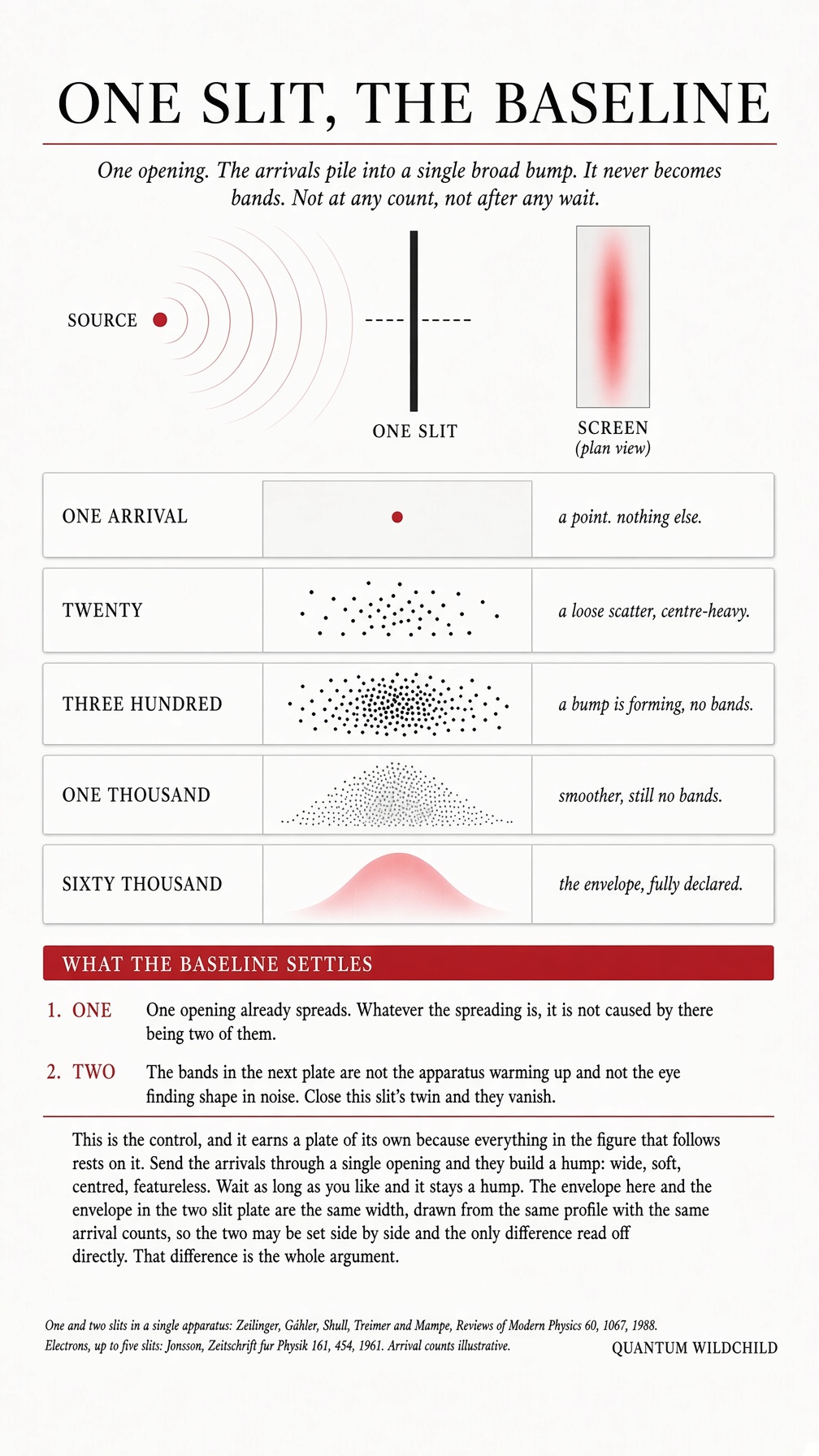
A control is the arrangement you run to find out what happens when the thing you are testing is absent, so that you know which part of the result belongs to it. Without one, any pattern can be blamed on the apparatus, the detector, the room or the observer's willingness to see shape in noise. This plate is that control, and it is the reason the next two cannot be dismissed.
The detail that closes the argument is that both configurations were run on the same equipment. Zeilinger and colleagues did exactly this with neutrons in 1988, one slit and two slits in a single apparatus, published in Reviews of Modern Physics. Nothing was moved between the two runs except the number of openings. So the difference between the two pictures cannot be an artefact of a different machine, a different day or a different alignment, and the only variable left is the one under test.
Plate Five
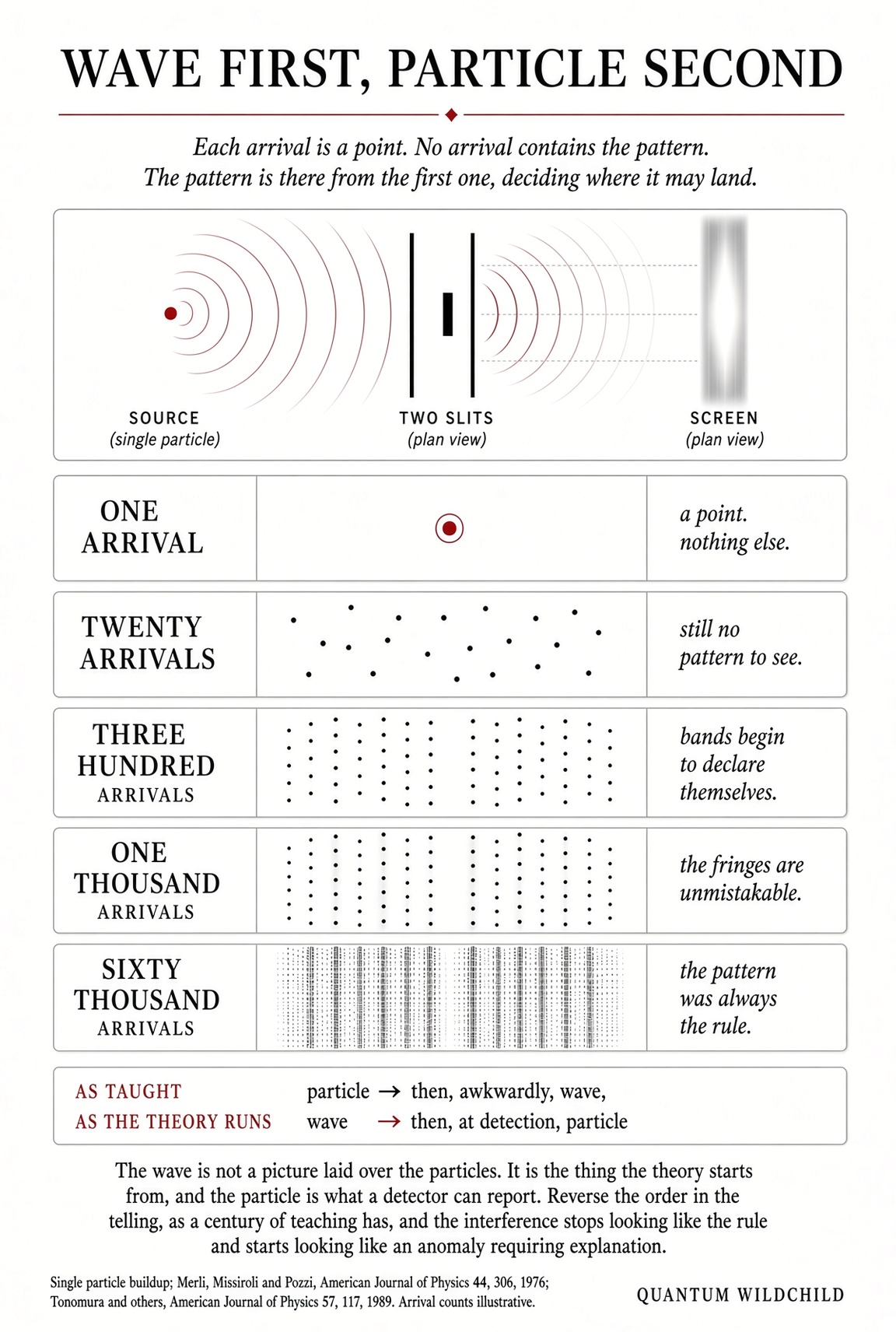
The obvious objection is that the particles must be interfering with each other, which would make this a crowd effect and nothing stranger. That objection was closed by turning the source down. Merli, Missiroli and Pozzi did it with electrons in Bologna in 1976, and Tonomura's group repeated it in 1989 with the beam so weak that on average only one electron was inside the apparatus at any moment, the next not yet emitted when the previous one had already landed.
Each arrival was recorded as a single point on the detector. No individual electron showed a pattern, because a point cannot have one. Yet where each was permitted to land was already constrained, and after enough of them the fringes appeared. Nothing was interfering with anything else. Whatever governs where a single electron may arrive was present before there was a second one to interfere with.
Plate Six
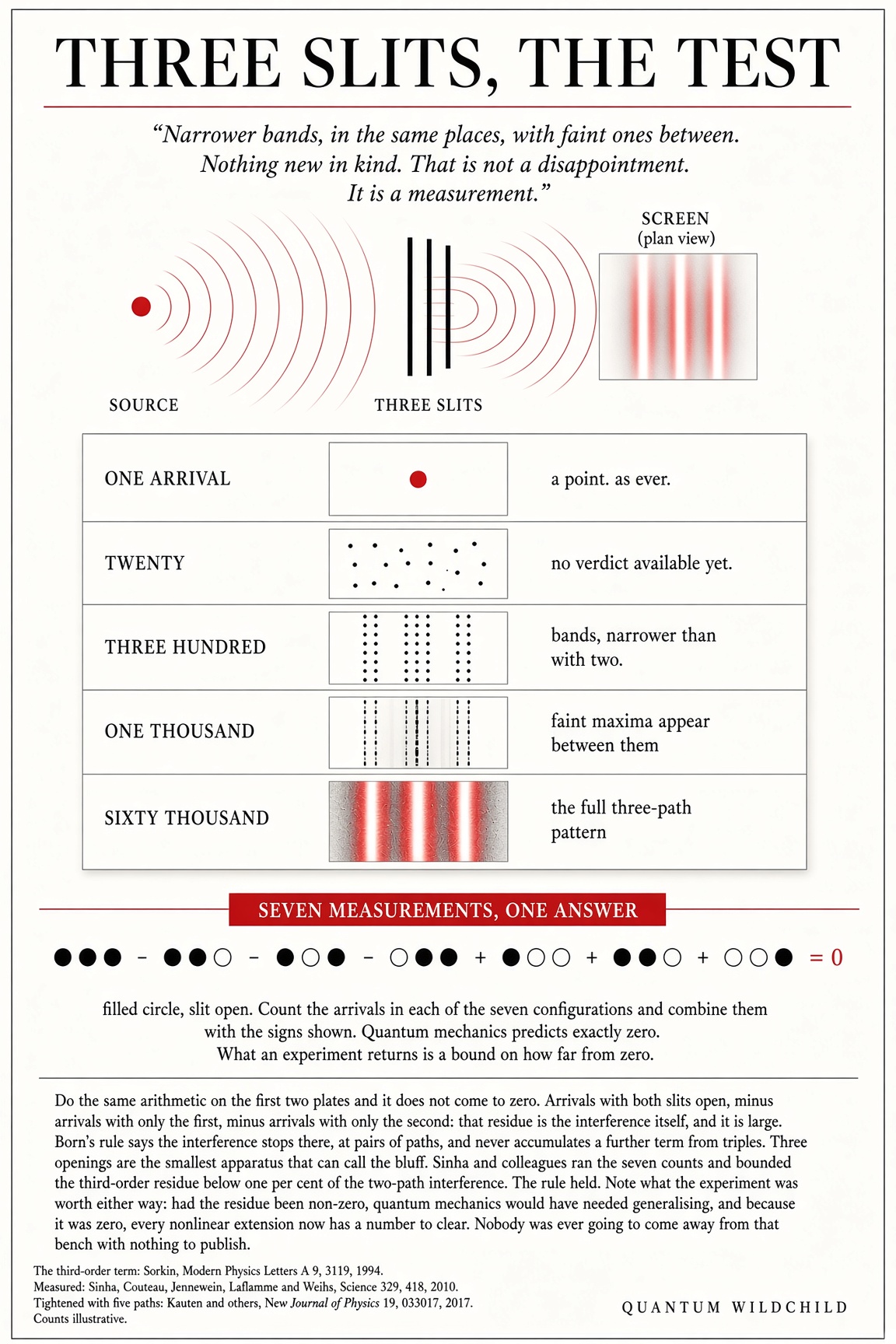
Born's rule is the instruction that turns quantum mathematics into a prediction you can check: the chance of finding a particle somewhere is the square of the wave's amplitude at that point. Squaring is what creates interference, and squaring produces cross terms only in pairs. Two paths give one interference term. Three paths give three pairs and nothing further. The rule forbids any additional term arising from all three routes together.
That forbidden term is what Sorkin proposed testing in 1994, and it is testable because seven separate counts, with each combination of openings, can be added and subtracted so that everything permitted cancels out and only the forbidden quantity is left. Sinha and colleagues ran it in 2010 and found the residue below one per cent of the two path interference. Kauten and others tightened it in 2017 with five paths. A rule that could have broken did not, which is what distinguishes a test from an illustration.
Plate Seven
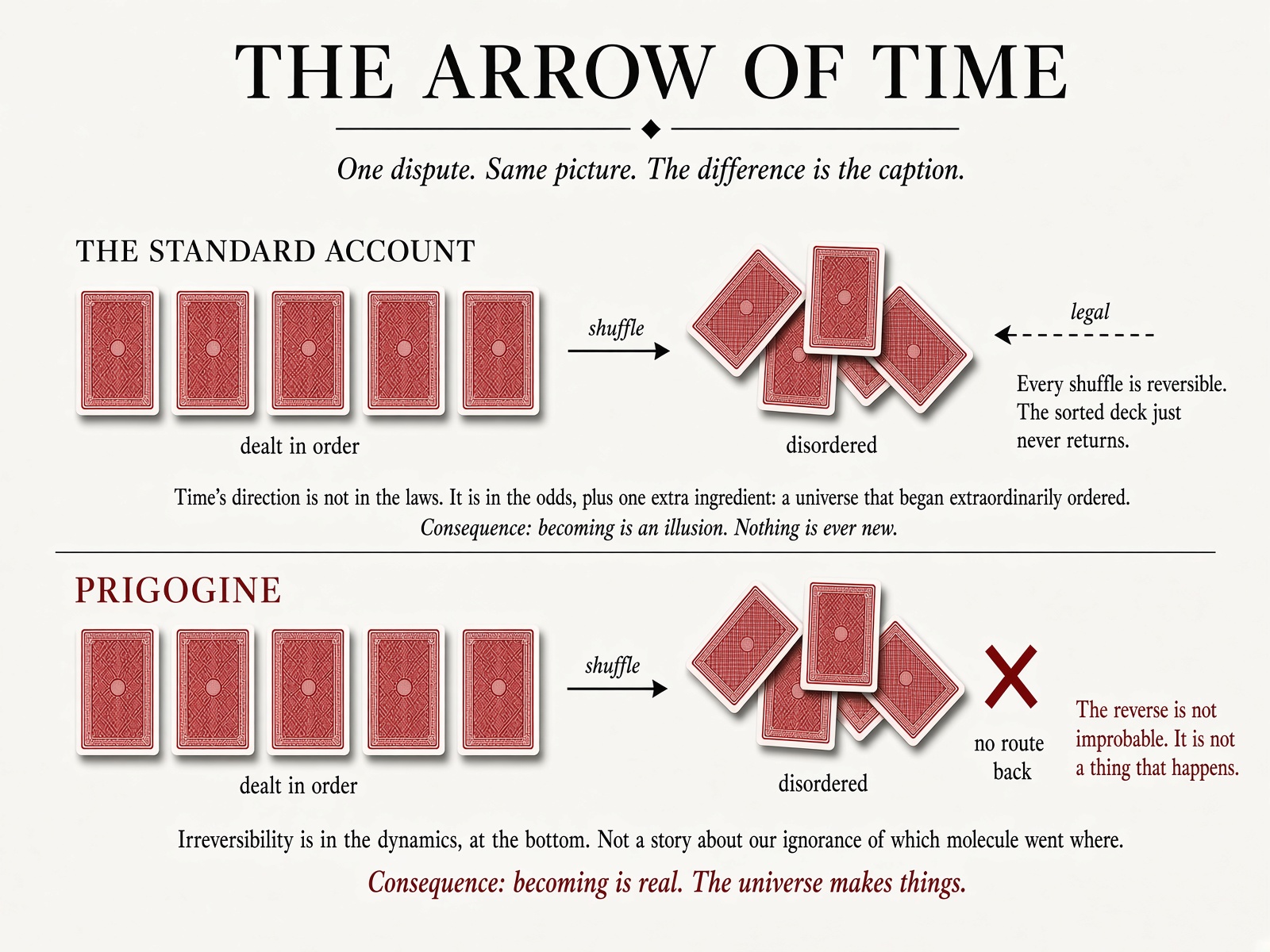
The problem this plate sets out is genuine and unresolved. Every fundamental equation in physics runs equally well forwards and backwards. Nothing in them says which way time goes. Yet cups break and do not reassemble, and heat moves from hot to cold and never back. The standard resolution says the direction is statistical, not fundamental: disordered arrangements outnumber ordered ones so overwhelmingly that the ordered state never recurs, and the universe began in an extraordinarily ordered condition that it has been leaving ever since.
Ilya Prigogine took the Nobel Prize in Chemistry in 1977 for work on systems held far from equilibrium, and he argued the resolution was in the wrong place. On his account irreversibility belongs in the dynamics themselves rather than in our ignorance of which molecule went where. The distinction sounds technical and is not. On the standard account the future contains nothing genuinely new, because everything is already implied. On Prigogine's, the universe makes things. The same picture supports both readings and physics has not chosen between them.
Plate Eight
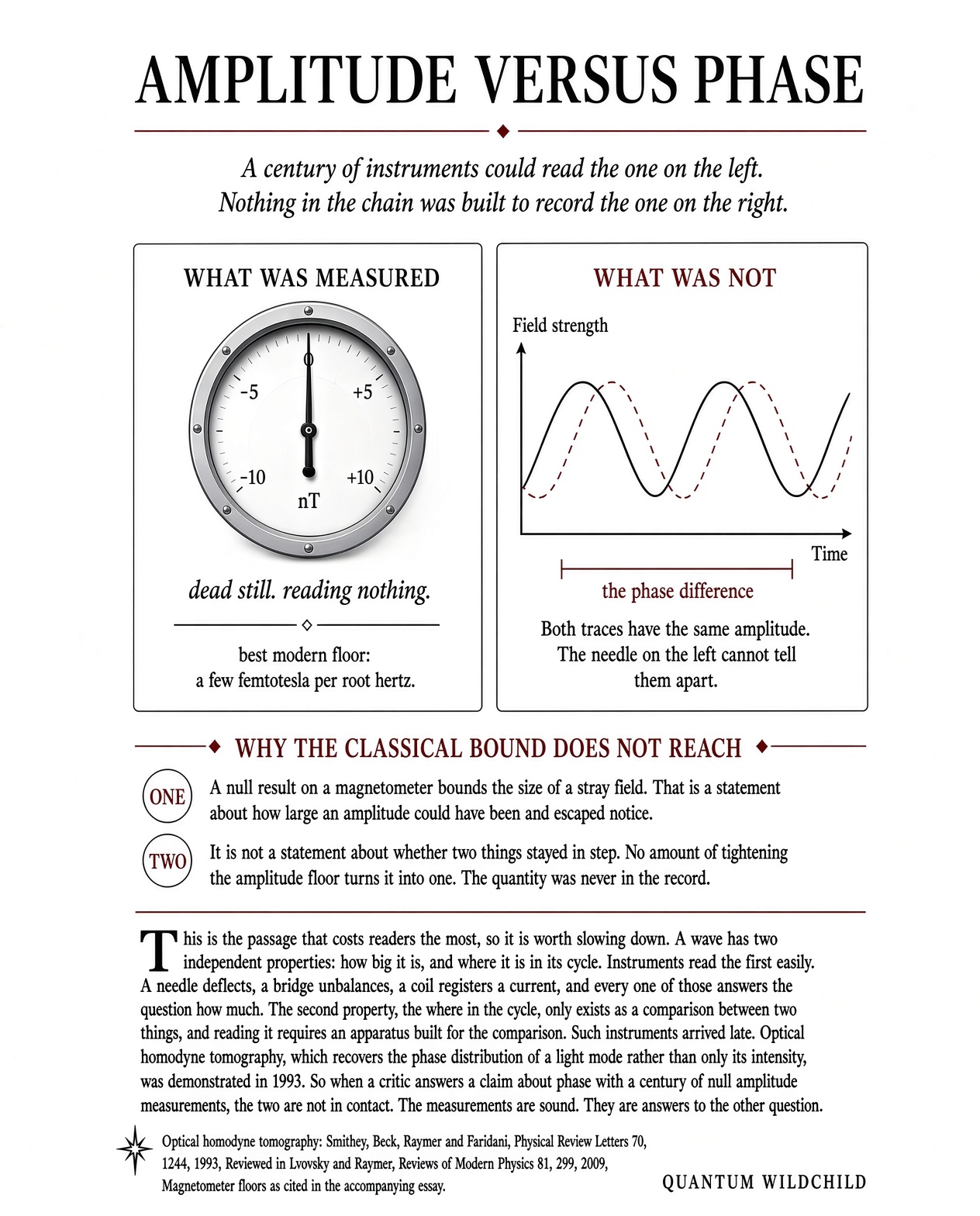
Some sense of the scale involved. The Earth's magnetic field, the one that moves a compass needle, is about fifty microtesla. A femtotesla is a billion times smaller than a millionth of that. The instruments that reach it are SQUIDs, superconducting rings cooled to near absolute zero, and they are the most sensitive magnetic detectors ever built. Their floor is a few femtotesla for each second of averaging. The null results that critics cite were taken with these, and they are genuinely null.
But every one of those instruments measures a magnitude. Reading where a wave stands in its own cycle requires comparing it against a reference wave, which is a different apparatus entirely. Optical homodyne tomography does exactly that, mixing a signal against a reference beam at many different settings and reconstructing the full state rather than just its brightness. It was first demonstrated in 1993. So the null results are sound, they are simply answers to the question that was asked, and the other question was not being asked at all.
Plate Nine
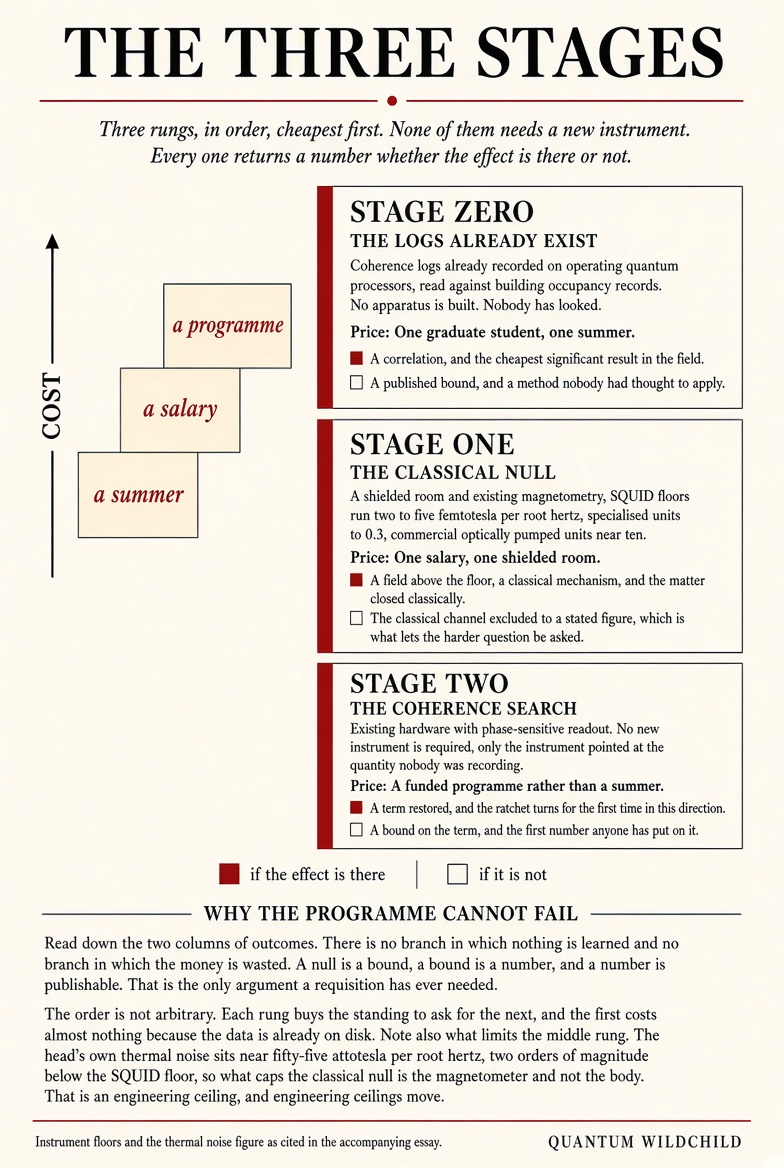
Stage zero needs explaining because it sounds too cheap to be real. Every quantum computer in operation logs how long its qubits hold coherence, and those logs are kept as routine engineering data. Every building those machines sit in logs occupancy. Both datasets already exist, on disk, going back years. Setting one against the other is a statistical exercise on data nobody has to gather, and if it produces a correlation it is the cheapest significant result in the field. If it produces nothing, that is a published bound and a method nobody had thought to apply.
The middle rung has a ceiling worth naming. An attotesla is a thousand times smaller than a femtotesla, and the human head's own thermal noise sits around fifty five attotesla, two orders of magnitude below what the best magnetometer can currently resolve. So what limits that measurement is the instrument, not the body, and instrument floors move. Read the two outcome columns on the plate and there is no branch in which nothing is learned. A null is a bound, a bound is a number, and a number is publishable. That is the only argument a requisition has ever needed.