
PO-FACED POKER
AND A JOKER WITH NOTHING TO LOSE
Note on Method
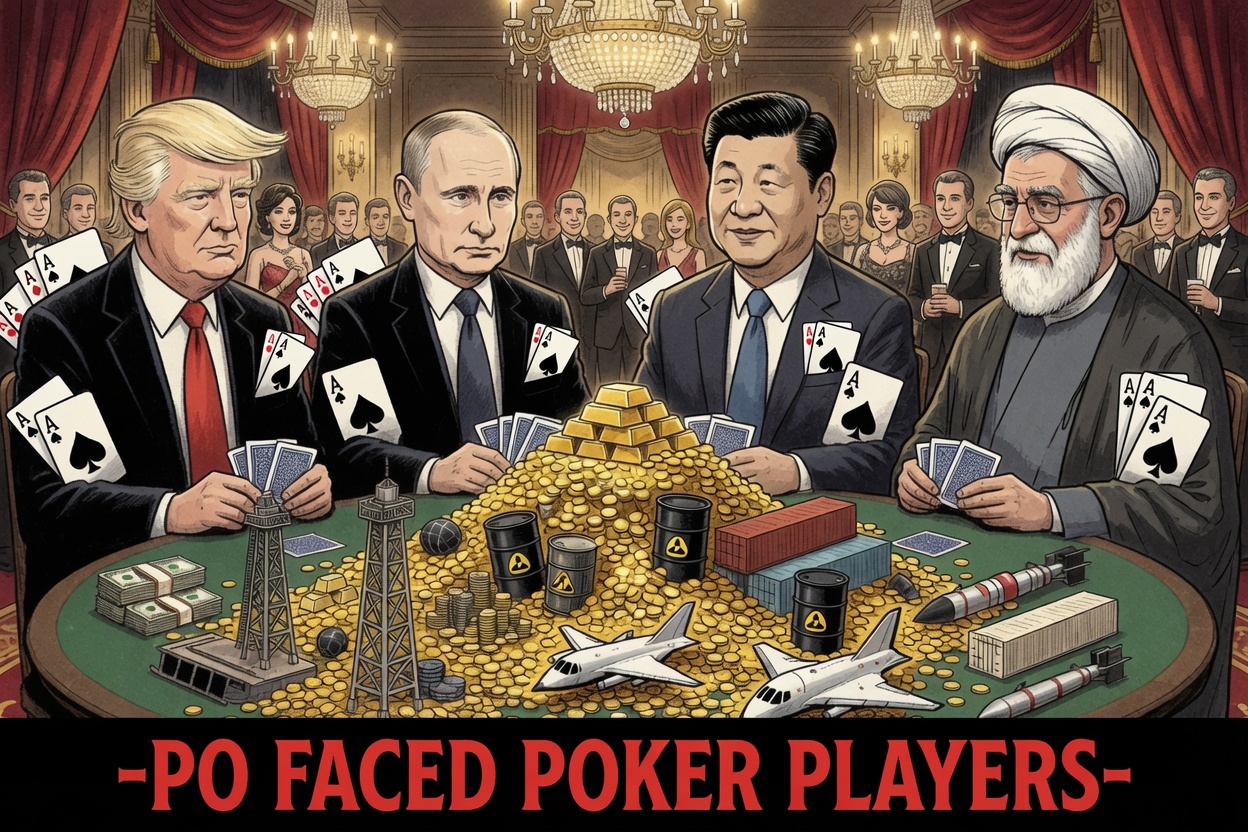
This is written from the seat of the pants, and it says so from the outset, because honesty about what can and cannot be known is the whole discipline of reading a table where nobody shows their cards. I trust none of the players, because none of them is showing their hand, and the stakes are too high for any of them to. The visible layer, the speeches, the summits, the daily press briefings, is the finest organic offal, prepared for public consumption. The real exchange runs beneath it: constant, guided, and mutually understood, because the alternative to mutual understanding at this altitude is a third world war, and not one player at the table wants that. So they keep straight faces and clear the market between hands. What follows is not a claim to know the deal. It is a claim that the deal exists, that it is deliberately kept below the waterline, and that the surface noise is there precisely to keep you looking at the wrong thing.
I. Caracas: The First Card
The board was cleared in two moves, and the first was dealt in Caracas, weeks before anyone was looking at the Gulf. In the small hours of 3 January 2026 the United States launched Operation Absolute Resolve, an aeronaval strike across northern Venezuela whose full cost nobody has yet quantified and which the Government Accountability Office will one day sweat over. Venezuelan air defences were wholly ineffective. In roughly two and a half hours, one of the shortest military operations on record, Nicolas Maduro was seized in his own capital and flown to a Manhattan courtroom to face narco-trafficking charges. The man sold to the world as a strongman folded like wet cardboard, which told you what he had always been: not a Chavez but a stand-in, a puppet propped-up by Havana.
The tell was in who died defending him. Maduro's praetorian guard was not Venezuelan. It was Cuban. Havana had denied any military presence in Venezuela since 2008, and Maduro himself claimed in 2019 that his personal guard was home-grown. The raid exposed the lie in a single stroke: Cuba acknowledged thirty-two of its own killed, described by Havana in its own words as members of the armed forces and intelligence services, and confirmed as Maduro's security detail. Among the dead was Colonel Humberto Roca, once responsible for the personal security of Fidel Castro. Trump said it without ornament: a lot of Cubans were killed. On 15 January their urns came home draped in the Cuban flag, received at Havana's airport by Diaz-Canel and a 94-year-old Raul Castro in full uniform, to trumpets and drums and thousands lining the boulevards, two days of national mourning, posthumous promotions, tribute events in every municipality, one of only a handful of such state funerals Cuba has staged in half a century.
You do not stage a funeral like that for bodyguards. You stage it for the load-bearing layer of your own power projection, and that is what the thirty-two were. The United Nations' own fact-finding mission had already documented the 2008 memorandum under which Cuba restructured Venezuelan military intelligence, embedding advisers across the civilian intelligence service, the military counter intelligence directorate, the defence ministry, the ports, the airports, and the national identity system. The Cubans did not merely guard Maduro. They ran the machine, and a crucial valve on that machine was the flow of subsidised Venezuelan oil to Cuba itself. So ask the question the arrest-warrant framing is designed to stop you asking: why does a drug bust require putting Havana's senior intelligence colonels in the ground? Because the operation was never about the man. It was about severing Cuba's grip on the Venezuelan state and its oil at the only point that mattered, the people who worked the valve.
The rest of the casualty list stayed below the fold, as such lists do. Independent monitors put the Venezuelan military dead at around forty-two or forty-three, most of them at Fort Tiuna, alongside the thirty-two Cubans and a number of civilians, with other counts running higher still. Perhaps a hundred dead in two and a half hours, for an event sold to the world as a clean, surgical law-enforcement action.
And what replaced Maduro confirmed the design. Delcy Rodriguez, his own vice president, was sworn in within forty-eight hours and began, in Washington's own word, cooperating. The DEA had run an intelligence file on her since 2018 and made her a priority target in 2022; her brother had negotiated her elevation with US envoys through Qatari channels the year before, offering a Madurismo without Maduro that would welcome US investors and quietly loosen the ties to Iran and Russia. She is not the resistance. She is the manager Washington chose and now steers, on pain of a price Trump promised would be bigger than Maduro's own. He stated the objective plainly: the United States would run the country, control its oil industry, and hold its reserves, the largest on earth, indefinitely.
That is the move behind the move. Venezuela sits on close to three hundred billion barrels. The rot did not begin with Chavez, and pinning it on the left is the lazy read. Venezuela pumped 3.7 million barrels a day at its 1970 peak, near a tenth of the planet's oil, one of the richest nations on earth. Then the political class went to work on it. The state nationalised the oil in 1976 and threw out the foreign majors who had trained the engineers and kept the fields running, and what came after was not ideology but pillage, wearing two party rosettes and taking turns. Carlos Andres Perez, twice president and a bosom friend of Spain's Felipe Gonzalez, left office impeached for looting a secret slush fund; oligarch dynasties like the Cisneros clan wove their fortunes straight through the rotten establishment that governed the till. They ate the eighth-richest economy in the world down to the bone, called it stewardship, and handed the wreckage to their own populations. That is what produced Hugo Chavez in 1999, not a foreign plot but a nation's disgust with a class that had robbed it blind. He arrived as the symptom, and became, in time, the disease's next stage. By the time he and then Maduro had finished with expropriation, default, and the purging of every competent hand that remained, they were only accelerating a collapse a quarter of a century in the making.
Rebuilding that output to its old managed heights is a decade-long project costing hundreds of billions, and the new US-aligned managers are eager to supply exactly that. The purpose is not Venezuelan prosperity. The analysts say the quiet part in plain print: the rebuilt flood of Venezuelan crude is aimed at structurally weakening OPEC-plus and crashing the price to cripple rivals, Russia first among them. Caracas was not a drug bust. It was the opening hand in the clearing of the global energy market, and the broker dealt himself the first card.
II. Hormuz: The Second Card
The second move came on 28 February 2026, when the United States and Israel opened the war on Iran, and within days the Strait of Hormuz, the single most important energy chokepoint on earth, went from carrying some fifteen million barrels of crude a day to near zero. Roughly a fifth of the world's oil supply was removed from the market in a stroke. The International Energy Agency called it the most severe supply shock in the history of the oil market. Insurance evaporated, tankers refused the passage, and by mid-April the United States was running a naval blockade of Iran's own ports.
A shock of that magnitude should have sent prices into orbit and the world into immediate depression. It did not, or not at once, and the reason is instructive. The buffers held the line for a season: strategic reserves drained, floating storage tapped, the US Strategic Petroleum Reserve emptied steadily toward its structural floor, the point below which the caverns themselves take damage. The pain was real and it was global, but it was managed, staged, absorbed by mechanisms that only a coordinated set of players could have deployed in concert. A genuine free-for-all does not look like this. A cleared table does.
And here is the tell that the confrontation narrative is offal. Throughout the closure, ships did pass the strait. Mostly petroleum, and mostly bound for China and India. Iran opened its own private channel north of Larak Island and charged for passage; China, which publicly criticised the war, kept its Gulf crude flowing through that lane while the Western reserves bled. The people the war was ostensibly aimed at inconveniencing were the people who quietly kept getting their oil. Follow the molecules, not the headlines, and the map inverts. Two moves, one hand: the Western hemisphere's largest reserves brought to heel in January, a fifth of the world's supply throttled in February, and in both the same broker positioning himself to sell the replacement.
III. The Broker Steps Forward
Every removed barrel is an opportunity for whoever can supply the replacement, and one player was positioned to do exactly that. As the Gulf choked, US crude and refined-product exports surged. The architecture assembling around this is not hidden if you read the trade documents rather than the speeches. The European Union has committed to some seven hundred and fifty billion dollars of US energy over three years, please read that figure again, and is projected to depend on the United States for up to eighty percent of its liquefied gas once its own ban on Russian supply ends in 2027. Deliveries of US crude and gas to Japan and to Asia climb as the Gulf falters. A twenty-five percent secondary tariff now falls on any country importing Venezuelan oil, which is to say the flows out of Venezuela are being routed through US hands or penalised for escaping them.
This is the shape of a deliberate strategy, and it is the answer to a question that ought to trouble anyone watching the US balance sheet. How does a power carrying a national debt beyond comprehension keep the dollar enthroned and the deficit leashed? By making itself the indispensable broker of the one commodity every economy must buy. The petrodollar does not defend itself. It is defended by ensuring that the energy trade, wherever the molecules originate, clears through instruments and intermediaries the broker controls. A war that removes a fifth of supply from a rival's preferred channel, and routes the replacement through your own, is not a policy failure. It is the policy.
IV. The Nord Stream Gambit
The audacity of the design shows clearest at its most improbable edge, and it is the edge that sounds like a joke until you read the proposals. There are reported US plans to take control of the Nord Stream 2 pipeline, the Baltic conduit built to carry cheap Russian gas straight to the German doorstep, by acquiring the Swiss-registered, Gazprom-owned company that legally holds it. Combine ownership of the pipe with the existing US grip on Germany's liquefied-gas imports, and the United States would sit astride both taps at once: the Russian gas in the pipe it now owns, and the US gas on the ships. The broker would control the supplier's own delivery route.
Consider what that means, and permit the bitter laugh it earns. The Russians sank on the order of eleven billion into laying that infrastructure to deliver cheap, high-energy gas to Europe's doorstep. Europe's leadership thanked them by sanctioning the supply, presiding over the destruction of the pipeline, and then kicking the supplier in the gonads an uncertain but generous number of times. And the endgame on the table now is for the US broker to buy the wreckage cheap and sell the same Russian gas back to the same Europeans, through the same pipe, at a margin. The customer who blew up the delivery van gets to buy its own groceries back from the man who bought the van for scrap. If it were fiction it would be rejected as too zany.
V. The Suicide of the Middle Man
There is one player at the table who is not playing poker, because a poker face requires knowing you are in a game. Europe does not appear to know. It is not a principal in this negotiation; it is the terrain the negotiation crosses and the mark the table has agreed to fleece. The eleven billion was Russian, but the self-inflicted wound is European, and it is the same wound opening on every front at once.
The pattern is suicidally consistent. On energy, a leadership that severed itself from cheap supply and bound itself, at premium prices, to a single distant broker, calling the dependency security. On the war it now runs by proxy, the increasingly irrelevant EU seeks a suicidal economic reactivation by kicking the bear in the teeth. Striking Moscow, its rearguard industrial infrastructure, and innocent Russian civilians by a thousand cuts.
Drones produced in the EU, to make up for Ukraine's army of the dead, funnelled to Ukraine through three primary EU logistic hubs, launched by EU-trained Ukrainian troops, EU advisers, or drone-launch motherships docked in EU Baltic ports, flying EU and NATO-generated flight plans deep into Russia.
The inversion is total. For seventy years the fear ran one way, the great power dragging a reluctant Europe into its wars, in the transparent hope of provoking a reprisal that lets them invoke Article Five and drag in a Washington that has made plain it will not come. Now Brussels strains to drag a reluctant Washington into one, manufacturing a trigger because the willing partner has walked.
And on the ledger that matters most, the material welfare of the populations in whose name all of it is done, the account runs only one way: inflation, deindustrialisation, dependency, and the slow consumption of a continent's accumulated capital, sold to the public as sovereignty. Brussels should be careful what they wish for. The Oreshniks raining on Romania, Poland, Estonia, Germany or even Vauxhall Bridge in London may jolt them all back to an unwelcome reality.
Whether this leadership is degenerate, corrupt, and compromised, or merely captured and out of its depth, is the one question this dispatch leaves open, because the outcome is identical either way and the answer changes nothing about the mechanism. A ruling class that governs against the material interest of its own base, consistently, across every file, toward the balance sheet of another power, has told you what it is by what it does.
Am I surprised by the outcome? No. When a supplier spends eleven billion to lay cheap energy at a customer's door and the client's government answers by destroying the pipe and kicking you in the balls, the rest of the story writes itself. The supplier turns east. The broker pockets the margin. And the punter is left performing the rituals of relevance over the drained account of its own household.
VI. The Straight Faces Hold
So the table sits, and the faces hold. Washington, Beijing, Moscow, and behind the felt the older money that keeps its own counsel, understand one another's demands with a precision that never reaches print, because reaching print would break the leash that is keeping the worst outcome off the table. They confront in public and settle in private, daily, because the option they are all quietly avoiding has a name, and none of them will say it out loud. Every one of them is, at the deepest level, on the same side: the show must go on, growth and progress must continue, each on his own terms and at the other players' expense where it can be arranged. That shared interest is exactly why nothing surfaces. The secrecy is not a failure of transparency. It is the mechanism of the peace.
I cannot show you the hand, because none of the players will. I can tell you the game is poker, not war, that the war is a hand within the game, and that the player losing chips fastest is the one who came to the table believing the speeches. Read the Oil and Gas flows, not the media offal. The hydrocarbon molecules do not lie, and they are all moving toward the broker.