
GRAPHENE: Death By A Million Cuts
Each sheet is an atomic blade, too fine to see and too durable to expel, and we are making it by the tonne. It is the way asbestos killed. There is no exposure limit for it anywhere on earth, and it is going into the food, the soil and the brain.
The wonder material
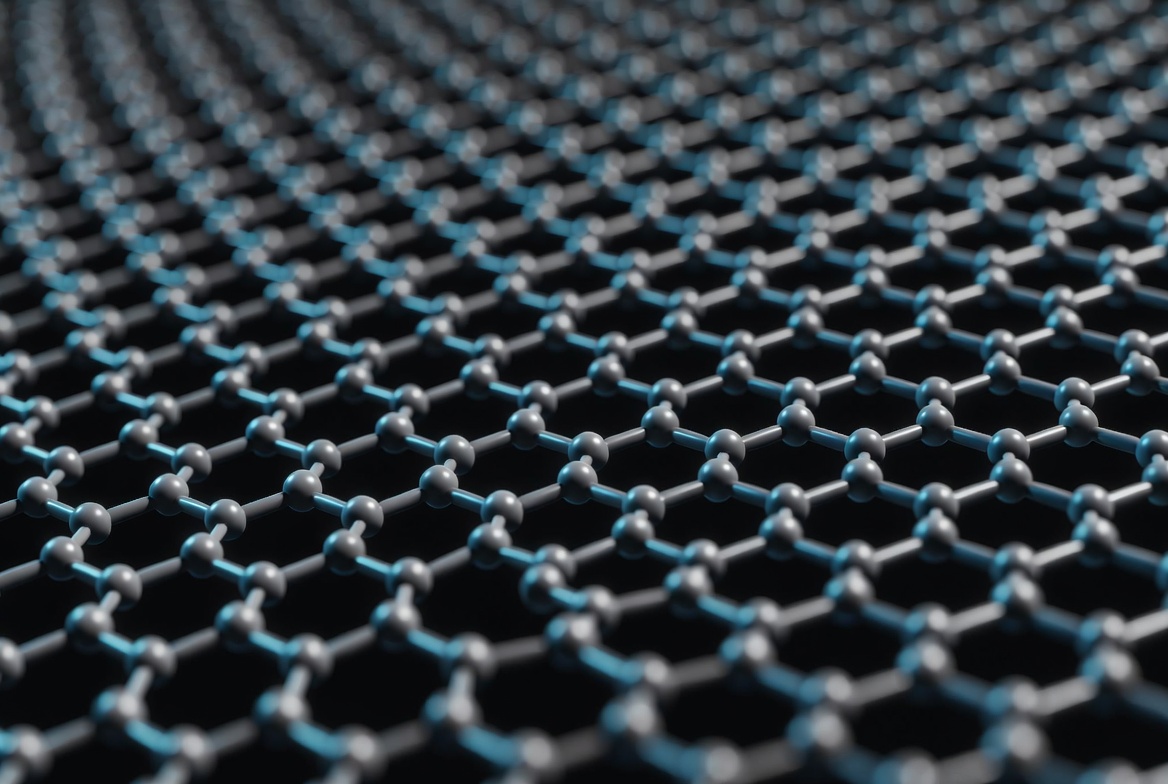
In 2004, two physicists at Manchester pressed a strip of sticky tape onto a lump of graphite, the soft grey carbon that is in every pencil, and pulled. What came away was a sheet of carbon one atom thick. A single layer, the atoms locked in a hexagonal mesh like chicken wire. They called it graphene. Six years later they had the Nobel Prize.
The properties are not modest, and they are the reason for everything that follows. Graphene conducts electricity better than copper and carries roughly a thousand times more current before it burns. It conducts heat better than any substance known. By weight it is stronger than steel, and it is very nearly transparent. A sheet of it the area of a football pitch would weigh less than a gram.
The marvels are stranger than the sales pitch. Stack two sheets, twist them against each other by precisely 1,1 degrees, and the material becomes a superconductor, electrical resistance falling clean to zero, though only within a whisker of absolute cold, at 1,7 Kelvin, 271 degrees below freezing. It is faintly repelled by a magnet, the way water is. And it drinks electromagnetic radiation, which is why it is quietly going into radar-absorbing coatings and the shielding inside electronics. These feats are real, and each belongs to the pristine single sheet in a laboratory, not to the brown tonnage in the industrial vats. That gap, between the wonder in the physics paper and the powder on the loading dock, is the first thing to hold on to, because the whole story lives inside it.
And if you pass a very high voltage through cheap carbon of almost any kind, a capacitor bank dumped in a few milliseconds, the carbon reaches 3.000 degrees and flashes into graphene. That is not a laboratory trick, it is a manufacturing process. You can make the wonder material out of rubbish.
What nobody stopped to ask, then or since, is what a material with those properties does inside a lung.
Nanoconfusion: Four materials, same word
Almost nothing sold as graphene is the pristine chainlink sheet from the sticky tape. That is a laboratory object, like a perfect diamond. What industry makes is a family, and the members are as different from one another as diamond is from pencil lead.
Graphene oxide, GO. Take graphite, attack it with strong acids until the layers are studded with oxygen and prise themselves apart, and you are left with a brown sludge of oxidised carbon sheets. It costs between 100 and 500 dollars a kilo in bulk, less at the bottom of the market, and it can be made in industrial vats by anyone with a chemistry degree and a fume hood. Because it mixes into water and biological fluid rather than clumping, it is the form the pharmaceutical literature reaches for as a drug carrier, loaded with a molecule and injected.****
Reduced graphene oxide, rGO. Strip the oxygen back off with heat or chemistry and you recover part of the conductivity you destroyed making the oxide. What you get is never as good as the original: it is riddled with holes and defects, a bad photocopy of a masterpiece. But it is cheap and it conducts, and it is the industrial workhorse. Battery electrodes, supercapacitors, conductive inks. It is the single largest slice of what the world actually manufactures.
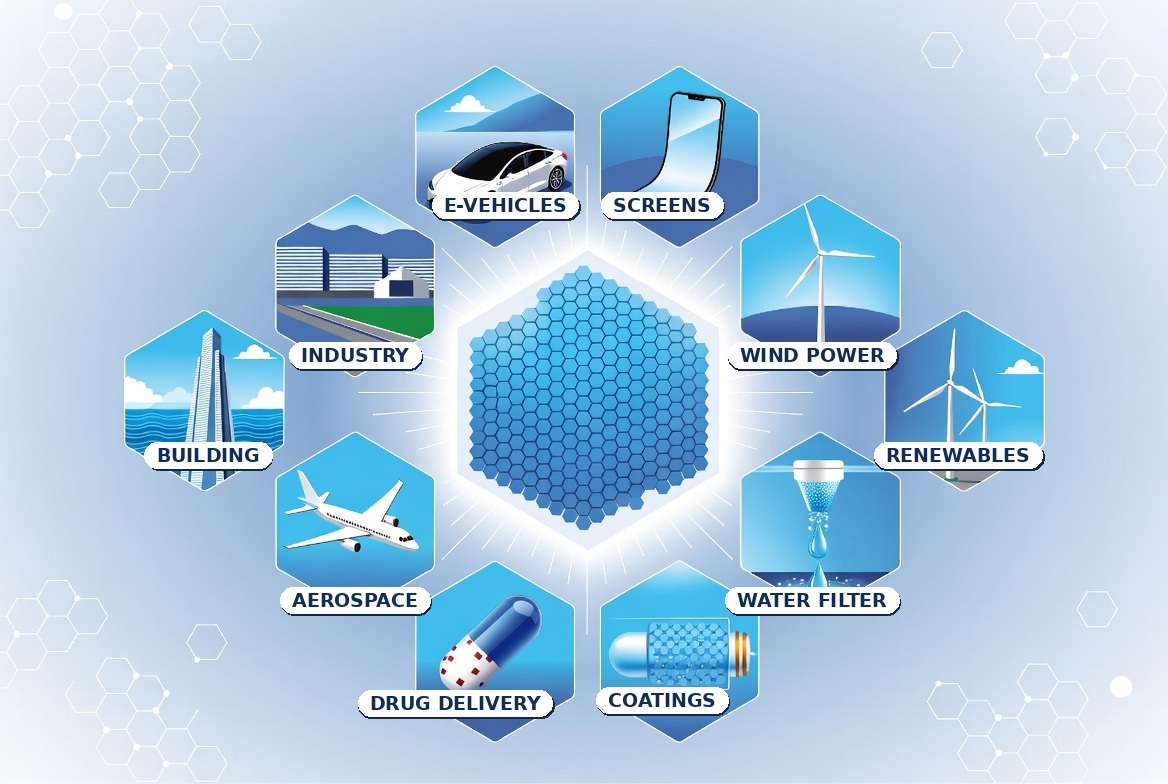
Graphene nanoplatelets. Not one layer but a small stack, ground down mechanically. Under USD 5/kg at industrial volume. The crudest member of the family and the one made in the greatest quantity, and its destination is concrete. This is worth understanding, because it explains where the tonnage goes. Cement production is responsible for roughly 8 per cent of all human carbon dioxide emissions. Add a fraction of one per cent of graphene platelets to the mix and they act as seeds, giving the setting crystals something to grow on, and the concrete comes out 20 to 30 per cent stronger and far less porous. Which means you can use less cement for the same wall. Graphene arrives in the construction industry not as a wonder but as a carbon credit, and that is why it is being poured into the ground by the tonne, into a material that will one day be demolished, crushed and turned to dust.
CVD graphene. The letters stand for Chemical Vapour Deposition: a metal foil is heated to a thousand degrees, flooded with a carbon gas such as methane, and the carbon sheds from the gas and assembles itself on the metal, atom by atom, into a single flawless sheet, which is then peeled off. The good material, and priced priced accordingly. The bulk grades, powders and flakes with real weight, run to thousands of dollars a kilo. The pristine monolayer is not sold by weight at all, because a sheet the size of a football pitch weighs about a gram, so a kilo of it would be a thousand pitches. It is sold by area instead, and a research-grade monolayer reaches up to USD 200.000 per square metre, sold by area rather than by weight, because a film of it weighs less than a feather. Sensors, transparent electrodes, and the microscopic electrode arrays now being built to go into the human brain.
Six orders of magnitude between the cheapest and the dearest. All four are called graphene, all four are legitimately so called, and the trade press uses the word loosely across the whole range. That looseness is where the numbers start to come apart.
How much Graphene have we produced?
Nobody can tell you, and that is the first thing worth being angry about.
The best peer-reviewed estimate has global production of the nano scale graphene family materials rising from around 14 tonnes in 2009 to close to 23.000 tonnes a year by 2025. The Graphene Council gives the same annual figure. Against it sit numbers that do not fit: about 1.000 tonnes a year in 2015; market forecasts putting annual output below 4.000 tonnes by 2026, while the same industry values the reduced graphene oxide market alone in the tens of billions of dollars. One survey of the field gives a range for 2022 of anywhere between 500 and 12.000 tonnes and settles on a median of 2.500, which is another way of saying that the people whose job it is to count have given up counting and taken an average of the guesses.
And one more figure, which cuts the other way. As of mid-2022, according to the analysts IDTechEx, global installed capacity for graphene and graphene oxide exceeded 12.000 tonnes a year, but utilisation was low because the orders had not arrived to fill it. Note the word: installed capacity, the amount the factories could make, not the amount they actually made. Capacity that stands idle today is capacity that runs tomorrow the moment demand appears, and it is a measure of how fast this industry is built to scale, not of how much has yet been produced.
These figures cannot all be true. The gap between them is not a rounding error, it is a factor of ten, and no authority anywhere is obliged to close it, because no authority anywhere is counting.
As a ballpark estimate: somewhere between 60.000 and 100.000 tonnes of graphene family material has been manufactured worldwide since 2011, most of it in the last five years. Reduced graphene oxide is a minority share, plausibly a few thousand tonnes in total. Nobody publishes the breakdown. Most of the physical output is Chinese, made outside any nanomaterial regulation that exists.
Tens of thousands of tonnes of an engineered material, then, and the industry that makes it cannot say within a factor of ten how much of it there is.
What it means to be that small
A sheet of graphene is 0,34 nanometres thick. To get a feel for that: a human hair is about 80.000 nanometres across. You would need to stack roughly a quarter of a million graphene sheets to match the width of one hair.
But thickness is not the useful number. The useful number is this. The shortest wavelength of light the eye can see is around 400 nanometres. A graphene sheet is a thousand times thinner than that. It is not merely too small to see with the naked eye. It is too small to see with any optical microscope that has ever been built or ever can be, because light itself is too coarse an instrument to touch it. To look at this material you need an electron microscope, and even then you are looking at a shadow.
So set aside for a moment the question of whether the stuff is dangerous, and ask a simpler one. How do you keep something contained when you cannot see it, cannot smell it, cannot taste it, and cannot photograph it with light? How do you know whether it is on the bench, on the glove, on the sleeve, in the corridor, in the car park? How do you clean a spill you cannot find?
In a well-run plant, you can. Filters do catch particles this small: below a certain size they stop behaving like grit and start behaving like smoke, drifting into the fibres of a filter by random motion rather than punching through. Enclosure works. Wet handling works. The industry's own guidance is not to handle the dry powder at all, but to take delivery as a paste, a liquid dispersion, or a pellet with the material already locked into plastic.
In a plant that is not well run, nobody would ever know. And this is the point at which to stop and notice the shape of the hole.
Why you have never heard of a graphene accident
There has never been a graphene safety scandal. No factory closure, no compensation case, no cluster of sick workers on a front page. Read that as reassurance if you like. Here is the other reading.
You cannot breach an exposure limit that does not exist. There is no legal maximum concentration of graphene in workplace air anywhere on earth, which means there is no threshold to exceed, no inspector arriving with an instrument, no citation to issue, no fine, no record. A regulatory violation is not possible, because there is no regulation. The absence of prosecutions is not evidence of safe practice.
Nor is there a disease to count. If this material harms people it will do so the way asbestos did, and asbestos took 20 to 40 years to present. The first mesothelioma deaths came a generation after the exposure. Graphene reached industrial volume around 2020. If we are running the asbestos experiment again, we are five years into it, the patients are healthy, and the results are due in 2050.
And there is no cohort. Nobody has registered the workers, nobody is following them, no health authority has an entry for graphene exposure, and the workforce is small and scattered across chemical plants in a dozen countries. If a signal appeared in it tomorrow, there is no instrument pointed at the place where it would show.
Silence is being produced here, industrially, and it is being mistaken for safety.
The composite defence, and where it fails
The industry's answer to this is that most of the tonnage is not loose. It is locked into things. Bound into concrete, into tyre rubber, into composite panels, into battery electrodes, into plastic pellets. A graphene sheet set into dry cement is not going to blow off the wall this afternoon. For today, it is held.
But nothing built is held forever, and this is where the reassurance turns to ash. A building is not a tomb, it is a delay. Every structure ever raised comes down in the end, by wrecking ball, by decay, by fire, or by catastrophe, and when it comes down the material in it does not vanish, it is liberated, all at once, as breathable dust. The precedent is not hypothetical and it is not old. When the towers fell in Lower Manhattan they did not topple, they pulverised, and a whole triple structure's worth of what had been safely bound inside the walls, asbestos among it, went up as a cloud that the living breathed for months and were still dying of years later. That is the model for graphene concrete, poured now by the tonne into the bones of cities. It is a building-sized reservoir with a fuse measured in decades, and the release is not a spill from a broken drum, it is the structure itself returning to powder on a date nobody has written down but everybody can be sure of. Carbon credits with a Bang!
Demolition, then, is one way out. It is not the only one. A material bound today is a material released tomorrow, and the exits are not mysterious. There are three
Manufacture. Somebody, somewhere, handled the dry powder before it went into the matrix, and that somebody is a worker in a plant with no exposure limit to protect them.
Wear. A tyre is a composite too, and a tyre wears out. Every tyre on earth deposits its substance onto the road surface as it goes, and what is in the rubber ends up blown away by the wind, in the gutter, the drain, the river. Brake pads, coatings, painted surfaces, all of them subject to abrasion. A material designed into a wearing part is a material designed to be released slowly into the environment. That is not a failure mode. It is the intended life cycle.
Disposal. Concrete is demolished. It is crushed, and the crushing makes dust, and the dust is carted away as aggregate and used again. There is no recycling stream for graphene. There is no recovery method, no separation technology, no take-back scheme, no end-of-life directive, no landfill classification, in any country. The material was never designed to come back out, and no one has been asked to design it.
The shape of the knife
Now the part that makes the geometry matter more than the chemistry.
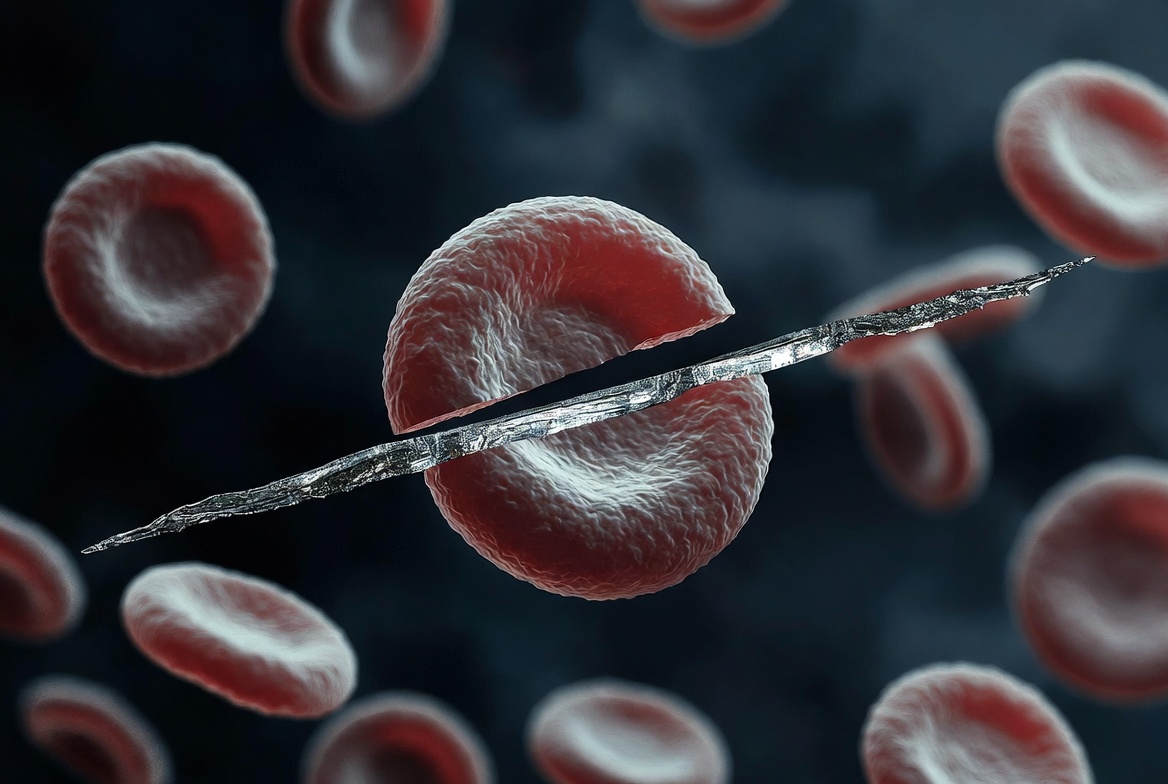
A graphene oxide sheet is wide, vanishingly thin, stiff, chemically reactive along its torn edges, and biologically indestructible. It does not dissolve. It does not rot. And its edge, at the scale of a cell, is not an edge in any sense you have a feeling for. It is an atomic blade. Atomic not in the sense of atom bombs or radiation, but in the literal sense: a one atom thick, the thinnest cutting edge that can physically exist.
When such a sheet meets a living cell, several things happen and none of them are good for the organism be vegetal or animal...or human. It cuts. The edge slices into the membrane, the fatty envelope that holds the cell's contents in, and the contents come out. Worse, it does not need to cut. The flat face of the sheet is intensely attractive to the fatty molecules the membrane is built from, and it can simply pull them out of the wall and onto itself, sucking the cell's own skin away molecule by molecule, like a magnet drawing filings out of a wall.
And then there is what the body tries to do about it. The macrophage is the cell whose job is to find foreign matter, engulf it, and digest it. Faced with a stiff sheet larger than itself, it tries and cannot close. The trade has a name for this, and the name tells you everything: frustrated phagocytosis. The macrophage cannot swallow, cannot let go, and dies where it stands, spilling its digestive chemistry into the surrounding tissue. Then the next one arrives and does the same. The inflammation does not resolve, because the thing causing it cannot be removed. It just sits there, and the body keeps sending cells to die on it.
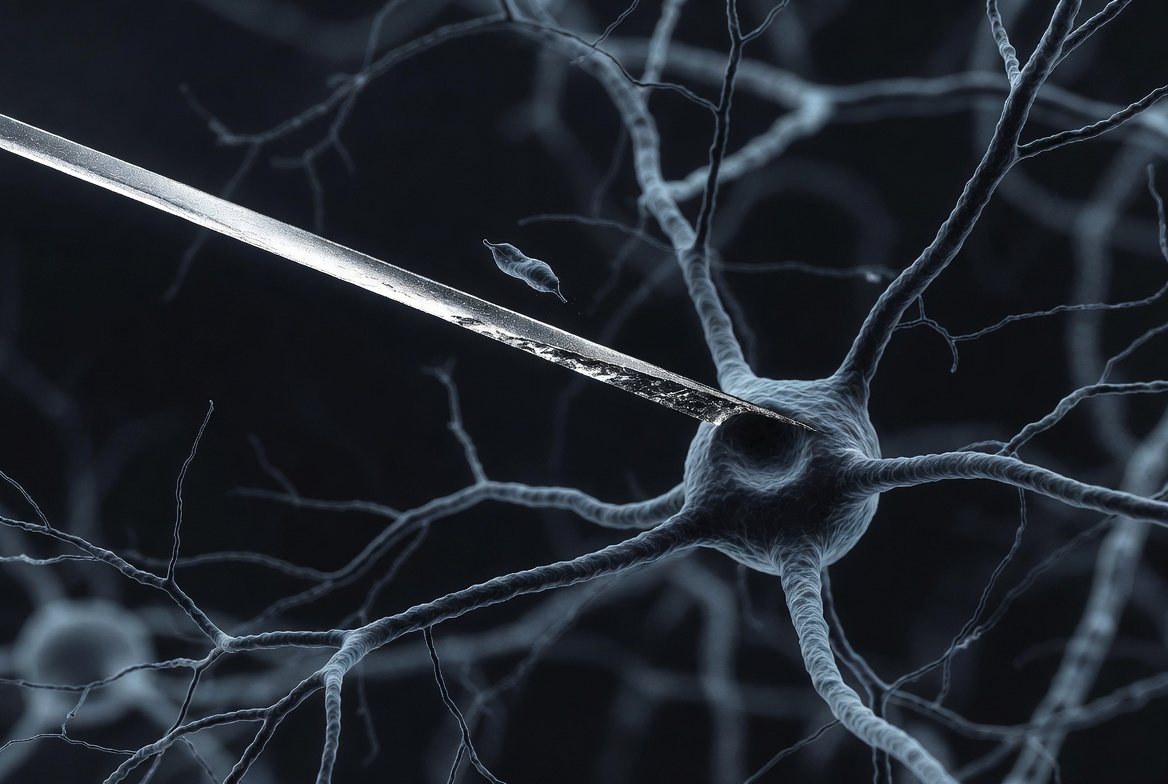
And now add the one thing a still picture of a blade cannot show, which is time. A sheet that reaches the bloodstream does not strike once. The heart does not rest, and neither does the sheet. Every beat drives the same material through the same vessels again, a hundred thousand strokes a day, and on each pass the sheet tumbles against the red cells and shreds or strips them, dragging the fat from the cell wall until the cell ruptures and spills its cargo. Where such a sheet reaches the sheath of a nerve, it frays the insulation, the myelin, that lets the nerve carry a signal at all, which is the same class of injury that in another guise is called demyelination. It does not cut once. It cuts for as long as you have a pulse.
And follow the nerve to where it leads, because the destination is the worst case of all. The brain is the fattest organ in the body, close to 60 per cent lipid by dry weight, and the fat is not padding, it is the working substance: the myelin that sheaths every fibre, the membrane that walls every neuron. The one property that makes a graphene sheet deadly to a cell is that its flat face is voracious for exactly that lipid, prising it out of the wall and onto itself. A material whose signature act is stripping fat from membranes, arriving at an organ built out of fat, is a solvent reaching the thing it dissolves. And the brain does not mend the way the rest of the body mends. A cut in the skin closes. A liver rebuilds itself. A neuron, once stripped, mostly does not come back, because the brain holds almost no spare parts and runs no repair shop worth the name. Damage there does not heal over. It accumulates. Whatever is scarred in that grey fat stays scarred, for as long as the person lasts, and every heartbeat brings the next sheet.
Follow that to the organ it beats through. A material that inflames whatever tissue it lodges in, arriving at a heart, would produce myocarditis or pericarditis, inflammation of the heart muscle and its lining, indistinguishable from the kind a death certificate marks cause unknown. And here is the trap the whole system is built into. No coroner tests for graphene, because there is no test, no reference range, no line in any autopsy protocol instructing anyone to look. The instrument does not exist and the question is not on the form. So if this material were reaching hearts and stopping them, the death would be recorded as a mystery, filed, and closed. Not because anyone hid it. Because nobody was equipped to find it, and nobody was asked to try.
One wonders what Brussels had in mind when in 2013 it announced, with pomp and gravitas, a billion euros to kickstart a European graphene industry. Was any due diligence done. Were the risks weighed. Did anyone raise a hand, and if they did, did anyone listen. Or was it simply assumed, as it always is, that the consequences would fall due on someone else's watch, long after the ribbon-cutters were safely retired or dead. They have funded, with great ceremony, the industrial scale-up of a cellular reaper: the oldest tool in the medieval field, the hay-cutter's sickle, machined down to a single atom's edge and multiplied by the tonne. The billion was signed off in the Barroso era, and José Manuel Barroso, the Lusitanian cheerleader for the European project, went on in 2016 to chair Goldman Sachs International, a move that so troubled Brussels it opened an ethics review of one of its own former presidents. Make of the trajectory what you will.
2009 was when Barroso started his second term, and it was the year Geim and Novoselov's work was heading toward the 2010 Nobel. So graphene was in the air in 2009, but the billion-euro EUFlagship Billion euros in a decade was announced in January 2013.
This is not a hypothesis about graphene. The fibre mechanism is the confirmed way asbestos killed a hundred thousand people, and it is why the International Agency for Research on Cancer, in 2014, classified a particular multiwalled carbon nanotube, abbreviated MWCNT, the specific variant known as MWCNT-7, as possibly carcinogenic to humans on the strength of animal evidence alone, with no human cancer data at all. They did it because the shape was enough. A durable fibre the body cannot dispose of was, on its own, sufficient grounds.
So let it be said in one sentence, what the whole trade has spent fifteen years declining to say it. A durable sheet the body cannot break down, cannot dissolve and cannot expel, lodged in a lung or a heart or the grey fat of a brain, is not a health concern, it is a mechanism of death. It is the same mechanism, fibre by fibre, that has already killed hundreds of thousands of people under the name asbestos, and it is being manufactured now at a scale asbestos never reached, and put deliberately into places asbestos never went.
And do not mistake this for a poison. Graphene is not arsenic. It does not attack a metabolic pathway, and by the crude measures of classical toxicology it is close to inert.
That inertness is the trap. A poison the body can process and pass. This it cannot break down, cannot dissolve, cannot expel. The harm is not chemistry, it is a shape that cuts and a durability that means the cut never stops. Asbestos is not a poison either.
Graphene, graphene oxide and reduced graphene oxide have never been evaluated by IARC. Not cleared. Never examined.
The carrier chosen for the reason that should disqualify it
There is a form of graphene oxide already being injected into living animals, on purpose, in laboratories on four continents, and lined up for human trials. It is a drug carrier. You load a therapeutic molecule, a chemotherapy agent, a gene fragment, an imaging dye, onto the vast flat surface of the sheet, put it into a vein, and let it ride the bloodstream to its target.
The sheet is chosen for this precisely because of the two properties that make it dangerous everywhere else. It carries an enormous payload, because a flat sheet is nearly all surface, and the numbers are not modest. Where a conventional carrier struggles to hold a fraction of its own weight in drug, graphene oxide has been loaded with doxorubicin, one of the commonest chemotherapy agents on the ward, at up to 393 % by weight. Read that again: the sheet carries nearly four times its own mass in cytotoxic drug. And it slips through the biological membranes that stop other things, because that is what a thin, stiff, fat-hungry sheet does to a cell wall. The pharmaceutical literature does not treat any of this as alarming. It treats it as the specification. The membrane-crossing that is a wound in a lung is a feature in a syringe.
This is not a fringe experiment. It is one of the busiest fields in nanomedicine, with thousands of published papers and a market that analysts project into the billions of dollars, led by North America and Europe with Asia forecast to grow fastest. The drugs being loaded onto these sheets are the real furniture of the cancer ward: doxorubicin, paclitaxel, methotrexate, camptothecin, 5-fluorouracil. The mechanism relied upon, called the enhanced permeability and retention effect, is that the leaky, disordered blood vessels around a tumour let nanoparticles of the right size, roughly 20 to 200 nanometres, slip out of the bloodstream and pool in the tumour tissue. That is the passive targeting the whole field is built on.
And here is the part that belongs in bold. Graphene oxide crosses the blood-brain barrier, the dense cellular wall that evolution built to keep foreign matter out of the brain, the barrier that stops most drugs cold. The literature on brain tumours states it flatly: GO penetrates the barrier and accumulates in the tissue beyond it. That is presented as good news, because it means a chemotherapy drug can be carried into a brain tumour that was previously unreachable. Turn it over and it says something else. The one barrier the body keeps around its most irreplaceable organ, this material walks through.
So where does it go once it is in the body. The animal work is consistent and it is not reassuring. Within 48 hours of an intravenous dose, graphene oxide leaves the blood and lodges, preferentially, in three organs: the liver, the spleen and the lungs. In rodents the liver alone can take 30 to 50 per cent of the injected dose. A share settles in the spleen and stays. One study followed spleen-resident graphene oxide for nine months.
Now hold all of that against one number. A team preparing a review of the field went looking for the human evidence. They searched the four principal clinical trial registries on earth, the US National Library of Medicine, the Chinese registry, the European registry, and the World Health Organization's international platform, for graphene oxide drug studies in people. They found three. Thousands of papers, fifteen years of work, a market measured in billions, an enthusiasm bordering on the evangelical, and three human clinical studies to show for it. The distance between the volume of the laboratory noise and the silence of the human record is the whole story of this sector, and it is the same story as the rest of this essay: the adoption is racing, the evidence is walking, and nobody in a position to slow it down has any reason to.
So the billion-dollar question. What could go wrong. And the answer is that every property they are selling is a loaded gun pointed to our heads, if it sheds its cargo in the wrong place, delivers a chemotherapy overdose to healthy tissue, and doxorubicin is toxic to the heart on its own. The blood-brain barrier crossing: a door that opens for the drug does not close behind it, and a particle that has learned to defeat the one defence the brain keeps does not cross only when it is carrying medicine. The biodistribution: the therapeutic dose is a fraction, and the rest, a third to a half of it, parks itself in the liver and the spleen for the better part of a year, a durable non-degrading sheet sitting in the organs with no exit, which is precisely the thing this essay has already shown you does not end well. And the targeting itself is leaky: the reviewers admit it gives less than a two-fold concentration in tumour over healthy tissue, which means most of the dose goes where it was never meant to. What could go wrong is that it works exactly as designed. The design was never the problem. The sheet that carries the cure is the same asbestos-shaped, membrane-stripping, non-clearing blade the rest of this essay is about, and putting it in a vein does not change its nature. It only chooses the entry wound.
The switch on the outside
There is one more property, and it is the one that should stop you cold. These sheets answer to light.
Graphene oxide is a powerful absorber of near-infrared light, and near-infrared occupies a narrow, crucial window: it is the one band of light that passes through skin and living tissue, a couple of centimetres deep, without being absorbed by the body itself. Which means you can inject the material, and then reach it with a beam from outside the body. The trigger never enters you. The receiver is already inside.
Shine an 808-nanometre laser on the skin above where the sheets have gathered, and two things happen on command. The sheet converts the light into heat, and cooks the surrounding tissue, a technique called photothermal therapy. One published study reports total tumour elimination in mice after an intravenous injection followed by the laser. And the same heat, or the light itself, orders the sheet to release its drug: the near-infrared pulse roughly doubles the release rate, and one system delivered more than eight times the drug into the tumour with the laser switched on than with it off. Heat on demand. Release on demand. A material inside the body, obeying a switch held outside it, through the skin, with no wire and no second surgery, for as long as the material remains, which you already know is months.
Now set three facts side by side, and just check them, each one is built, funded and published, and the alarm goes like this. One: we can insert inside the body a material that persists for months and obeys an external light switch through unbroken skin. Built. Two: we can deliver genetic instructions, by the lipid nanoparticle systems now breeding into dozens of variants, that reprogram what a living cell manufactures. Built, and already entering through a great many arms. Three: we can make cells themselves answer to light, once they have been handed the machinery to do it. Built.
Three finished parts of one obvious machine, sitting on the same bench, in the same decade, funded by the same money. Has anyone bolted them together. Not in any journal you can read, and here is the part the fact-checkers will want you to swallow: because it is not published, it does not exist. Think about who benefits from that logic. A system worth this much is a trade secret, and a trade secret is the one thing on earth that is deliberately kept out of the literature. The mushroom treatment, kept in the dark and fed on press releases. The absence of a paper is not the absence of a device, it is the presence of a legal department.
So no, I cannot prove the machine is assembled, and I won't insult you by pretending a hunch is a citation. But I am also won't insult you by pretending the parts are not there, gleaming, machined to fit, when they are laid out neatly in front of us. Every component is real. Every one is cited above. Nothing remains to be invented, only assembled together, and the entire history in this essay is future history exactly the instant it turna a profit, with the biology checked afterward if it was ever to be checked at all. Draw your own conclusion, and if a gatekeeper tells you that you are not permitted to, ask him which of the three parts he would like to claim is imaginary, and watch him change the subject.
The industry's answer to the obvious worry is that the body can clear it, and in part that is true and must be said. Small sheets can pass the kidney's filtration barrier and leave in the urine. The liver can, over time, take sheets into its cells and break them into dot-like fragments for excretion through the bile. This is real, it is measured, and an honest account reports it.
But read what the same papers also say in their own cautious voices, because caution is the story. The pharmacokinetics, one review states plainly, need extensive further investigation before the long-term toxicity of these materials is understood. Clearance depends brutally on size, coating and charge: change the sheet a little and its fate in the body changes completely, which means there is no single answer to whether it clears, only a different answer for every batch. The sheets that clear well are the small, coated, engineered ones made for the paper. The crude industrial oxide, made by the tonne in the vats already described, is not that material.
And here is the sentence to hold. Their reassurance covers the version designed to be reassuring. It does not cover the version made by the tonne, and nobody is studying that one inside a human body, because nobody injects industrial-grade oxide on purpose. That form enters people the other way: through the lung, the water, the food, uninvited, in a size and a state that no clearance study was built around. The drug-delivery science has spent fifteen years demonstrating in exquisite detail that graphene oxide travels through the body and parks in the organs, and has done it with the clean laboratory grade while the dirty industrial grade accumulates in the world unwatched. They have mapped the behaviour of the safe, expensive, cousin and left the dangerous one uncharted.

The limit that does not exist
There is no legal occupational exposure limit for any graphene material anywhere in the world. Not a weak one. Not a contested one. None. No jurisdiction has set a number that an employer is obliged to keep the air below: not the EU, not the UK, not the US, not China, which makes most of it.
In 2018 a review in the Royal Society of Chemistry's journal Nanoscale went through the animal data for graphene, few-layer graphene, graphene oxide, reduced graphene oxide and nanoplatelets and concluded that an exposure limit cannot be determined from what exists.
That phrase deserves unpacking, because it sounds like bureaucratic throat-clearing and it is not. To set an exposure limit you need a dose-response curve: this much material produces this much harm, and below this line nothing is seen. You get that curve by dosing animals at several levels and reading the damage. It has been done, many times, for graphene. So why is there no number?
Because there is no single material to have a number about. Every batch differs. The sheets vary in width from a few hundred nanometres to tens of microns. They vary in the number of layers, in how much oxygen they carry, in how torn and defective the edges are, in what solvent they arrived in, in what they were made from. A laboratory in Seoul and a laboratory in Milan can both publish results for graphene oxide and be testing materials with less in common than chalk and cheese. The studies cannot be pooled, because they are not measurements of the same substance. There is no dose axis, because there is no agreed unit to put on it. Mass? Surface area? Number of sheets? The field has not settled it.
So the scientific position is not that the material is safe, and not that it is dangerous. It is that a hundred laboratories have measured a hundred different things and called them all by one name, and out of that no regulator can build a line on a graph. The evidence will not carry a number. And in a regulatory system, a substance without a number is a substance without a rule.
The US National Institute for Occupational Safety and Health, NIOSH, unable to set a limit, fell back on a fallback: an exposure banding process, the tool you use when you have to guess. Three of the six health endpoints it assessed landed in the most severe band available, meaning harm is plausible at or below 0,01 milligrams per cubic metre of air. Then it went into the field, sampled 44 workers at 11 US graphene producers and users, and found airborne carbon running as high as 6.327 micrograms per cubic metre.
Set those two figures side by side and take a breath. The guess says harm may occur at or below 10 micrograms. The measurement in the plants found 6.327.
The NIOSH hygienist's own summary of why deserves quoting for its calm. There are roughly 84.000 chemicals in commerce in the US, against a few thousand exposure limits.
Consider what that ratio means in practice. An exposure limit is not a scientific fact, it is a committee decision, and the committees are small, slow, consensus-bound, and set upon by industry at every stage. A single limit can take a decade. The committees work through substances that already have decades of human epidemiology behind them, which is to say substances that have already hurt enough people, for long enough, to leave a statistical trace. That is the queue. New materials join it at the back, with no human data at all, and no constituency demanding that they be moved up. Graphene is not being singled out for neglect. It arrived at industrial scale while the queue was long, and the queue is not a delay in the system. The queue is the system, and it was designed by people who assumed that anything genuinely dangerous would announce itself with bodies.
Nobody is looking
The next thing worth knowing is where it has gone: in the water? the soil? the crop? the fish? the lung?
That question cannot be answered, and not because the answer is comforting. It cannot be answered because nobody has built the means to ask it. There is no environmental quality standard for graphene anywhere. There is no routine monitoring programme in any country. There is no surveillance capable of telling an engineered graphene sheet apart from the ordinary background soot of a burning world at the concentrations that would matter. Laboratory work shows that plants take these materials up through their roots and that they move through aquatic food chains, but those are dosed experiments run at concentrations chosen to produce an effect. They tell you it can happen. Nobody has gone out into the world to find out whether it is happening, because the instruments have not been deployed and the money to deploy them has not been asked for.
This scenario is worse than the frightening one. It is not that we know the material is in the food chain. It is close to simply impossible that it has not been in the food chain for years, and there is still no apparatus on earth to tell us. The silence is not a clean bill of health. It is an empty chair where an inspector should sit.
Where it is being put, on purpose
None of what follows is a secret. It is funded, published, patented and, in the specialist press, boasted about.
Into your food. Graphene and graphene oxide are in active development as barrier films and antimicrobial coatings for packaging. Whether the material migrates out of the film and into what you eat is an acknowledged open question in the literature. The EU has authorised no graphene food contact material, which means the development is running ahead of the permission, not behind it.
Into your bloodstream. Graphene oxide and its reduced form are standard platforms for drug delivery and medical imaging, chosen precisely because they carry a heavy payload and pass through biological membranes. The property that makes them useful is the property that makes them dangerous, and this is stated openly in the papers, because among specialists it is not a scandal. It is a specification.
Into the soil and onto the crop. Graphene is being tested as a carrier for foliar nano-fertilisers and as a soil amendment: deliberate application, in the open field, at agricultural scale.
And into the skull. This one deserves more than a line.
The electrodes that have been used to read and stimulate the human brain for half a century are made of metal, and metal is a poor thing to put in a head. It corrodes. The body walls it off in scar tissue until it stops working. It is stiff, and the brain is soft, so it saws gently at the tissue with every heartbeat. And it cannot be made very small, because a small metal electrode has a high impedance and hears nothing but hiss.
Graphene solves all four problems at once. It does not corrode, because it is carbon. It is flexible enough to move with the tissue. It has an enormous surface area for its size, so it can be made minute and still hear clearly. And it can be fabricated with the same equipment that makes computer chips, which means it can be made in quantity, cheaply, in hundreds of channels rather than dozens.
The EU's Graphene Flagship, a billion-euro programme launched with Nobel laureates and fanfare in 2013, ran its full ten years and produced, among other things, exactly this: a flexible graphene neural interface with electrodes 25 microns across, built on nanoporous graphene using standard semiconductor fabrication, intended for brain-computer interfaces. It has a name and a press release. The press release went nowhere, because a 25 micron electrode does not photograph like a Nobel Prize.
So the same shape that a macrophage cannot swallow, the same material for which no exposure limit exists in any country on earth, the same substance IARC has never troubled to evaluate, is being engineered into an implant designed to sit permanently in the human cortex, on public money, with the toxicology of its family unresolved and the safety case for its parent form unwritten.
This is the second crossover. The first was the injection. This one is the brain.
We have run this experiment before
Anyone who lived through the 1990s will recognise the machinery.
Exposure standards for radiofrequency fields, abbreviated RF, the electromagnetic radiation that governs every mobile network from the second generation to the fifth and now the sixth, 2G through 6G, built on the original digital mobile standard known as GSM, the Global System for Mobile Communications, were set on thermal grounds. The band in question runs across most of the usable radio spectrum, from Low Frequency to Extremely High Frequency, roughly 300 hertz to 300 gigahertz. The standards were set on one thing only: how much the radiation heats tissue, because heating was the effect the physics of the day could model and put a number on. Everything else, every question about what a lifetime of non-thermal exposure at these frequencies might do to a living cell, went into a file marked unresolved. There it stayed, unfunded, while the generations of the network were built on top of it, one atop the next, in plain sight.
When the large studies finally came, the international Interphone study and the others, they arrived after saturation. There was no unexposed population left anywhere on earth to compare against, because by then everyone was exposed. IARC, the International Agency for Research on Cancer, classified radiofrequency fields as Group 2B, possibly carcinogenic to humans, on limited evidence, in 2011. It changed nothing at all, because by then the infrastructure was the ground everybody was standing on.
Graphene is running the same script, earlier in the reel and with less cover. There is no thermal threshold to hide behind, so there is no threshold at all. There is no carcinogen classification, so there is not even a contested one to argue about. And this time the deployment is not into the air around us but into the packaging, the crop, the injection and the cortex.
The pattern, stated as judgement rather than finding: we do not stop for the biology. We adopt, and we study afterwards, and by the time the studies land there is nobody left to compare against.
Why you never heard about it
Nothing needs to be hidden when nobody is looking, and that is the part worth sitting with, because it is more damning than any conspiracy and it requires no one to lie.
A conspiracy needs people to keep a secret. This needed only that they keep being boring. The papers are paywalled. The tonnage is in a table in a technical review. The regulatory hole is an absence, and absences do not make news, because there is nothing to photograph. Asbestos took 70 years and a body count that could be put on a front page: the cluster, the widow, the courtroom. Graphene has none of that. It has a review paper you cannot open and a number nobody has a reason to read.
It is not being kept from you. It is being left in front of you, unremarked, while you are looking somewhere else. Nobody has to lie. They only have to not mention it.
What comes, and when
So do not ask why. The why is the private business of whoever profits, and they will not tell you, and it does not change what is coming. Ask the two questions a reader can actually use. What, and when.
The what is not a bang. Nobody drops dead in the street from graphene, and anybody promising a sudden reckoning is doing the industry's work for it. This is the asbestos clock, and the asbestos clock is slow and patient and never once wrong. It runs in decades, not headlines. You will not see the moment it starts. You will only, twenty and thirty years on, see the graph.
And the graph is the how. First the workers, because they always go first, the few thousand who handled the dry powder in plants with no limit to protect them, and they will start to present in the 2040s with lung disease and cancers that the certificates will file as idiopathic, cause unknown, because there is still no test that names the cause. Then the wider slope, gentler and far larger, the rest of us, carrying the trace that came off the tyres onto the road and the coatings into the water and the packaging into the food, showing not as a single named disease but as a low tide rising under everything: a little more inflammation, a little more of the heart trouble no one can source, a little more of the neurological wear that gets shrugged off as ageing because ageing is what we call decline we have decided not to investigate. And last, arriving on its own separate and deliberate track, the harm we are engineering on purpose, the sheet placed by a surgeon's hand into the cortex, in a body of evidence about its long-term behaviour in living tissue that does not yet exist and is not being gathered.
None of it will be provable, and that is by design, not by accident. There will be no cohort, because no one enrolled one. No smoking gun, because the gun was distributed by the tonne across the whole surface of ordinary life until it stopped looking like a weapon and started looking like the road, the wall, the wrapper, the pill.
When the epidemiologists finally come, decades late, they will find what they found with tobacco and with asbestos and with the phone mast: a world so saturated that there is no clean population left to measure against, no unexposed control, nobody who was spared to serve as the line the sick are compared to. The experiment will have no control group because the experiment is all of us.
That is the shape of it, and here is the one thing in the whole story still open to decision. Asbestos got its reckoning, late and partial and paid in coffins, but it got one, because in the end there was a fibre in a lung you could put under a microscope and a name you could read off a certificate and a courtroom you could carry it into. Graphene has been built, deliberately or not, to deny all three. No test names it. No certificate records it. No court can be shown it. It is the perfect poison precisely because it refuses to behave like one.
Which leaves exactly one move on the board, and it is the reason this exists and the reason you have read this far. The reckoning that came for asbestos came because someone wrote it down before the bodies, not after, and enough people read it that the writing could not be unread. That is the whole game, and it is still open, and it closes a little more with every tonne. They were counting on the boredom. The single thing that beats them is a reader who was told in time and refused to be bored. You are now that reader. Do with it what they were betting you would not.
M. A. Rozas Pashley is a Madrid-based journalist, conflict and security analyst. He co-edited the book 'Dia de la Infamia' (2002, Esfera de los Libros, Madrid), presented at the IEEE (Instituto Espanol de Estudios Estrategicos, Ministerio de Defensa), and is the author of 'On the Road to Transhumanism: Staring Into the Dark Side of Scientific Progress' (July 2026, Amazon Kindle ebook under the Quantum Wildchild imprint).
Figures checked July 2026. Production series from a 2026 techno-economic review of graphene manufacture at scale, corroborated by the Graphene Council. Installed-capacity figure from IDTechEx, 2022. Prices from supplier and market surveys, 2025 and 2026, where the six-order-of-magnitude spread is itself the finding. Superconductivity in magic-angle twisted bilayer graphene from Nature, 2018, and Physics Today, 2023. Drug-carrier data: doxorubicin loading capacity from magnetic graphene oxide studies (Journal of Colloid and Interface Science and related); named-drug and enhanced-permeability material from the graphene oxide oncology and glioma reviews (PMC, 2022 and 2025); blood-brain-barrier penetration from the glioma nanocarrier review (PMC, 2022); biodistribution and nine-month splenic retention from ACS Nano and the Nanoscale Horizons in-vivo review; the count of three human clinical studies from the systematic registry search in the 2025 oncology review (PMC). Near-infrared photothermal and light-triggered release data from in-vivo studies including the nano-reduced-graphene-oxide PEG tumour-elimination study (2011) and the GO@Ag laser-triggered release study (Biomaterials, 2014). Exposure limit status from the 2018 Nanoscale occupational risk assessment and the 2024 NIOSH exposure banding case study in the Journal of Occupational and Environmental Hygiene. Field sampling from the NIOSH study of 11 US producers. Carcinogenicity status from IARC Monograph 111. Neural interface specifications from the Graphene Flagship's own published materials.