
On April 19 2026 Palantir Technologies posted a 22-point manifesto on its X account. Thirty-two million views in the first news cycle. The document, drawn from a book titled The Technological Republic: Hard Power, Soft Belief, and the Future of the West, co-authored by CEO Alex Karp and head of corporate affairs Nicholas Zamiska, was described variously as technofascism, an AI-driven threat to humanity, and a declaration of war on democratic norms. All of those descriptions are accurate, according to the globalist Fabian neoliberal technocratic faction, currently in decline. None of them are the most important thing about it.
The most important thing about it is that it was published at all. Palantir has been doing what the manifesto describes for twenty years. The decision to say so openly, at this moment, in this register, is the data point that deserves the analytical attention.
The 22 points, stripped of the corporate language:
Silicon Valley owes a moral debt to the United States and has an affirmative obligation to participate in national defence. The engineering elite has spent decades building consumer applications while the country that made their wealth possible required something more serious from them.
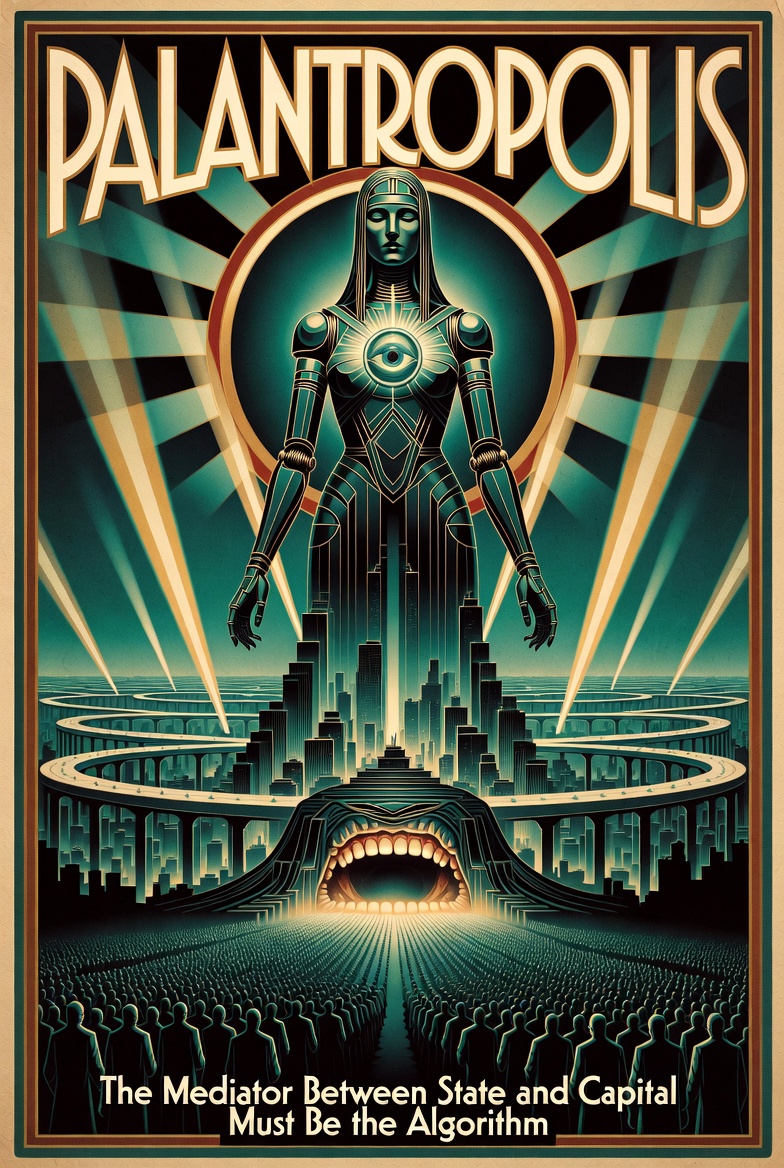
The question is not whether AI weapons will be built. It is who builds them and for what purpose. Adversaries will not pause for theatrical debates about the ethics of military AI. The atomic age is ending. The AI deterrence era is beginning.
The postwar disarmament of Germany was an overcorrection for which Europe is now paying. Japan's pacifism has outlived its purpose. National service should be reinstated. Religion in public life deserves respect rather than elite contempt. Public servants should be paid competitively rather than expected to work as secular priests.
Modern pluralism glosses over the fact that some cultures produce wonders and others are regressive and harmful. The West's obsession with hollow pluralism and inclusivity has prevented it from defining and defending what it actually is.
Hard power, not soaring rhetoric, will determine whether free societies survive the coming era.
These are not the positions of a technology company making a business case. They are the positions of a political actor announcing an ideological platform and daring the audience to object.
Palantir's own SEC filings are unambiguous: the company derives the majority of its revenue from government contracts with defence, intelligence, immigration, and police agencies. These 22 points are not philosophy floating in space. They are the public ideology of a company whose revenue depends on the politics it is advocating.
The manifesto makes sense only against the background of what the company has been building since Peter Thiel and Alex Karp founded it in 2003 with seed funding from the CIA's venture arm In-Q-Tel.
Palantir builds data integration and analysis platforms for governments, intelligence agencies, and militaries. Its two primary products, Gotham for government and defence clients and Foundry for commercial clients, function as operating systems for large-scale data environments, pulling disparate information streams into unified analytical frameworks that allow pattern recognition at scales impossible for human analysts.
In practice this means:
Gotham powers targeting systems for the US military under Project Maven, the AI-assisted targeting programme that Google declined to renew in 2018 after employee protests. Palantir took the contract.
ImmigrationOS, awarded to Palantir in 2025 under a 30 million dollar no-bid contract, is an AI platform that identifies non-citizens, tracks their movements, and coordinates deportation logistics for ICE. The no-bid designation removed the normal competitive procurement process.
The Israeli military relationship, formalised in a strategic partnership announced in January 2024 and expanded considerably after October 7, involves Palantir integrating intercepted communications, satellite imagery, signals intelligence, and other data streams to produce targeting databases for Israeli military operations in Gaza and the West Bank. The industry term for what these databases enable is kill lists. That is not a polemical description. It is the operational function.
Under Karp's leadership Palantir has drawn heavily on former members of Israeli military intelligence Unit 8200, the signals intelligence formation whose alumni populate a significant fraction of Israel's technology sector and whose operational expertise in surveillance, data exploitation, and targeting is directly applicable to Palantir's core products.
Peter Thiel is Palantir's co-founder and chairman. Understanding Palantir without understanding Thiel is like understanding the manifesto without reading who signed it.
Thiel has stated openly that he considers capitalism and traditional liberal democracy incompatible. He has described competitive markets as a failure mode for businesses, arguing that monopoly is the goal of every successful company. He has funded seasteading projects designed to create sovereign territories outside existing state jurisdiction. He has been among the most substantial financial backers of Donald Trump's political career across two election cycles.
His investment in JD Vance's Senate campaign in Ohio, at a moment when Vance had no other serious financial backing and was regarded as an unlikely candidate, was the decisive intervention that made Vance's political career. The relationship predates the politics. Vance worked at Thiel's venture fund. The ideological formation Vance displays, the national conservatism framework, the specific critique of liberal democracy as incompetent rather than wrong, the alignment with Silicon Valley sovereign technocracy rather than traditional conservative politics, maps onto the Palantir manifesto with a precision that reflects shared intellectual core not coincidental convergence.
Karp attended the World Economic Forum annual meeting in Davos in January 2026, photographed there in the same month the manifesto positioning Palantir as the defender of Western civilisation against hollow globalist pluralism was being finalised for publication. The conjunction is not irony. It is the two-flavour technocracy model operating without embarrassment. Sovereign nationalist branding for the public manifesto. Davos network for the operational relationships. Both doors lead to the same room.
The manifesto's political positioning connects directly to the infrastructure thread mapped in the AI infrastructure notes.
The US Army's March 2026 announcement of commercial hyperscale data center operations on active military installations, Carlyle Group at Fort Bliss Texas and CyrusOne at Dugway Proving Ground Utah, represents the physical merger of corporate AI infrastructure and military jurisdiction that the manifesto's ideology provides the political rationale for.
When commercial data centers are built on military land, the regulatory friction that communities use to resist the power and water demands of hyperscale facilities disappears. Environmental impact assessments are compressed or bypassed. Local opposition cannot reach inside the wire. The permitting processes that would take years in civilian jurisdictions are governed by military procurement timelines instead.
The legal consequence, established by the March 2026 Iranian strikes on AWS facilities in the UAE and Bahrain, is that commercial infrastructure hosting military workloads becomes a legitimate military target under international humanitarian law. The threshold is functional not volumetric. A single significant military function on shared physical infrastructure renders the entire facility targetable regardless of what else it contains.
Palantir's manifesto provides the ideological framework within which this merger of commercial and military infrastructure is not merely acceptable but morally obligatory. Silicon Valley has a moral debt. The engineering elite has an affirmative obligation to participate in national defence. The data center on the military base is not a regulatory arbitrage. It is a patriotic duty.
The circularity is complete. The ideology justifies the infrastructure. The infrastructure generates the revenue. The revenue funds the ideology.
The AI infrastructure buildout has a physical constraint that the ideological framework cannot resolve through manifesto.
Data centers require water for cooling at scales that the geography of their preferred locations cannot sustain. The western US, which hosts the largest concentration of planned hyperscale facilities, is operating under sustained aquifer depletion, with Lake Mead and Lake Powell at one third of normal capacity and water rationing already operational across multiple states.
The 2027-28 window is when the Fort Bliss facility reaches Initial Operating Capability, when the Stargate campus in Abilene reaches full build-out, and when the next approved wave of hyperscale facilities begins drawing water from systems already in deficit. The curves cross in that window in ways that no amount of hard power rhetoric resolves.
The financial architecture of the water problem follows the same pattern as the power demand. The profit from the operation is private. The infrastructure cost is socialised through utility bill increases to residential customers. The water depletion is permanent and non-renewable on any human timescale.
Texas is the test case for whether a deregulated energy market combined with military land access and a sympathetic state government can absorb AI infrastructure demand without the democratic accountability mechanisms that would slow it in other jurisdictions. Governor Abbott's World Economic Forum membership is the data point that connects the sovereign technocracy franchise and the globalist technocratic network into the same operational picture. The tension between Texas energy independence rhetoric and WEF participation is not a contradiction. It is the delivery model working as designed.
The question the manifesto raises is not whether its positions are defensible. It is why now.
Palantir has been building kill lists for twenty years. It has been running surveillance infrastructure for ICE since 2011. It has been the defence contractor that took the contracts other companies refused after employee protests. None of this required a public manifesto. The business model functioned without the ideological declaration.
The decision to publish, to accumulate 32 million views, to provoke the technofascism headlines and the Al Jazeera coverage and the congressional scrutiny, is a choice made at a specific moment for specific reasons.
One reading: the Trump alignment makes the ideological declaration commercially advantageous. The administration rewards ideological loyalty. The manifesto is a business development document dressed as a political statement.
A second reading: the moment of unmasking has arrived because the infrastructure is sufficiently built that the ideological declaration no longer carries the risks it would have carried earlier. You announce the republic when the republic is already constructed. The manifesto is not a plan. It is a progress report.
The Sorelian analysis applies directly. The social myth is no longer the general strike or the national revolution. It is the Technological Republic. The vanguard is no longer the party cadre. It is the engineering elite with a moral debt and a defence contract. The manufactured enemy is no longer the bourgeoisie or the foreign conspiracy. It is hollow pluralism, regressive cultures, and the psychologisation of politics.
The template is identical across two centuries of application. The branding is updated for the current delivery environment. What is different this time is the scale of the infrastructure the vanguard controls and the degree to which that infrastructure has been merged, legally and physically, with the state apparatus it nominally serves. Palantir does not seek to capture the state from outside. It builds the operating system the state runs on and then publishes a manifesto explaining why this arrangement is morally necessary.
That is not fascism in the twentieth century sense. It is something more contemporary and in some ways more difficult to name precisely, which is possibly why the naming matters and why the manifesto was published.
They are telling you what they are building.
The question is whether enough people are still paying attention.
Quantum Wildchild · quantumwildchild.com
M. A. Rozas Pashley · May 2026