
History
The Architecture of Planetary Control
Part One: How the 21st Century Was Engineered
“That is no vision of a distant millennium. It is a definite basis for a kind of world attainable in our own time and generation. That kind of world is the very antithesis of the so-called ‘new order’ of the dictators, a moral order... To that ‘new order’ we oppose the greater conception, the Moral Order...”
President Franklin D. Roosevelt, message to the 77th Congress on the State of the Union, the Four Freedoms speech, 6 January 1941
From the Gomberg Map to the Boreal Alliance Thesis
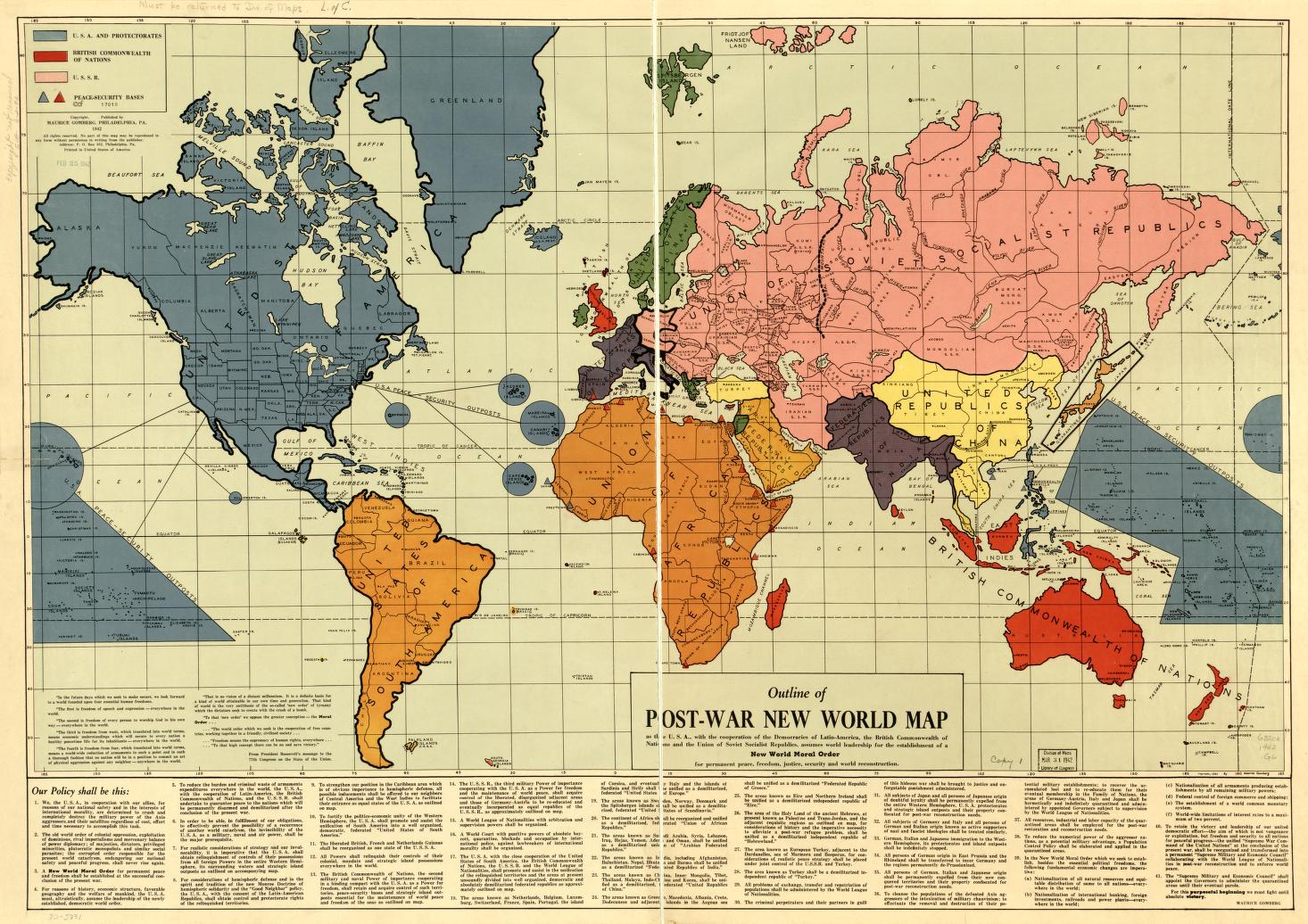
In February 1942, a map appeared in Philadelphia that should have changed our understanding of the twentieth century. It did not. The document, deposited at the Library of Congress Geography and Map Division was titled “Outline of Post-War New World Map,” and in many aspects, it depicted a world that would not exist for yet another decade: a tripartite division of the planet between the United States and its “protectorates,” the British Commonwealth, and the Union of Soviet Socialist Republics. Which reminds us of and predates Orwell’s “1984” vision.
The map showed an expanded United States territory absorbing Canada, Mexico, most of Central America, Greenland, Iceland, and strategic insular outposts spread across the Atlantic and Pacific Oceans. It also depicted a “United States of Europe” under undefined governance. Most remarkably, it also showed a territory called “Hebrewland” encompassing Palestine, Transjordan, and adjacent territories, six years before the State of Israel declared its existence.
The map was copyrighted by Maurice Gomberg, a Polish-Jewish immigrant who arrived to the US in 1913 via Liverpool. Gomberg was a watchmaker by trade. He read the Yiddish communist daily Morgen Freiheit, a publication aligned with Soviet interests and a staunch defender of Stalin’s purges. The FBI took interest in him. He never produced any other cartographic work, before or after this single, extraordinarily detailed projection of post-war global architecture. The map included a forty-one point manifesto describing a “New World Moral Order” to be enforced through collective security arrangements that would not be publicly discussed for another three years.
The question that should trouble any inquisitive student of history is not whether Gomberg possessed any geoprophetic abilities. The question is who created this document, and why a watchmaker from Philadelphia was chosen to put his name on it.
Douglas Reed, former chief correspondent for the London Times who covered Europe through the 1930s, identified Gomberg as heading a so called “Group for a New World Order.” This was not a one-man operation. The map’s technical sophistication, its alignment with planning documents that back then were being drafted in classified settings, and its accurate prediction of territorial arrangements that would require ending a world war and years of diplomacy to achieve, points to some deeper institutional connection.
Gomberg seems what the intelligence community would describe as a “cut-out”, a person who provides their name, willingly or unwillingly, to conceal the real source of something.
The timing may provide us a clue. The Gomberg map appeared in February 1942, the exact month that the Council on Foreign Relations formally integrated its research operations with the US Department of State. This may not be just a coincidence.
The CFR’s War
The Council on Foreign Relations had been preparing for this moment since September 1939, when it launched a classified planning operation to provide a blueprint for a post-war American hegemony. The operation was called the War and Peace Studies, and it was funded with three hundred and fifty thousand dollars from the Rockefeller Foundation, about seven million dollars today.
During the next five years, over one hundred participants assembled into specialized study groups produced six hundred and eighty-two memoranda for the US State Department. All classified. All designed to shape the post-war world. The participants included the most influential figures in US foreign policy: Allen Dulles, who ran the armaments study group and later became Director of the Central Intelligence Agency; Isaiah Bowman, the geographer who advised US President Woodrow Wilson at Versailles and now briefed Franklin D. Roosevelt on territorial matters; Hamilton Fish Armstrong, editor of the CFR’s journal Foreign Affairs; and Norman Davis, who chaired the Council itself.
The CFR integration with the State Department was handled with extreme discretion. Beginning in March 1942, research secretaries were assigned to split their weeks between the Council’s offices in New York and government bureaus in Washington DC. Bowman explained the need for secrecy in terms that reveal everything about how power actually operates in the United States. “The matter is strictly confidential,” he wrote, “because the whole plan would be ditched if it became generally known that the State Department is working in collaboration with any outside group.”
Let us consider the implications of that statement. The State Department, the official instrument of US foreign policy, was conducting its planning in secret partnership with a private entity funded by tax-exempt foundations, and the partnership had to be hidden from the US public because exposure would have destroyed it. Difficult to label it a conspiracy theory as this portrays the working method of the US foreign policy establishment, documented in their own papers.
The Council’s influence was not merely advisory. On March 17, 1940, the CFR Territorial Group produced a memorandum on Greenland that went directly to President Roosevelt. When Nazi Germany occupied Denmark the following month, cutting off the Danish colony in Greenland from its European metropolis, Roosevelt’s policy response followed the Council’s recommendations precisely. The private organization was not merely studying US foreign policy. It was making it.
The Foundations of Power
To understand how the Council on Foreign Relations achieved this position, we must understand the architecture of tax-exempt foundations that created it. The CFR was established in 1921 as a merger between a group of US diplomats who had advised Wilson at Paris and a network of New York financiers organized around the banking houses of Morgan and Rockefeller. From its inception, it was funded by the great philanthropic foundations, and those foundations had been designed from the beginning as instruments of social engineering.
The evidence for this comes from an unlikely source: a congressional investigation almost entirely erased from US history. In 1953, the House of Representatives established a Special Committee to Investigate Tax-Exempt Foundations, chaired by Representative Carroll Reece of Tennessee. The committee hired Norman Dodd, a former banker, as research director. What Dodd found in the archives of the big foundations would have scandalized the nation if it had ever been made public.
Dodd was allowed to examine the minute books of the Carnegie Endowment for International Peace, going back to its founding in 1908. What he found in those minutes described a deliberate, methodical plan to use war as an instrument of social transformation. The trustees had asked themselves a question: “Is there any means known more effective than war, assuming you wish to alter the life of an entire people?” They concluded that there was not. The next question followed logically: “How do we involve the United States in a war?”
The minutes showed that the trustees determined they must control the US State Department and its diplomatic machinery. When the First World War broke out, the Carnegie Endowment dispatched a telegram to President Wilson urging the war must not end too quickly. After the armistice, the 1919 minutes recorded the trustees’ concern that American life might return to its pre-war patterns. They resolved to prevent this by controlling the teaching of American history.
The foundations divided the task. The Rockefeller Foundation would control domestic education. The Carnegie Endowment would control international education and, crucially, writing history itself. They approached four of the most prominent historians in the US with an offer to fund revisionist histories of the war. All four refused. The foundations responded by building what Dodd described as a “stable of historians”, academics who understood what conclusions their funders expected. This network eventually became the nucleus of the American Historical Association, whose members would train the next generation of history teachers. Their conclusion, documented in foundation records, was that “the future of this country belongs to collectivism, administered with characteristic American efficiency.”
When Dodd presented these findings to the Reece Committee, he also reported a conversation with Rowan Gaither, who was then president of the Ford Foundation. Gaither had served with the Office of Strategic Services during the war, the predecessor to the CIA, and he was surprisingly candid about the Ford Foundation’s actual purpose. “We operate in response to directives, the substance of which is that we shall use our grant-making power to alter life in the United States so that it can be comfortably merged with the Soviet Union.”
Dodd was stunned. He asked whether Gaither would be willing to repeat that statement publicly. Gaither declined. The Ford Foundation’s public communications would continue to emphasize democracy, freedom, and the American way of life.
The Dulles Nexus
The man who connected Wall Street to the intelligence community, the foundations to the State Department, and American capital to Nazi Germany was John Foster Dulles, senior partner at the law firm Sullivan and Cromwell. His younger brother Allen would run the armaments study group for the Council on Foreign Relations before becoming the most consequential Director of Central Intelligence in US history. Together, the Dulles brothers represent the perfect case study in how a small network of individuals, operating through interlocking institutional positions, can shape the destiny of a nation.
Sullivan and Cromwell was not merely a law firm. It was the choice legal counsel for the largest US corporations and, crucially, for their German counterparts and subsidiaries. John Foster Dulles personally managed the firm’s relationships with I.G. Farben, the German chemical cartel that produced wartime synthetic rubber and gasoline, with a 1931 oil cartel patent which included the US Standard Oil of New Jersey, massive amounts of ordnance and armaments, Opel Blitz Wehrmacht vehicles, one hundred per cent owned by General Motors, and the infamous Zyklon B gas pellets. He represented Krupp, the armaments manufacturer, floating their first US bond offerings. He brought German industrial interests into international cartels that gave the Nazi regime access to strategic resources, most notably the arrangement with International Nickel Company that ensured German access to nickel essential for weapons production, until summer 1939, when Canada and the UK ceased their supplies.
Foster Dulles was not naive about his clients. He met Adolf Hitler in April 1933, travelling to Berlin with Anglo-Polish historian Norman Davis on official State Department business. He maintained Sullivan and Cromwell’s Berlin office until 1935, a full two years after Hitler’s seizure of power, and only closed it when the Nazi requirement that all correspondence end with “Heil Hitler” became too embarrassing to sustain. The columnist Drew Pearson, one of the few journalists willing to document these connections, called Foster Dulles “the chief agent for banking circles that rescued Adolf Hitler from financial depths.”
Allen Dulles followed a parallel track. He joined the Council on Foreign Relations as a director in 1927, becoming only the second new director added since the Council’s founding in 1921. He served as the Council’s secretary from 1933 to 1944, overlapping entirely with Hitler’s rise and the Second World War. During the war, he ran the Office of Strategic Services station in Bern, Switzerland, where he cultivated relationships with German officials that would prove remarkably durable.
The brothers supported the America First movement, which opposed US entry into the war against Hitler. Foster Dulles wrote sympathetically of Germany, Italy, and Japan in major publications. Their circle included Prescott Bush, a partner at Brown Brothers Harriman, whose involvement with Nazi finance through the Union Banking Corporation would result in the seizure of his assets under the Trading with the Enemy Act in October 1942.
The Bush-Harriman-Nazi Pipeline
The Union Banking Corporation was established in 1924 as the American correspondent bank for Bank voor Handel en Scheepvaart, a Dutch bank owned by the German industrialist Fritz Thyssen. Thyssen later wrote a book titled “I Paid Hitler,” and his claim was accurate. He was one of the earliest and most important financiers of the Nazi movement, channelling funds to Hitler from the early 1920s through a network of shell companies and correspondent banks designed to obscure the money trail.
The American side of this network was managed by W. Averell Harriman and Prescott Bush, through Brown Brothers Harriman and its subsidiary, the Union Banking Corporation. E. Roland Harriman and George Herbert Walker, Bush’s father-in-law, were also involved. The arrangement was straightforward: US capital flowed to Germany, German assets found safe harbour in the US, and the Bush-Harriman network took its percentage of both flows.
The Union Banking Corporation transferred funds, bonds, gold, and strategic materials between the United States and Germany throughout the 1930s. The Hamburg-Amerika shipping line, which Bush and Walker controlled, transported Nazi agents into and out of North America. The Consolidated Silesian Steel Corporation, another Bush-Walker enterprise, used slave labour from concentration camps in its Polish mining operations.
On October 20, 1942, the United States government seized the Union Banking Corporation under the Trading with the Enemy Act. A month later, on November 17, the government seized the Silesian American Corporation and charged Prescott Bush with trading with the enemy. He was not prosecuted. His assets were frozen, then released after the war when his principal partner, Fritz Thyssen, conveniently died on February 8, 1951. Bush would go on to become a United States Senator from Connecticut and father a political dynasty that would place two of his descendants in the White House.
The decision not to prosecute Bush, or the Harrimans, or any of the major US financiers who had funded Hitler’s rise, was not an oversight. It was policy. The same networks that had built Nazi Germany would be needed to rebuild it as a bulwark against the Soviet Union. The men who had moved money to Hitler would move money to Adenauer. The intelligence officers who had served the Third Reich would serve the new West German state. And the US official who would manage this transition was Allen Dulles.
Operation Sunrise and the Preservation of Fascism
In March 1945, with the war in Europe entering its final months, Allen Dulles began secret negotiations in Switzerland with senior SS officers. The ostensible purpose was to arrange the surrender of German forces in northern Italy. The actual purpose was to establish relationships that would survive the Nazi defeat.
Dulles met with SS General Karl Wolff, who had served as Heinrich Himmler’s chief of staff and who had personally organized the transportation of three hundred thousand Jews to the Treblinka extermination camp. Wolff wrote triumphantly in official communications about sending “five thousand of the Chosen People to Treblinka every day.” Also present were Eugen Dollmann, Himmler’s representative in Italy, and Guido Zimmer, another SS officer. The negotiations, codenamed Operation Sunrise, resulted in the German surrender in Italy on May 2, 1945.
The surrender was presented to the public as a military achievement. What was not disclosed was the quid pro quo. Wolff escaped prosecution at Nuremberg entirely. Zimmer was hired by the OSS and later by the CIA. Dollmann received protection and comfortable treatment. National Archives documents declassified decades later revealed that “Operation Sunrise was at least as much Operation Wool, a German initiative” designed to secure favourable terms for Nazi officials who had something to offer American intelligence.
What they had to offer was intelligence on the Soviet Union. Colonel Reinhard Gehlen, who had run Hitler’s military intelligence operations on the Eastern Front, understood this perfectly. Before the German surrender, Gehlen ordered his files on the USSR to be microfilmed and buried in waterproof containers in the Austrian Alps. Then he surrendered himself to American forces, offering his intelligence archive and his network of agents in exchange for employment.
Allen Dulles accepted the offer. The Gehlen Organization was established in West Germany with CIA funding and direction, eventually becoming the nucleus of the Bundesnachrichtendienst, the West German federal intelligence service. Gehlen had promised not to hire former SS, SD, or Gestapo personnel. He broke that promise immediately and the CIA did not object. The Gehlen Organization set up the “ratlines” that helped at least five thousand Nazi war criminals escape Europe to South America, including Klaus Barbie, the “Butcher of Lyon,” and Josef Mengele, the Auschwitz physician who conducted experiments on concentration camp prisoners.
Operation Paperclip ran parallel to the Gehlen operation, importing more than fifteen hundred German scientists, engineers, and technicians to the United States. Many were committed Nazis. Some were war criminals. Military intelligence officers systematically cleansed their files of references to Nazi Party membership or wartime atrocities. Presidents Truman and Eisenhower issued directives excluding ardent Nazis from the programme. Those directives were ignored. The programme officially ended in September 1947 but actually continued into the mid-1950s.
FBI Director J. Edgar Hoover attempted to stop some of these operations. He pressured President Truman to prevent Allen Dulles from moving Nazi funds out of Germany in the final months of the war. Dulles proceeded anyway, working with his long time business associate Kurt Baron von Schröder, the Cologne banker who had helped finance Hitler’s 1933 seizure of power. The funds were moved. The Nazis who owned them were protected. And when the time came to rebuild Germany as a staunch anti-communist ally, the infrastructure was already in place.
The Hiss Connection
If the Dulles brothers represented the Wall Street and intelligence nexus, Alger Hiss represented something even more troubling: the penetration of the US government at its highest levels by agents serving a foreign power. Hiss was a State Department official from 1936 to 1946. He advised President Roosevelt at the Yalta Conference in 1945, where the post-war division of Europe was negotiated. He served as Secretary-General of the United Nations founding conference in San Francisco. And from 1946 to 1949, he was president of the Carnegie Endowment for International Peace, the same organization whose minute books had revealed the plan to use war as an instrument of social transformation.
Hiss’s appointment to the Carnegie Endowment was arranged by Dean Acheson, who would become Secretary of State under Truman. When Whittaker Chambers, a former Soviet agent turned anti-communist, accused Hiss of espionage before the House Un-American Activities Committee in 1948, Acheson stood by his protégé. “I do not intend to turn my back on Alger Hiss,” he declared publicly, even after Hiss’s conviction for perjury.
Hiss served three years and eight months in Lewisburg Federal Prison. He maintained his innocence until his death in 1996. That same year, the Venona decrypts were released, translations of Soviet intelligence communications that American and British codebreakers had intercepted during the war. The decrypts provided strong evidence of Hiss’s guilt, identifying him by codename in communications about Soviet intelligence operations in Washington.
The Hiss case matters not because one man spied for the Soviets, but because of what his career trajectory reveals about institutional capture. Here was an agent of Soviet intelligence who rose to advise the President on the post-war settlement, who helped establish the United Nations, and who then moved seamlessly into the leadership of a major foundation. His path through US institutions was smoothed at every step by the establishment figures who vouched for him, promoted him, and protected him even after his exposure.
The Carnegie Endowment that Hiss led was the same institution that had decided, in 1908, that war was the most effective means of altering the life of an entire people. The State Department where Hiss served was the same department that was secretly collaborating with the Council on Foreign Relations. The United Nations that Hiss helped found was the institutional expression of the “collective security” arrangements depicted on the Gomberg map. Whether Hiss was serving Soviet interests, foundation interests, or some convergence of both, his career demonstrated that the boundaries between these networks were remarkably permeable.
The Recognition of Israel
On May 14, 1948, David Ben-Gurion declared the independence of the State of Israel. Eleven minutes later, President Harry Truman extended de facto US recognition. The speed of this recognition has been treated by historians as evidence of Truman’s personal sympathy for Zionism or his political calculation regarding the Jewish vote. The documentary record suggests a more transactional explanation.
Truman was facing the 1948 election as an underdog. His own party had fractured, with Strom Thurmond running as a Dixiecrat and Henry Wallace running as a Progressive. Thomas Dewey, the Republican nominee, was heavily favoured. Truman lacked the money to mount an effective campaign.
Abraham Feinberg, a New York hosiery manufacturer and committed Zionist, organized a solution. Working with Edmund Kaufmann and other wealthy Jewish donors, Feinberg arranged the whistle-stop campaign funding that would allow Truman to take his message directly to the US public. The campaign needed one hundred thousand dollars immediately, a sum equivalent to well over a million dollars today. Feinberg delivered it.
The connection between this funding and the recognition of Israel was not hidden. Feinberg acknowledged it in an oral history recorded for the Truman Library in 1973. “Without Truman,” he said, “Israel would have had very difficult days and times trying to even come into existence.”
Secretary of State George Marshall opposed recognition. He warned Truman that it would lead to “perpetual war in the region.” Marshall’s opposition was so strong that he reportedly told Truman he would vote against him in the election if recognition went forward. Clark Clifford, Truman’s political advisor, argued the other side. Recognition proceeded.
The Gomberg map of 1942 had depicted “Hebrewland” six years before this moment. The Council on Foreign Relations’ War and Peace Studies had addressed the Palestine question in classified memoranda. The Zionist lobby that financed Truman’s campaign was not operating in isolation from the broader networks we have been examining. The Rockefeller interests had their own investments in the Middle East, primarily through oil. The intelligence community saw Israel as a potential asset in the emerging Cold War. The recognition was not Truman’s personal decision. It was the culmination of planning that had been underway for years, implemented through the kind of financial pressure that the US political system is designed to accommodate.
The Architecture Revealed
We can now see the outlines of a system that was not supposed to be visible. Tax-exempt foundations, funded by the great industrial and banking fortunes of the early twentieth century, had established control over US education and the writing of US history. They had created and funded the Council on Foreign Relations, which in turn conducted the actual planning of US foreign policy in secret collaboration with the State Department. The same law firms that represented these foundations and the corporations that funded them also represented Nazi German industry, facilitating the flow of capital and technology that built Hitler’s war machine. When that machine was defeated, the intelligence networks it had created were absorbed into US service rather than destroyed. And throughout this process, the personnel moved seamlessly between Wall Street, Washington, and the emerging national security state.
The Gomberg map was not prophecy. It was a planning document, released through a cut-out to establish a public marker for arrangements that were being developed in private. The watchmaker from Philadelphia did not imagine a world divided into three spheres of influence, with an expanded US territory and a Jewish state in Palestine. He was given that vision by people who intended to make it real.
This is not conspiracy theory. Conspiracy theory, as the term is now used, was itself created as a weapon of institutional defence. In 1967, the CIA dispatched a cable to its overseas stations with instructions for countering criticism of the Warren Commission’s investigation of President Kennedy’s assassination. The cable, which was declassified in 1976, recommended that critics be labelled “conspiracy theorists” and accused of being motivated by financial gain, political interest, or psychological instability. The term entered common usage as a pejorative precisely because it was designed to serve that function.
What I describe is not theory but method. Powerful interests coordinate their actions to achieve outcomes that benefit them. They do so through institutions designed to obscure accountability. They fund scholars and journalists who construct narratives that legitimize their power. They marginalize or destroy those who expose their operations. This is not speculation about hidden forces. This is how power works, documented in the foundations’ own archives, the Council’s own papers, and the government’s own declassified records.
The architecture of control that was assembled in the first half of the twentieth century did not disappear when the Second World War ended. It adapted. The same networks that had financed both sides of that war would finance the Cold War that followed. The same techniques of institutional capture and narrative control would be refined and expanded. And the map that Maurice Gomberg copyrighted in 1942 would continue to serve as a template for territorial arrangements that are still being implemented today.
In Part Two, we will examine how this architecture operates in the present moment, how the apparent conflict between East and West conceals a convergence toward identical systems of technocratic control, and why the choice between “nationalism” and “globalism” may be the most consequential false binary of our time.
This essay is Part One of a four-part analysis. Part One examines the historical architecture of geopolitical control and the historical foundations from the Gomberg Map to the current multipolar rush to secure spheres of influence. Part Two examines the contemporary convergence toward technocratic and digital control systems. Part Three projects the Boreal Alliance thesis I propose of US and Russia rapprochement and where these forces lead us to. Part Four considers the Chinese variable that makes all projections uncertain.
M. A. Rozas Pashley is a Madrid-based journalist, conflict and security analyst. He co-edited the book 'Dia de la Infamia' (2002, Esfera de los Libros, Madrid), presented at the IEEE (Instituto Espanol de Estrategicos, Ministerio de Defensa), and is the author of 'On the Road to Transhumanism: Staring Into the Dark Side of Scientific Progress' (July 2026, Amazon Kindle ebook under the Quantum Wildchild imprint).
MARP 2026